Jason Miller
The name Juja comes with its own collection of stories, folklore, and superstition. Like so many places in Africa, the history of the land is about more than what you see on a map. Sometimes the story behind a name is every bit as interesting as the place itself, especially when you consider how quickly the landscape has changed over the years.
Long before the highways, factories, and expanding towns, this area was known as Weru Wa Ndarugu, which translates roughly from Kiswahili as the Ndarugu plains. It was an open landscape of grassland and bush, where wildlife moved freely and life followed the seasons rather than the traffic lights and construction schedules that would eventually arrive.
It is difficult to imagine that landscape today. The plains have gradually disappeared beneath settlement, roads, and industry, and the boundaries of the region have changed along with the people who live there. Yet the old name remains in local memory, a reminder that the busy, developing area we see today was once a very different place.
But the story of Juja is not simply one of a changing landscape. It involves a wealthy American adventurer, two small carved figures, and a little superstition that would eventually become part of the area’s identity.
Introducing William Northup McMillan
William Northup McMillan was born in St. Louis, Missouri, in 1872. He came from a wealthy family, and apparently money provided him with something that many people can only dream about: the opportunity to spend his life going places and doing things most of us would never get around to attempting.
McMillan was an adventurer in an era when much of the world was still being explored, at least from the perspective of Western travelers. He was restless, curious, and willing to follow an opportunity wherever it might lead.
One of his early African adventures took him to Ethiopia as part of an expedition to explore the Blue Nile and investigate whether the river could be navigated toward its source. It was the sort of undertaking that combined exploration, scientific curiosity, and the imperial-era fascination with Africa’s great rivers. His contribution to the expedition reportedly earned him two medals from Emperor Menelik II.
Africa, however, was only one part of McMillan’s rather unusual life.
In the United States, he worked as a cattle rancher in New Mexico and Texas, experiencing the American West at a time when ranching still involved plenty of hard work and considerable uncertainty. He later became involved in Romania’s oil industry and invested in rubber plantations in Malaysia.
Not content with ranching, oil, and rubber, McMillan also traveled along the coasts and waterways of West Africa, visiting remote communities and taking an interest in the people and cultures he encountered.
Like many travelers of his era, he was particularly fascinated by local spiritual beliefs, including witchcraft, traditional healing, and the role of objects believed to possess supernatural powers.
During one of his journeys, he met a village chief who presented him with two small carved figures. According to the story, the figures were intended to bring him good luck and protect him during his voyages across the sea. There was, however, a condition attached to this generous gift. He was warned that if he failed to protect and cherish the figures, he would perish at sea.
I’m not sure how seriously McMillan took the warning, but it was certainly the sort of thing a traveler might remember, even if only as an amusing story to tell over dinner.
The chief gave the figures names: one was called Ju and the other Ja.
McMillan packed them away with the other curiosities and souvenirs he had collected during his travels. They would accompany him across continents, eventually making their way to a place in East Africa that would become permanently associated with their names.
A Little Something Called Juju
Most of us have heard the word juju, generally used to describe witchcraft, spiritual power, or objects believed to possess some sort of supernatural influence.
The word and the beliefs associated with it have a long history in parts of West Africa, including present-day Benin, Togo, Ghana, and Nigeria. Depending on the community and context, such objects and practices can be associated with protection, healing, good fortune, or harm.
The origin of the word itself is debated. One explanation suggests it may have come from the French word joujou, meaning a toy or plaything, possibly used by Europeans who encountered ritual objects they didn’t understand. Another theory connects the word to Hausa usage and the terminology surrounding spiritually significant objects.
As with many words that cross cultural boundaries, the history is not entirely clear. Language, colonial encounters, and local traditions have a way of becoming mixed together over time, until separating fact from interpretation becomes a challenge.
Whatever the precise origin of the word, the belief in objects possessing spiritual significance is not something that can simply be dismissed as a curiosity. Such beliefs have real meaning within the communities where they exist, whether or not an outsider shares them.
And that brings us back to McMillan’s two little figures.
From the Blue Nile to British East Africa
Like many people who visited Africa during that period, McMillan eventually fell in love with the continent and decided to make it his home.
On September 14, 1904, he arrived in British East Africa with his wife, Lucie. The territory would later become the Kenya Colony, and eventually the independent nation of Kenya we know today.
They landed at Mombasa and boarded the Uganda Railway, the remarkable railway that was pushing inland toward the highlands and the emerging settlement of Nairobi.
Nairobi was still a young town, but it was growing rapidly. Dusty roads, new buildings, railway facilities, and the beginnings of colonial administration were transforming what had recently been a much smaller settlement. For an adventurous and wealthy man like McMillan, the possibilities must have seemed considerable.
North of Nairobi, however, lay a very different world.
The land stretched across open grassland and bush, with wildlife roaming through a landscape that had not yet been transformed by the development we see today. It was a frontier in the eyes of the incoming settlers, although, of course, it was not an empty landscape. People had lived in and moved through the region long before the arrival of the railway or the colonial administration.
It was here that McMillan and Lucie acquired a remarkable stretch of land along what is now Thika Road.
The estate reportedly covered approximately 19,000 acres, or about 7,700 hectares. That was an enormous holding, particularly when compared with the roughly 5,000-acre limit often associated with settler land allocations under the regulations of the period.
Such an acquisition tells us something about the world McMillan had entered. Wealth, connections, and colonial land policies created opportunities for some that were simply unavailable to others. The landscape was changing, and land was becoming an increasingly valuable and contested resource.
McMillan had found his place in Africa, and he was about to give it a name.
The Lucky Figures
One evening, while sorting through crates of personal belongings, McMillan came across something he had not thought about for years.
There, wrapped in straw inside a wooden crate, were the two little figures he had received from the village chief in West Africa.
Ju and Ja had traveled with him across oceans and continents, only to spend much of that time forgotten among his possessions. Now, in his new home, they had turned up again.
According to the story, McMillan placed the figures on the mantelpiece and returned to the business of establishing his estate.
He had applied for the substantial landholding along what is now Thika Road, and the application was approved.
Whether it was good timing, the influence of wealth and connections, or simply the normal workings of the colonial administration, McMillan got the land he wanted. But perhaps remembering the warning he had received years earlier, he decided to credit his good fortune to the two little figures.
The story goes that he combined their names, Ju and Ja, and called his estate Juja.
I suspect McMillan may have regarded the whole thing as a private joke. He had traveled the world, met people with all sorts of beliefs, and collected enough unusual experiences to keep a storyteller busy for years. Naming his estate after two lucky charms would have been entirely in keeping with the sort of man he appears to have been.
But a story can take on a life of its own, particularly when it involves something that people already have reason to find mysterious.
When a Joke Becomes a Legend
McMillan might have considered Ju and Ja harmless curiosities, but the story takes a different turn when we consider how others may have viewed them.
In communities where spiritual beliefs and the power attributed to certain objects were part of everyday life, the presence of two foreign carvings associated with good fortune could easily have been interpreted differently from the way McMillan intended.
The figures became associated in local storytelling with ideas of juju, spiritual influence, and perhaps even danger. As stories circulated, the estate acquired a reputation that went beyond its size or its wealthy owner.
It is difficult, after more than a century, to establish precisely which stories were told at the time and which were added or embellished in later years. Folklore rarely comes with a reliable paper trail. One person tells a story, another adds a detail, and eventually the original event becomes almost impossible to separate from the legend.
Still, the story of Juja is a fascinating example of how two people can look at the same object and see entirely different things.
To McMillan, the figures may have represented luck, adventure, and a humorous reminder of his travels. To others, they may have represented something far more serious.
The estate gradually became associated with misfortune and spiritual unease. Whether that reputation arose from the figures themselves, local interpretations, unexplained events, or a mixture of all three is difficult to say.
There may also have been something rather convenient about the distance such a reputation created. McMillan had acquired a vast estate, and a little local apprehension would hardly have made his private world less comfortable.
Whatever the truth, Juja had acquired a story that would outlive its original owner.
Presidents, Princes, and Other Visitors
For all the local stories surrounding the estate, Juja was hardly an obscure corner of Africa.
On May 28, 1909, former American president Theodore Roosevelt visited the ranch during his African expedition. Accompanied by his son Kermit, Roosevelt was traveling through East Africa on a journey that combined hunting, collecting scientific specimens, and exploring the region’s extraordinary wildlife.
Roosevelt later wrote about his African experiences in African Game Trails, including his encounters with McMillan and the hospitality he received. His accounts also provide a glimpse of a landscape in which wildlife was still extraordinarily abundant.
It is worth remembering that this was a very different Africa from the one we know today. The railway had opened the interior to more travelers, but vast stretches of land remained relatively undeveloped by modern standards, and the wildlife populations were correspondingly different.
Juja was part of that world. It was a wealthy settler’s estate, a hunting destination, and a place where influential visitors could experience the African landscape from the comfort of a private ranch.
Winston Churchill was also among the prominent figures associated with travel through British East Africa during this period.
There is something interesting about the contrast. In one version of the story, Juja was a place surrounded by superstition and unease. In another, it was a prestigious destination for wealthy travelers and important visitors from abroad.
Both stories became part of the estate’s identity, one rooted in local legend and the other in the written record of the colonial era.
The Final Journey of Ju and Ja
William Northup McMillan died in 1925, aged 52. His death marked the end of an adventurous life that had taken him from the American West to Africa, Europe, and Southeast Asia.
But the stories surrounding Juja did not end with him.
According to the local legend, Lucie eventually came across the two small figures that had accompanied her husband on his travels and had become so closely associated with the estate.
By then, the idols were said to have acquired an uncomfortable reputation. Whether Lucie herself believed the stories or simply wanted to put an end to the association, the tale says she decided to remove them from the house.
She reportedly carried Ju and Ja to a remote part of the Ndarugu Valley, near what is now Thika, and buried them deep in the ground.
And that, supposedly, was the end of the two little figures.
Of course, stories like this leave us with more questions than answers. Were the figures actually buried in the valley? If so, where? Did Lucie believe she was putting an end to a curse, or was the burial simply a way of disposing of objects that had become an unwelcome reminder of her husband’s past?
We may never know.
Over the years, the original story became mixed with local folklore, and folklore gradually became legend. The name remained, however, linking the modern town of Juja to a wealthy American, an expansive estate, and two small carvings that had supposedly traveled halfway around the world before finding their final resting place in African soil.
Whether every detail is true is almost beside the point. The story itself has become part of the history of the place.
From Private Ranch to National Park
The landscape around Juja continued to change long after McMillan’s death. What had once been a vast expanse of open country gradually became part of a more developed and populated region.
In 1967, the eastern portion of the former estate was officially acquired and designated as a protected area, later becoming Ol Donyo Sabuk National Park.
The park takes its name from the mountain at its center, which rises to approximately 7,037 feet above sea level. The name Ol Donyo Sabuk is commonly translated from Maasai as “large mountain.”
Standing above the surrounding plains, the mountain provides a dramatic landmark in a landscape that has seen enormous changes over the past century.
Today, the park supports troops of baboons, monkeys, antelope, and a variety of birdlife. Hyenas are also reported in the surrounding area, moving through the lower slopes and foothills as part of the region’s natural ecosystem.
It is a reminder that, despite the growth of towns and industry, parts of the original landscape remain. The modern world has certainly made its mark, but Africa still has a habit of preserving a little wilderness in places where you might least expect it.
There is also a more personal connection between the mountain and the McMillan family.
Both William and Lucie were buried near the summit of Ol Donyo Sabuk, overlooking land that once formed part of their enormous estate. Their graves remain a physical link to the people who played such a significant role in the area’s colonial history.
Naturally, I wanted to find them.
A Search in the Bush
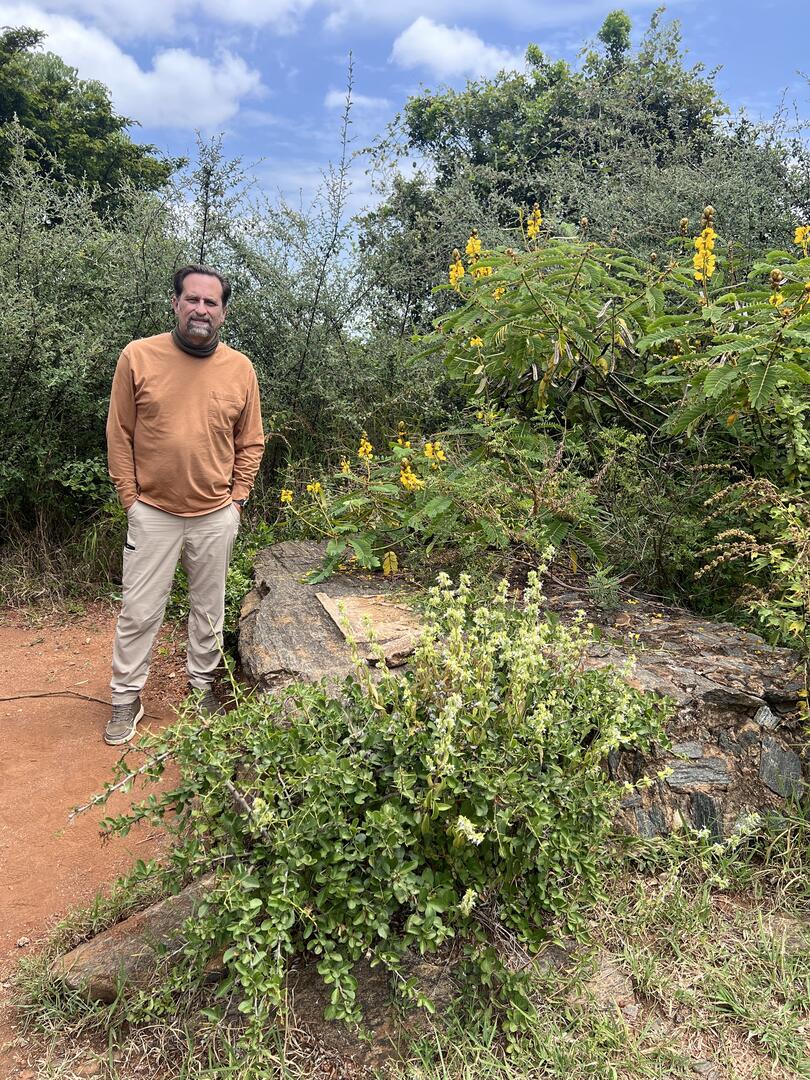
I spent an entire afternoon fighting my way through overgrown bush, trying to locate the McMillans’ final resting place.
It sounded simple enough when I started. Find the graves, have a look around, take a few photographs, and add another little piece to the story. But Africa has a way of reminding you that what sounds simple on paper can become an entirely different proposition once you leave the road.
The bush had other ideas. What began as a search for two graves turned into an afternoon of pushing through vegetation, looking for clues, and wondering whether I was anywhere close to the right place.
There is something about visiting a historical site that you have read about for years. You want to see it for yourself, to stand where the people you have been researching once stood, and to connect the written history with the physical landscape. Sometimes you find exactly what you came looking for. Other times, the place seems determined to keep its secrets.
That afternoon, the bush was winning.
I had spent hours trying to locate the graves of William Northup McMillan and his wife, Lucie, two people whose lives had become entwined with the history of Juja and the mountain that now bears witness to it all. I was searching for a tangible connection to their story, something more than names, dates, and accounts written long after the events themselves.
Whether the two idols were ever buried in the Ndarugu Valley remains a different question entirely. I was looking for the graves of the people behind the legend, not the legendary objects themselves.
By the time the afternoon wore on, I had learned something about historical research in Africa that no amount of reading can quite prepare you for. Sometimes the answer is in a book. Sometimes it is in a conversation with someone who remembers a story passed down through generations. And sometimes it is somewhere out in the bush, hidden beneath vegetation, waiting for someone with more time, better directions, or perhaps a little of McMillan’s famous luck.
I didn’t spend the afternoon standing beside the graves and reflecting on a neatly documented piece of history. I spent it digging through the bush, trying to find them.
And perhaps that is an appropriate ending to the story of Juja. More than a century after two small figures supposedly gave an American adventurer his good fortune, the landscape is still keeping a few secrets of its own.
Juja
Copyright © 2026 by Jason Miller
All rights reserved. No part of this publication may be reproduced, distributed, or transmitted in any form or by any means, including photocopying, recording, or other electronic or mechanical methods, without the prior written permission of the publisher, except in the case of brief quotations embodied in critical reviews and certain other noncommercial uses permitted by copyright law.

