Jason Miller- Mexico City
I love experiencing new cultures from the inside, whether it’s roadside attractions, street food, blending into the crowd, or simply taking in what an evening has to offer.
On a cool September evening, a few friends and I climbed into a taxi and headed into central Mexico City, to an area called Cuauhtémoc, along República de Perú. It was an older warehouse district, with dilapidated buildings dating back to the mid-1800s. The streets were filled with activity, people milling about, taxis sitting in stopped traffic, and food vendors on nearly every corner.
As we stepped out of what felt like the relative safety of the taxi, we were immediately swept into the bustling scene. Our guide simply said, “Follow me,” and we did, carving our way through the throng of people.
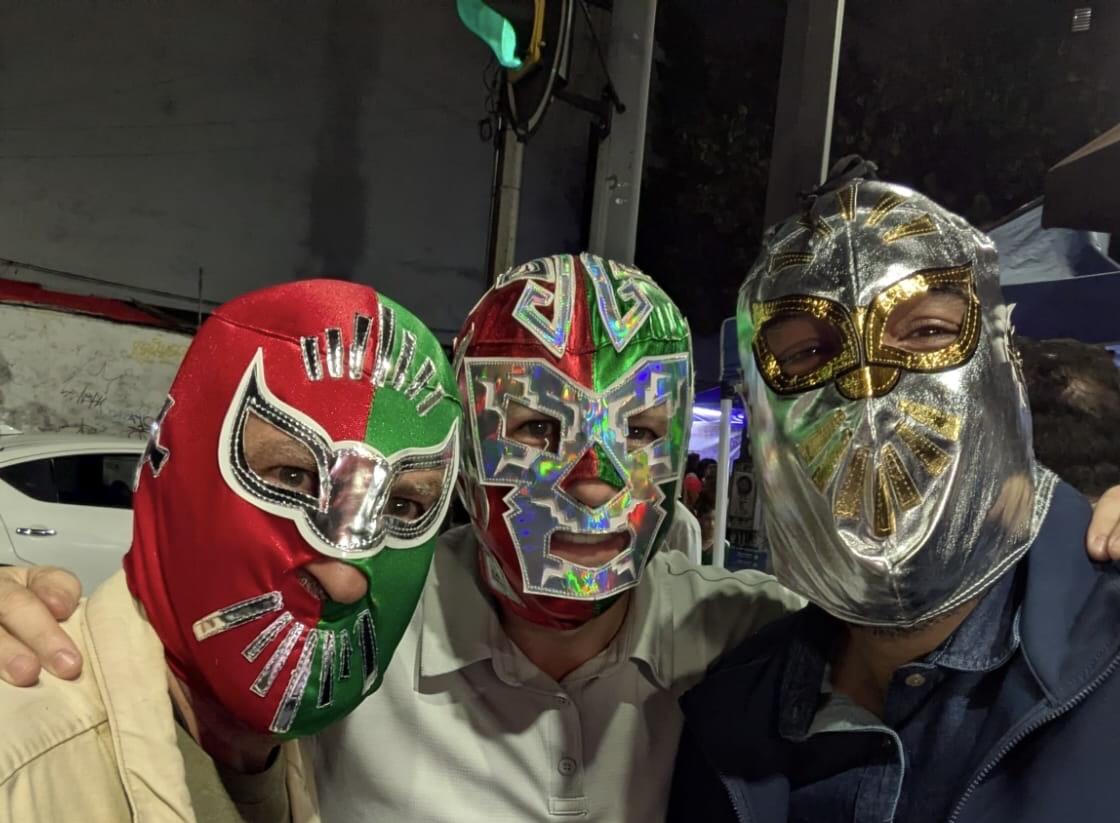
Along the sidewalks, vendors were selling brightly colored masks, and I remember thinking, I have to grab one of these before the night is through, just to remember this evening.
We eventually made our way to Arena Coliseo. Police frisked us, and a woman checked our tickets before we entered a concrete structure straight out of a 1960s movie. Our feet stuck to the multicolored painted floor as we climbed concrete stairs, higher and higher. The noise coming from the arena was deafening, with fans yelling at the top of their lungs.
As we emerged from the stairway onto the middle level, I could look down into the small wrestling ring, and our seats offered a perfect view of the entertainment below. Vendors walked the aisles selling beer, food, and snacks at fairly steep prices, but what the heck! We were here to experience the historic and famed Lucha Libre!
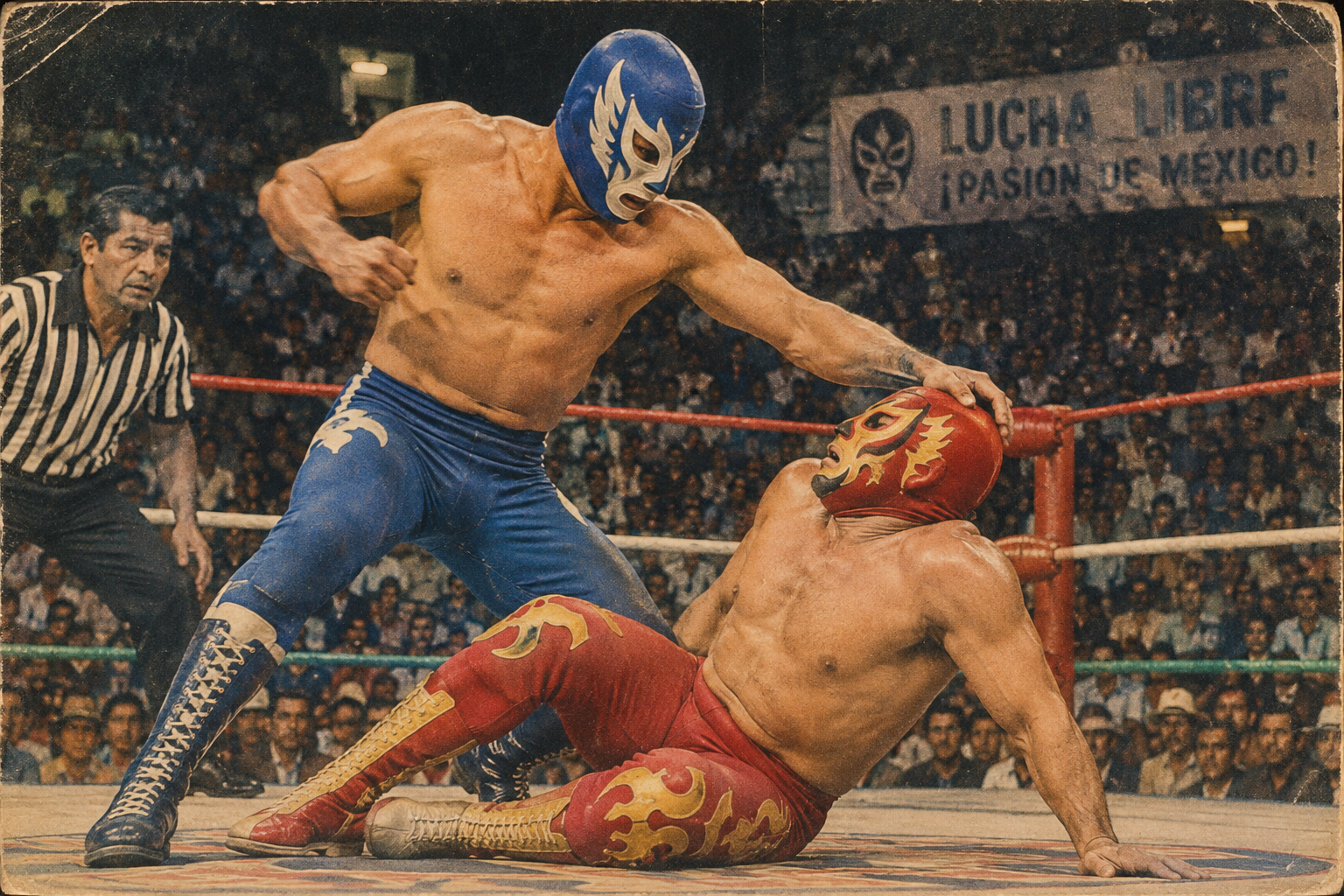
Lucha Libre, Mexico’s version of professional wrestling, dates back to the early 1900s, blending traditional wrestling with a little theater, a lot of athleticism, and more than its share of colorful characters. By the 1930s and 1940s, it had become a national obsession, with masked wrestlers known as luchadores becoming folk heroes. Their identities were hidden behind elaborate masks, some of which became just as famous as the men wearing them.
Perhaps the most famous was El Santo, known as the Silver-Masked Man. He became a national hero in the ring and later starred in dozens of movies. His silver mask was so closely tied to his identity that he rarely appeared in public without it. When he died in 1984, he was buried wearing that famous mask, having revealed his face on Mexican television just a week earlier. His funeral drew thousands of mourners, a remarkable tribute to a man who had become a Mexican legend.
His great rival, Blue Demon, was another wrestling icon whose blue mask became instantly recognizable. Mil Máscaras, meaning “Man of a Thousand Masks,” helped introduce Mexican wrestling to international audiences, while Black Shadow became famous for his fierce rivalries and dramatic matches. Other legends included Gory Guerrero, one of the founding fathers of modern Lucha Libre, and Huracán Ramírez, whose masked identity and acrobatic style made him a fan favorite.
But enough history. We were here to see the real thing!
The fans were worked into a frenzy. Men, women, and children filled the stands, each with a favorite wrestler. Soon, an announcer entered the ring, and the wrestlers began to emerge, wearing masks in every imaginable bright color. It was pretty obvious who represented the “good guys” and who represented the “bad guys.”
Some matches featured four wrestlers, two teamed against two, and there was never a dull moment. They danced around the ring, leaped over ropes, and occasionally took the fight right out into the stands. When that happened, everyone stood up and cheered, with the fans becoming part of the show. The whole place seemed to be caught up in the action.
A few things stood out to me about these staged acts. First, the good guys generally prevailed, which was pretty cool. If a bad wrestler cheated or managed to sneak something past the referee, the audience went crazy. And, of course, there were those moments when things looked hopeless for the good guy. He would be beaten down, seemingly out of the fight, only to miraculously recover and come roaring back to win the match to tremendous fanfare.
My cheeks were hurting from smiling nonstop.
During one match, the referee happened to be a young woman. Dressed in her striped uniform, she ruled with an iron fist, allowing no cheating or unsportsmanlike conduct. The audience loved her.
This particular match featured two good guys against two bad guys, and for a while, the bad guys seemed to have the upper hand. Both good wrestlers were down, trying to regain their composure, when the bad guys decided to take their frustrations out on the referee. Even though she stood her ground, they threatened to hurt her.
I had never seen an audience so worked up, screaming for the good guys to get back on their feet and protect the referee. When the two finally recovered, they came charging back into the action, not only rescuing the damsel in distress but defeating the bad guys in the process.
The small coliseum erupted in cheers!
What an exciting evening.
As Arena Coliseo emptied into the late-night streets, we talked nonstop about the jumps, the flips, the bright and colorful costumes, and our evening in old Mexico City. It was one of those experiences that reminds me why I enjoy traveling the way I do. You can read about a place, learn its history, and look at pictures, but there is something entirely different about being there, surrounded by the people who make it what it is.
And yes, we found a street vendor and purchased our masks, which now proudly sits on my bookcase as a reminder of that evening.
Lucha Libre
Copyright © 2026 by Jason Miller
All rights reserved. No part of this publication may be reproduced, distributed, or transmitted in any form or by any means, including photocopying, recording, or other electronic or mechanical methods, without the prior written permission of the publisher, except in the case of brief quotations embodied in critical reviews and certain other noncommercial uses permitted by copyright law.

