Inside the Changing World of the Wai Wai
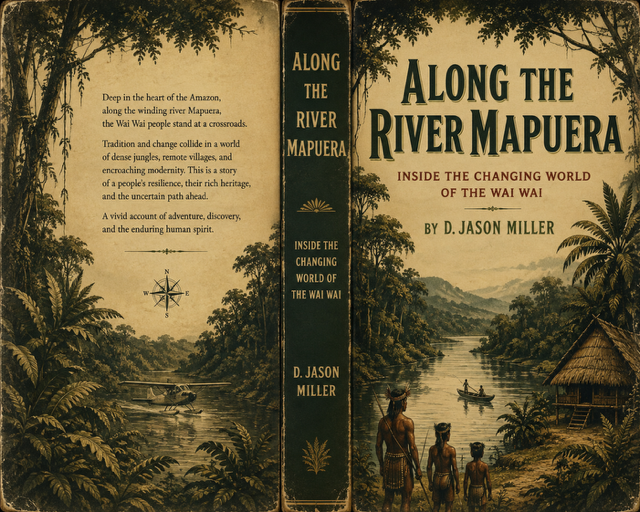
By D. Jason Miller
Book Synopsis -Release date 11/30/2026
Along the River Mapuera — Inside the Changing World of the Wai Wai is a personal account of adventure, Indigenous history, cultural change, and life in one of the most remote regions of the Brazilian Amazon. Combining travel narrative, historical research, firsthand encounters, and stories gathered along the river, D. Jason Miller introduces readers to the Wai Wai people and the world they inhabit.
The book began with a practical assignment: to assess the population and living conditions of Wai Wai communities in Brazil while supporting projects that provide clean drinking water to Indigenous populations. What began as a professional responsibility gradually developed into something much more personal. Through repeated journeys into the rainforest, Miller built friendships with community leaders, village elders, families, and guides who shared their knowledge of the region and its people.
The result is neither a conventional anthropological study nor simply an adventure story. It is an accessible, firsthand account of a people navigating the space between their ancestral traditions and a rapidly changing modern world. Through the author’s experiences, readers encounter the extraordinary beauty of the Amazon, the practical challenges of working in isolated communities, and the complex questions that arise when technology, education, religion, and outside influences reach places that were once difficult to access.
At its heart, the book asks a simple but important question: How can we understand and support a people without assuming that our own way of life is necessarily the one they should follow?
A Journey Begins in the Amazon
The story opens with Miller’s longstanding fascination with remote places, Indigenous cultures, and the histories that connect people to their land. Having spent decades traveling and working among Indigenous communities in Africa and South America, he approaches the Wai Wai with curiosity and respect, but without claiming the credentials of a professional anthropologist. His aim is to listen, observe, and record the stories shared with him.
The journey begins in Manaus, the remarkable capital of Brazil’s Amazonas state. Known historically as the “Paris of the Tropics,” Manaus offers a striking contrast to the wilderness that surrounds it. During the late nineteenth-century rubber boom, the city accumulated enormous wealth, importing European architecture, marble, steel, and cultural luxuries into the heart of the rainforest. Its magnificent Teatro Amazonas remains a reminder of that extraordinary period.
Miller explores the city’s history and character, from its grand but weathered buildings to its lively streets, riverfront, and Carnaval celebrations. Manaus is both a modern city and a gateway to a vast region where rivers remain the principal transportation routes. For Miller, it represents the first of many contrasts that define the Amazon: modernity and isolation, prosperity and hardship, history and change.
From Manaus, the expedition moves into the practical realities of remote travel. Permits must be obtained, equipment gathered, fuel arranged, food and water supplies organized, and transportation coordinated across hundreds of miles of waterways. Every detail matters because there are no convenient roads, nearby supply stores, or dependable emergency services once the expedition reaches the interior.
Working alongside local partners is central to the undertaking. Miller describes the importance of relationships with people such as Campos, his knowledgeable guide and friend, and Pastor Irlani and his wife, Maira, whose local connections, hospitality, and logistical support make the work possible. Their knowledge of the people, language, customs, and geography is indispensable.
Rather than treating access to the villages as something automatically granted to an outsider, Miller emphasizes the need for permission, patience, and trust. The region’s restrictions help protect Indigenous communities from exploitation and unwanted interference. Good intentions alone are not enough; the manner in which an outsider enters a community matters just as much as the work he hopes to accomplish.
After preparations are complete, Miller and his companions board an amphibious Cessna 206 and fly over the immense green expanse of the rainforest. Small tributaries twist beneath the aircraft, disappearing into the canopy, while the landscape stretches toward the horizon. Eventually, they descend toward the Rio Mapuera, landing on the river and making their way ashore.
The aircraft is met by villagers eager to help carry supplies up the steep embankment. There is little time for ceremony. The expedition has arrived, and the work—and the adventure—can begin.
The River: Road, Lifeline, and Wilderness
The Rio Mapuera becomes one of the central characters in the book. Its waters connect villages, carry people and supplies, provide food, and shape nearly every aspect of life in the region. In a place without conventional roads, the river is the highway, and understanding its changing character is essential to survival.
Miller describes a landscape that is never truly static. Rainfall transforms the waterways, creating new channels, exposing rocks and sandbars, and making passages that were once navigable impassable. The dry season can leave boats struggling through shallow channels, while the rains bring renewed depth and powerful currents. A route that seems straightforward on a map may require hours of careful navigation in practice.
Traveling by canoe offers an intimate view of the rainforest. The boat follows bends and loops through the jungle, sometimes appearing to travel in the wrong direction as the river winds away from the destination. Rapids, hidden rocks, shifting currents, heat, insects, and the need to conserve fuel all contribute to the challenge.
Yet these difficulties are part of the attraction. The river provides access to a world that remains largely beyond the reach of conventional travel. Its banks reveal wildlife, village life, and landscapes that would be invisible to someone moving only by air or along established roads.
The expedition follows the Mapuera from north to south, visiting communities and gathering information about their populations, families, health concerns, languages, and circumstances. The assessment is intended to provide a picture of the Wai Wai population in Brazil in 2025, recording the condition of communities that may change substantially over the coming decades.
Miller recognizes that a census can provide useful numbers, but numbers alone cannot explain a people. Behind every household count are family histories, personal experiences, traditions, and aspirations that cannot be reduced to a report. Conversations around lanterns, in community gathering places, and along the river become as important as the formal work.
Language adds another layer of complexity. Many conversations pass through Wai Wai, Portuguese, and English, creating opportunities for misunderstanding as well as humor. Miller recounts the difficulty of preserving the meaning of stories when words have no direct equivalent in another language. The resulting observations are not presented as the final word on Wai Wai history, but as a record of what people shared with him.
Following the Footsteps of the Wai Wai
The book then looks beyond the present-day villages to explore the longer history of the Wai Wai and their relationships with neighboring Indigenous peoples.
The Wai Wai story is not simply one of an isolated community encountering the outside world. Long before modern transportation and communications arrived, Indigenous peoples traveled the rivers, established relationships, exchanged goods, and sometimes came into conflict with one another. The forest was never an empty wilderness. It was a lived landscape filled with routes, territories, family connections, and histories passed from one generation to the next.
Miller draws on historical accounts, missionary records, linguistic studies, and the oral histories shared by Wai Wai elders to provide context for the communities he visits. He acknowledges that historical accounts can differ depending on who recorded them, when they were written, and which perspectives were represented. His intention is to preserve the stories as he encountered them while recognizing that they exist alongside a larger body of scholarship.
The arrival of missionaries during the twentieth century brought significant changes. Mission settlements attracted people from different Indigenous groups, creating new centers of interaction and altering patterns of movement and settlement. Missionaries also helped establish literacy, education, and written forms of the Wai Wai language.
These developments had consequences that were both practical and cultural. People gained new ways to communicate, learn, and engage with the outside world, while traditional oral histories and spiritual understandings continued to shape community life.
The history also includes displacement and return. Political changes in Guyana led to the expulsion of the Kanashen mission in 1971, prompting many Wai Wai families to disperse. Some moved elsewhere, while others returned to Brazil. Under Indigenous leaders, further migrations brought families back toward ancestral territories, including the Mapuera region.
Miller presents these movements as part of a continuing history of adaptation rather than a single moment in which one culture replaced another. The Wai Wai have repeatedly adjusted to changing circumstances, formed new relationships, and made decisions about where and how to live. Their present-day communities reflect both longstanding traditions and the consequences of more recent historical events.
Wai Wai Today: A Changing Cultural Landscape
The heart of the book lies in its examination of Wai Wai life today.
Miller visits villages that differ in size, location, language, and access to outside services. Some communities are growing, while others have divided, relocated, or been abandoned. Families move for work, education, marriage, and other reasons. Relationships with neighboring Indigenous groups continue to shape the social landscape.
The 2025 assessment offers a snapshot of this changing population. By recording households, children, language patterns, and other information, Miller hopes to create a useful reference point for future researchers and for anyone interested in understanding how the communities evolve.
One of the most striking contrasts he observes is the arrival of modern communications in places where basic infrastructure may remain limited. Solar panels can power satellite Internet connections in villages without conventional electricity. Smartphones and other electronic devices bring images, music, news, and social media into communities that may still depend on the river for nearly every journey.
The juxtaposition is remarkable. Young people in remote Amazon villages can now encounter the same online trends and cultural influences as their peers in major cities around the world. Ideas that once took years to travel across continents can arrive almost instantly.
Miller does not treat this development as an uncomplicated disaster or an automatic improvement. Internet access can create opportunities for communication, education, and connection with relatives and the wider world. At the same time, community leaders express concern about the influence of social media and the speed at which outside values can reach younger generations.
He recognizes that these tensions are not unique to Indigenous communities. Every generation encounters music, fashions, ideas, and technologies that can seem unsettling to those who came before. What makes the Wai Wai experience different is the speed and reach of the changes, combined with the relative isolation in which many communities have lived.
The question is not whether change will occur, but how the Wai Wai themselves will choose to respond. Their traditions, language, relationships, and collective decisions will determine what they retain, what they adapt, and what they leave behind.
Stories from the Jungle
Alongside the history and cultural observations, the book includes stories that reveal the danger, mystery, humor, and humanity of life in the Amazon.
Miller’s travels take him into remote settlements where evenings unfold beneath lantern light, conversations continue long after dark, and local people share accounts that combine personal experience with traditional beliefs. Some stories are frightening, others extraordinary, and still others offer a glimpse into the everyday relationships that bind communities together.
In “The Dog Woman,” a story recounted by a local pastor, Miller explores an unsettling account of a woman whose physical deterioration was interpreted by villagers as the result of a curse. Her story raises questions about the ways people understand illness, spiritual power, and events that do not fit easily into familiar explanations. Miller presents the account as it was told to him, allowing readers to see how beliefs and experiences can shape one another in an isolated setting.
The Amazon’s mysteries extend beyond village stories to the enduring fascination with lost cities, hidden caves, and treasures believed to lie beneath the rainforest. Miller considers the history of explorers drawn into the interior by the possibility of discovering something extraordinary. The jungle’s immensity makes it easy to understand why such legends persist, even when the boundary between fact and speculation remains uncertain.
These stories also provide a cautionary perspective on outsiders who enter Indigenous territory in search of personal gain. Miller describes how individuals have exploited the trust of local people to pursue gold and precious stones, sometimes disguising their intentions behind the appearance of charitable or religious work. Such behavior helps explain why communities are cautious about revealing certain locations and why trust must be earned over time.
One of the book’s most significant adventures centers on a remote cave that Miller had heard about but had never been invited to visit. The cave’s location is deliberately obscured because of the risk that treasure hunters could exploit the discovery. Miller explains that he has spent years building relationships with the Wai Wai and that the invitation represents a level of trust he does not take lightly.
For him, the attraction is not the possibility of acquiring wealth. It is the opportunity to explore a place few outsiders have seen and to experience an adventure that would otherwise remain inaccessible. The cave story therefore becomes about more than exploration: it illustrates the responsibility that comes with being welcomed into someone else’s world.
Another story demonstrates that the river’s beauty can conceal genuine danger. A young boy named Alfredo is attacked by a large anaconda while near the water. His uncle Tumuru, despite his own physical limitations, rushes into the river and struggles to pull the boy and the snake toward the rocks. Other villagers arrive, and a local Indigenous nurse attempts to revive the child.
Alfredo survives but suffers serious internal injuries and requires a long journey to medical care. His experience changes the way he and others view the river, which remains essential to daily life but can no longer be regarded without a heightened awareness of its dangers.
Miller uses the story to illustrate both the risks of living close to the natural world and the courage of those who respond when someone they love is in danger. Tumuru’s actions are driven by an immediate instinct to save his nephew, while the community’s response reflects the cooperation and resourcefulness required in a place where help may be many hours away.
The river continues to provide food, transportation, recreation, and connection, even after such an event. The Wai Wai do not simply abandon their relationship with the natural world because it can be dangerous. Instead, they adjust their behavior, monitor children more carefully, and establish new precautions while continuing to live alongside the environment they know so well.
The Future Belongs to the Wai Wai
The book’s closing reflections return to the central question that runs throughout Miller’s journey: what does it mean to help a community while respecting its independence and cultural identity?
His work with clean-water projects provides a practical starting point. Many Indigenous communities rely on rivers and other natural sources for drinking water, but the quality of those sources can deteriorate. Simple filtration systems can help address a basic need, provided they are introduced in a way that fits local circumstances and is supported by the people who will use them.
Yet Miller increasingly recognizes that the work involves more than delivering equipment. Effective assistance requires listening to the community, understanding its priorities, respecting its customs, and working alongside people who know the region far better than an outside visitor ever could.
This philosophy extends beyond water projects. The same respect is necessary when considering education, healthcare, religion, technology, and cultural change. An outsider may have useful resources or experience, but that does not automatically mean the outsider understands what another community needs or how its members wish to live.
Miller’s observations do not suggest that the Wai Wai should be shielded from every modern influence, nor do they romanticize a past that cannot simply be restored. The communities themselves are making choices, forming relationships, and responding to circumstances that previous generations could scarcely have imagined. Their future will inevitably be different from their past.
What matters is that those decisions remain theirs.
Through conversations with elders, leaders, families, and young people, Miller encounters a community whose history is still being written. Oral traditions continue to carry memories of earlier generations, while literacy, education, and modern communications offer new ways to preserve and share knowledge. Old customs may change, but cultural identity is not necessarily erased by every new influence. It can also be reshaped through the choices people make for themselves.
The book ultimately brings together two kinds of exploration. One is the physical journey into the Amazon, with its rivers, rapids, hidden caves, wildlife, and remote settlements. The other is a personal journey toward a better understanding of the people who call this region home.
Miller does not claim to have discovered a definitive answer to the challenges facing the Wai Wai. Instead, he offers readers a record of what he witnessed, what he heard, and what he learned through the privilege of being welcomed into their communities.
Along the River Mapuera is an invitation to look beyond stereotypes of Indigenous life and beyond the familiar assumptions of the modern world. It reminds readers that a census cannot fully describe a community, that history is often more complicated than a single written account, and that genuine service begins with listening rather than imposing solutions.
The Amazon remains immense, beautiful, and full of mystery. Its rivers continue to connect people and places, carrying stories from one generation to the next. Along the Mapuera, the Wai Wai are navigating a future shaped by both their ancestral heritage and the possibilities of an increasingly connected world.
For Miller, the greatest privilege is not simply reaching a remote village or exploring a place few outsiders have seen. It is being trusted enough to sit with the people who live there, hear their stories, and share a small part of their lives.
That is the journey at the center of this book: an adventure along one of the Amazon’s lesser-known rivers, and a personal exploration of the people, history, and changing world found along its banks.

