Tawana Village- Rio Mapuera Amazon Jungle
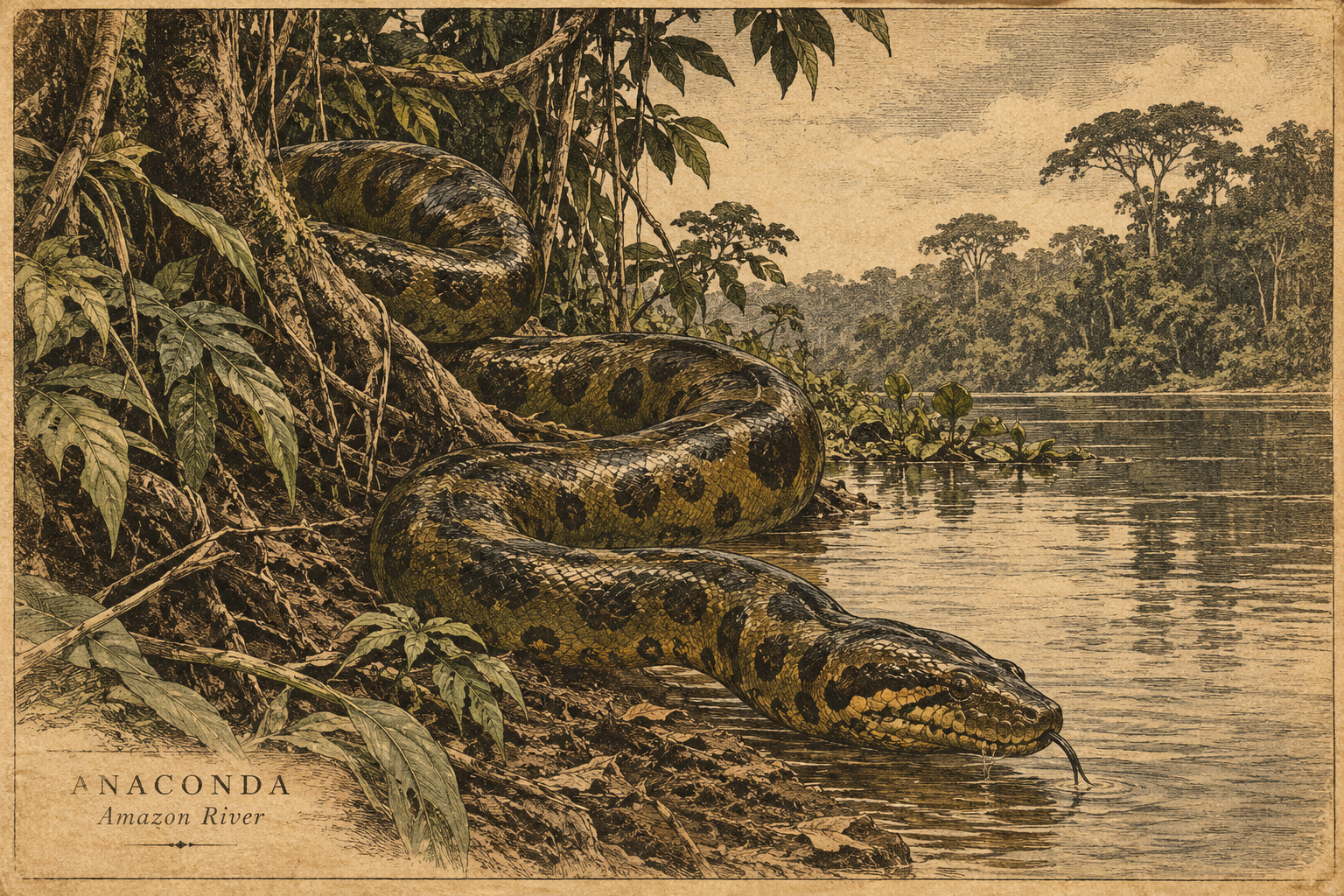
As evening fell over the Mapuera, the heat of the day slowly began to disappear. The river, quiet under the fading light, was beginning to take on the sounds of the evening as insects buzzed through the trees and frogs began their nightly concert. Somewhere beneath the surface, hidden among the vegetation and dark water, a midsize green anaconda was slowly beginning to move. It had spent the hottest part of the day basking just below the surface, almost invisible from above, but now the temperature was dropping and it was hunting time. The snake slowly made its way into the river, following the bank and watching for movement, patient and deliberate as it searched for its next meal.
Anacondas are built for this kind of hunting. Their eyes and nostrils are positioned on top of the head, allowing them to remain almost completely submerged while watching and smelling what is happening above the surface. They can also remain underwater for roughly 10 minutes, although the exact duration depends on circumstances. To anything moving along the riverbank, there may be no warning at all that a large predator is watching from just beneath the surface.
As it made its way out into the river, it scanned the banks for prey, slowly swimming along, its 15-foot body following as if on a track. These snakes feed occasionally, and sometimes weeks or even months can pass between meals. A large meal can take days to digest, so there was no need for this snake to hurry. It simply moved along the bank, searching for a caiman, turtle, or, if lucky, a small deer, dog, or capybara. The evening was quiet, the river was low, and the snake continued its slow patrol along the edge of the Mapuera.
Then, as it approached a rocky outcrop, something caught its attention. There was movement in the water, something that did not belong to the normal rhythm of the river. The snake slowed as it watched from beneath the surface. Above it, feet and legs were hanging off a canoe, splashing casually in the water. The anaconda did not rush. It remained hidden, watching the movement and slowly closing the distance. Then it submerged completely and began making its way across the bottom of the river, smooth rocks passing beneath its belly as it moved toward the canoe.
Above the surface, no one knew it was there.
Alfredo described it later as a blast from the water. The huge snake lunged at lightning speed, startling the boy in the relatively quiet evening. It coiled around his legs, the weight of the snake pulling young Alfredo from the boat in an instant. He tried to scream but only took in a large quantity of river water, and his struggles were short-lived. The anaconda instantly coiled around his small body, tightening its grip while holding him underwater.
Young Alfredo was on vacation. With a few days off from school, he had decided to accept his uncle Tumuru’s invitation to visit the village of Tawana along the Mapuera. Tumuru was excited, as he loved to hunt and fish with his nephew.
That day had been like every other day on the Mapuera, hot in the middle of the day, and Tumuru and Alfredo had discussed fishing later that evening, just after dark. They had planned to set their nets just off the rocky outcrop and go out on the boat after dark to retrieve them.
As they waited for the oven-like heat to slowly dissipate, stories were told of Tumuru’s youth, how he fished for his family and village and was an excellent swimmer. Of course, those were the days of old, and Tumuru, being later in life, now walked with the aid of a cane, yet still carried himself with the strength and vigor of youth.
Young Alfredo, being just 15 years old, loved and respected his uncle. He wanted to learn the ways of old and his heritage, despite living far away in another village. He was excited to spend time with Tumuru and learn the wisdom he was willing to share.
Right before dusk, Tumuru and Alfredo spread and mended their nets on the porch of their wooden house along the river. Each net was checked for tears and slowly mended, the weights were checked and secured, and just as the sun was setting, they made their way slowly down to the rocky outcrops along the river, as the water was low in the middle of the dry season. Alfredo helped his uncle navigate the slippery rocks and waded through the shallow water, placing the nets precisely as his uncle explained.
Once everything was placed perfectly, they went up to the house to wait until dark to retrieve the nets by canoe just beyond the rocks.
They shared a snack and a drink, discussing the anticipated catch, and like most young people, Alfredo’s excitement was overwhelming. He asked if he could go check the nets. Tumuru felt they should wait a bit longer, but young Alfredo’s excitement had swayed him, and he relented.
“Wait here, Uncle. I am just going to check the nets and will be right back.”
Tumuru smiled, agreed, and sat listening to the evening sounds of insects buzzing in the trees as the symphony of frogs began their nightly concert. Neither of them knew that something else had already begun its own evening routine along the riverbank.
As time passed, Tumuru sensed trouble. He heard splashing that wasn’t familiar to his many years on the Mapuera. At first he listened, trying to understand what he was hearing, but something about the sound was wrong. It was not the ordinary movement of the river or the sounds of someone checking a fishing net. Tumuru quickly got to his feet and hurried toward the water to check on Alfredo.
He was gone.
The floating canoe was in the distance, reflecting under the moonlight. Quickly and instinctively, Tumuru charged into the water, searching for young Alfredo. By chance, he felt something struggling beneath the surface. Grasping underwater for the moving object, choking on water and struggling for his own breath, Tumuru wrapped his arms around a large object and began dragging it toward the rocky outcrop.
Alfredo was in the full grasp of the large anaconda, coils of snake crushing the life out of him while holding him underwater.
Tumuru went into survival mode, dragging snake and boy from the river onto the rocks, screaming for help while beating the large snake with his fists. His struggle did not go unnoticed, and quickly men from the village began running down to the riverbank. Pitch black except for the moonlight, everyone struggled to keep track of the boy, the snake, or even understand what was going on.
The men uncoiled the snake from the boy, who lay lifeless on the rocks, and immediately began trying to revive him. A local Indigenous nurse happened to be in the village and came to young Alfredo’s aid, providing CPR on his small, fragile body.
In the turmoil, the anaconda made its escape off the rocks and into the river, disappearing into the forest across the Mapuera.
Alfredo slowly began breathing, struggling for each breath. How long he had been held underwater, with his life being crushed out of him by the snake, no one would know. He was taken up to the house, laid out on a table, and the nurse began taking his vitals and working on poor Alfredo.
Some men from the village loaded into canoes and began the hunt for the dreaded snake. Lights flashed along the dark jungle canopy late into the night and into the early morning as they searched the riverbanks and forest for the animal. They knew the snake was somewhere out there, but the darkness of the jungle and the river made it nearly impossible to follow its trail.
It escaped.
The following morning, Alfredo was loaded into a canoe for the long journey to Oriximiná, the closest town with medical help. It was a brutal experience, as every rapid and every wave caused great pain for young Alfredo. The journey was a minimum of eight hours, depending on speed and river flow. Once he arrived at the hospital and X-rays were taken, it was found that, due to the crushing force of the anaconda, Alfredo had suffered internal bleeding.
Alfredo spent two weeks recovering in the hospital and more time mentally coping with the experience. As someone who lived along the river, where the river played such an important role in his life, he now had to find a way to cope with what had happened. The river was not simply a place to travel; it was where people fished, hunted, worked, played, visited family, and lived their lives. Now the same river where Alfredo had grown up had nearly taken his life.
I sat along the bank of the Mapuera with Tumuru as he explained the night his nephew was attacked. He choked up as he described seeing his young nephew, the boy he was responsible for, wrapped in the coils of a large anaconda, and how, despite his handicap, he had leaped into the water and pulled both boy and snake toward the rocky outcrop.
He loved his nephew.
There was no hesitation in Tumuru’s story when he described what happened. He had heard something wrong in the river and went immediately after Alfredo. He did not stop to think about his own safety or what might be waiting beneath the surface. He simply went into the water.
He also pointed along the riverbank and explained that, as recently as the previous week, the same anaconda had been spotted swimming along the bank.
The Wai Wai are hunters but not killers and leave the snake alone, as it is not part of their diet. The anaconda was not something they wanted to kill simply because it was dangerous. It was part of the river, part of the forest, and part of the world they had lived alongside for generations.
New rules had been enacted about being careful along the banks. Children are monitored, and teams of two must be together along the water at night. The river was still their highway, their fishing ground, and an important part of life, but now there was a new awareness of what could be beneath its dark surface.
Somewhere along the Mapuera, the anaconda was still out there.
Anaconda Encounter
Copyright © 2026 by D. Jason Miller
All rights reserved. No part of this publication may be reproduced, distributed, or transmitted in any form or by any means, including photocopying, recording, or other electronic or mechanical methods, without the prior written permission of the publisher, except in the case of brief quotations embodied in critical reviews and certain other noncommercial uses permitted by copyright law.

