Casita De Tejas – Rosebud Texas
I was young once. A twenty-something kid working for Tandy Corporation in a data center, surrounded by what we considered state-of-the-art technology in the 1990s. It was a pretty exciting time. The 486 computer evolved into the Pentium, the internet was just beginning to crawl into our lives, and somehow we thought all of this new technology was going to make things simpler. It didn’t.
Adventure travel was already in my blood, and unlike today, traveling to places like Africa or the Amazon required something called saving money. There were no cheap last-minute flights, no apps to find a $12 hotel, and certainly no Starlink. If I wanted to climb Kilimanjaro, I had to put money away for quite a while and then actually go somewhere where nobody knew where I was. Naturally, being a technology junkie, I wanted to take the latest gadgets along with me.
In 1995, the first consumer GPS systems hit the market. I bought one and took it to Africa. It didn’t have a colorful map showing my position with a cute little blue dot. Nope. It simply displayed latitude and longitude on a tiny LCD screen, and I thought it was amazing. I hauled that thing all the way up Kilimanjaro and proudly showed other climbers my latitude and longitude. I’m pretty sure most of them were thinking, “That guy spent money to carry a calculator up a mountain.” They weren’t entirely wrong.
Communication in those days was a little different too. When traveling internationally, staying in touch meant international prepaid calling cards and payphones. You would find a phone, dial a 1-800 number, enter your mysterious string of numbers, and hopefully reach the person you were trying to call. Of course, there was one more requirement: the person had to actually be home. The late 1990s brought technology at a dizzying pace. I got my first Hotmail account and suddenly I could communicate by email. It felt revolutionary. Unfortunately, the internet was still a pretty limited creature, especially in places like Africa and South America. So naturally, I needed another gadget.
Enter the MAGELLAN GSC 100
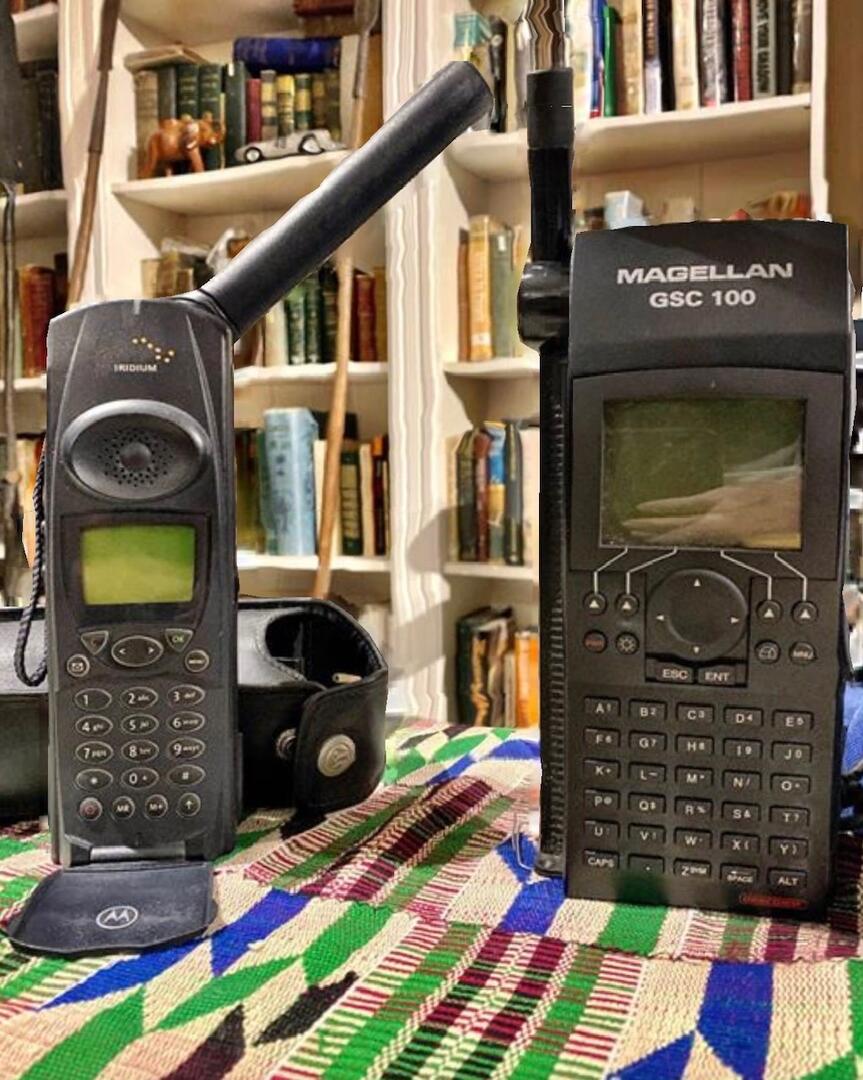
In 1997, the MAGELLAN GSC 100 appeared on the market. It was billed as the world’s first handheld global satellite communicator, combining GPS with the ORBCOMM satellite network to send and receive short text messages called GlobalGrams. It was absolutely fantastic. It was also huge, heavy, expensive, slow, awkward, and completely impractical. Naturally, I bought one.
I paid more than $1,000 for one of the first-generation units, which in 1997 was a rather impressive amount of money to spend on something that looked a little like a small paving brick. The antenna, when fully extended, reached about six feet. The keyboard was tiny and practically useless, typing a simple message took forever, and then the device had to find a satellite and transmit the message. The LCD screen was so small that reading it required patience, good eyesight, and perhaps divine intervention. And the batteries? Let’s just say you didn’t casually toss this thing into your backpack.
But it was COOL. With a pricey monthly subscription and additional charges for every character sent, I could send an email from just about anywhere in the world in the late 1990s. And it actually saved the day once. I was stranded and lost in an Alabama swamp during a canoe journey, and somehow that giant satellite brick became one of the more useful pieces of equipment I had brought along.
Of course, its usefulness didn’t last long. The GSC 100 had a remarkably short life before technology left it behind. It was expensive and cumbersome, the battery was heavy, and the charging equipment seemed to require a suitcase of its own. Customs agents also tended to give it a very long look whenever I entered a country. More than once I wondered if I was going to see it again. Eventually, the value of the GSC 100 dropped to essentially nothing. Mine still sits on a bookshelf. I keep it as a reminder of the early days of global communication—and perhaps as evidence that I have a long history of buying expensive gadgets that become obsolete almost immediately.
Pocket Mail
By the early 2000s, another miracle of technology appeared: Pocket Mail. Compared with the GSC 100, Pocket Mail was tiny. It was a little folding device with a keyboard, an LCD screen, and an ingenious acoustic modem. You would unfold the modem, place it against a telephone handset, and it would transmit your email through the phone line using a sound that can only be described as a fax machine having a nervous breakdown.
Once it finished sending the outbox, it downloaded the inbox. Then you could walk away from the phone, compose your replies at your leisure, and wait until you found another telephone. It ran on AA batteries, cost about nine dollars a month, and included an email address and an 800 number. Brilliant.
I carried one across Ghana into some pretty remote areas. Every time I pulled it out and started typing an email on its tiny eight-line display, a crowd would gather around me. Apparently, watching a grown man struggle to type an email one tiny line at a time was excellent entertainment. Like the GSC 100 before it, Pocket Mail eventually became obsolete almost as quickly as it became popular.
Then Came the Satellite Phone
By the early 2000s, satellite phones were the hot ticket. They had actually been around for some time, but they had previously been priced somewhere between ridiculous and you-have-got-to-be-kidding-me. Competition increased, prices started coming down, and suddenly a satellite phone was within reach of people who weren’t governments, spies, or oil companies. At about a thousand dollars, I decided to try one.
It worked fine. Really fine. But then there was the little matter of the monthly subscription and approximately a dollar per minute every time I actually wanted to talk to someone. At that price, I began to appreciate email. Then Wi-Fi arrived, laptops became smaller and lighter, and suddenly carrying a satellite phone around the world seemed less attractive. Today, that satellite phone sits on the shelf next to the GSC 100 and Pocket Mail. I suppose I’m building my own little museum of technological mistakes.
Welcome to the Future
Fast-forward about a quarter of a century into the 21st century, and communicating while traveling is no longer much of a challenge. My iPhone, using my regular U.S. service, works in probably 75 percent of the places I visit. I’ve actually FaceTimed my family from a safari in the Maasai Mara while a pride of lions was sitting nearby. My family was sitting comfortably in Colorado watching the whole thing live on their phones. Think about that for a moment. Thirty years ago, I was standing on a mountain proudly displaying my latitude and longitude on a little LCD screen while other climbers wondered what was wrong with me. Now I can show my family a live pride of lions from the middle of Africa.
And when there is no cell signal, I carry a Starlink Mini. It’s roughly the size of a small laptop, connects to satellites, and gives me internet access from places where there isn’t a cell tower for hundreds of miles. I carry a battery and a small solar panel, and I can literally host a Zoom call from a dugout canoe on the Amazon River. I’ve done it. Which is both incredibly cool and, when I think about it, completely ridiculous.
Maybe We Lost Something Along the Way
Having instant Wi-Fi makes travel much easier. There’s no question about it. But it also changes the experience. I find myself surrounded by groups of people in remote places, all asking how they can connect to the internet. Before long, everyone is sitting together staring at a screen, which is exactly what I try to discourage at home. And now we’re doing it in the middle of the African veldt.
There’s something about being truly disconnected that I miss. I miss the days when sending a message meant making an effort. I miss trying to get a satellite connection long enough to tell someone, “I’m okay.” I miss the relief of successfully getting a message through. I miss not knowing what was happening back home. And perhaps most of all, I miss simply being there.
In the late 1900s, adventure travel came with a price. Part of that price was being completely out of communication for days, sometimes weeks, at a time. You couldn’t post a photograph from the middle of nowhere, you couldn’t check Facebook, you couldn’t answer an email, and you certainly couldn’t attend a Zoom meeting from a canoe. You were simply there. And somehow, that was part of the adventure.
So What’s Next?
Apparently, the next step is that our smartphones will soon be able to connect directly to satellites instead of relying entirely on cell towers. Which means that eventually, we’ll have instant communication almost everywhere on Earth. No cell signal? No Wi-Fi? No problem. You’ll still be able to get the call.
Which means one of my favorite travel excuses may soon disappear: “Sorry, I didn’t answer. I didn’t have cell service.”
Technology has come a long way since that giant GPS brick I hauled up Kilimanjaro. I’m just hoping the next gadget doesn’t require another suitcase..
.
From Bricks to Starlink: How I Used to Communicate While Getting Lost
Copyright © 2026 by Jason Miller
All rights reserved. No part of this publication may be reproduced, distributed, or transmitted in any form or by any means, including photocopying, recording, or other electronic or mechanical methods, without the prior written permission of the publisher, except in the case of brief quotations embodied in critical reviews and certain other noncommercial uses permitted by copyright law.

