Nyae Nyae – A Place Without Mountains but Rocky- Jason Miller
The Kalahari is difficult to comprehend until you stand within it. Stretching across nearly 350,000 square miles of thorn bush, scrubland, and endless horizons, it spans parts of Botswana, South Africa, and eastern Namibia. It is a land of extremes—beautiful, unforgiving, and ancient beyond measure.
Of the countries that share the Kalahari, Namibia has distinguished itself through its commitment to conservation. The country has established a network of conservancies that protect not only wildlife but also the indigenous people who have called these lands home for countless generations. One such area is the Nyae Nyae Conservancy, a vast wilderness managed by a friend of mine who graciously granted me access to study the Ju/’hoansi San people, more commonly known as the Bushmen.
Over the past four years, I have spent considerable time among the Bushmen and have written extensively about both their culture and the wildlife conservation efforts taking place within the conservancy. Those experiences will eventually become a book of their own. For now, I want to share a glimpse into a people whose way of life is rapidly changing yet remains deeply rooted in one of the oldest cultures on Earth.
Finding the Bushmen is not particularly difficult. Like many indigenous groups throughout Africa, villages can be located with relative ease. Truly understanding them, however, is another matter entirely. I was not interested in the performances often arranged for passing tourists. I wanted to understand the realities of their lives—the challenges they face, the traditions they are struggling to preserve, and the future they see for their children.
One of my journeys involved filming a documentary about the Bushmen. A film crew from South Africa accompanied us into the conservancy, and through an interpreter, I sat down with a village leader for a lengthy interview. For hours we discussed the pressures facing his people.
Many of those challenges are surprisingly familiar. Like older generations around the world, the elders worry about their children abandoning traditional ways in favor of modern technology. It is a strange sight to witness a young man dressed in animal skins suddenly pull an aging smartphone from a leather pouch and ask if he can connect to my Starlink internet. In a single moment, two worlds separated by thousands of years collide.
The encroachment of other tribes presents another challenge. Cattle herders frequently move livestock into conservancy land in search of grazing. The Bushmen, known for their peaceful and non-confrontational nature, rarely resist. As a result, they often find themselves displaced as outsiders damage the delicate ecosystem upon which they depend.
Education presents its own difficulties. The Bushmen are generally small in stature and reserved in temperament. Many children struggle in public schools where they face social pressures and bullying from larger tribal groups. The dropout rate remains alarmingly high. In many ways, their situation mirrors that of the Pygmy peoples of Central Africa, whose traditional cultures are also under increasing strain.
Alcoholism has become another unfortunate reality. While excessive drinking can be found throughout rural Africa, I noticed the problem was particularly severe in villages located closer to small towns. Whatever money is earned is often spent quickly on cheap homemade alcohol—a temporary escape from the uncertainties of a rapidly changing world.
My first visit to a Bushman settlement remains vivid in my memory.
We drove for hours along deep sandy tracks, our Land Cruiser weaving through thorn bush and scrub. Eventually we arrived at what appeared to be nothing more than a small clearing in the wilderness, a place so inconspicuous it would be easy to pass without noticing.
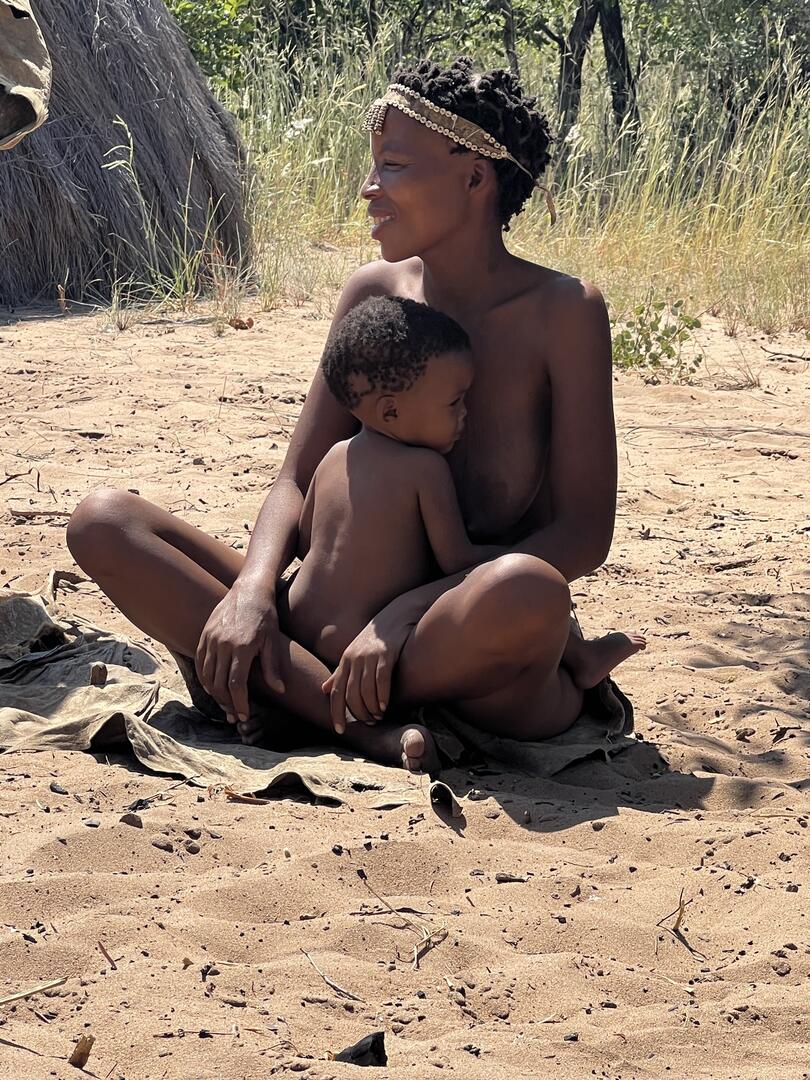
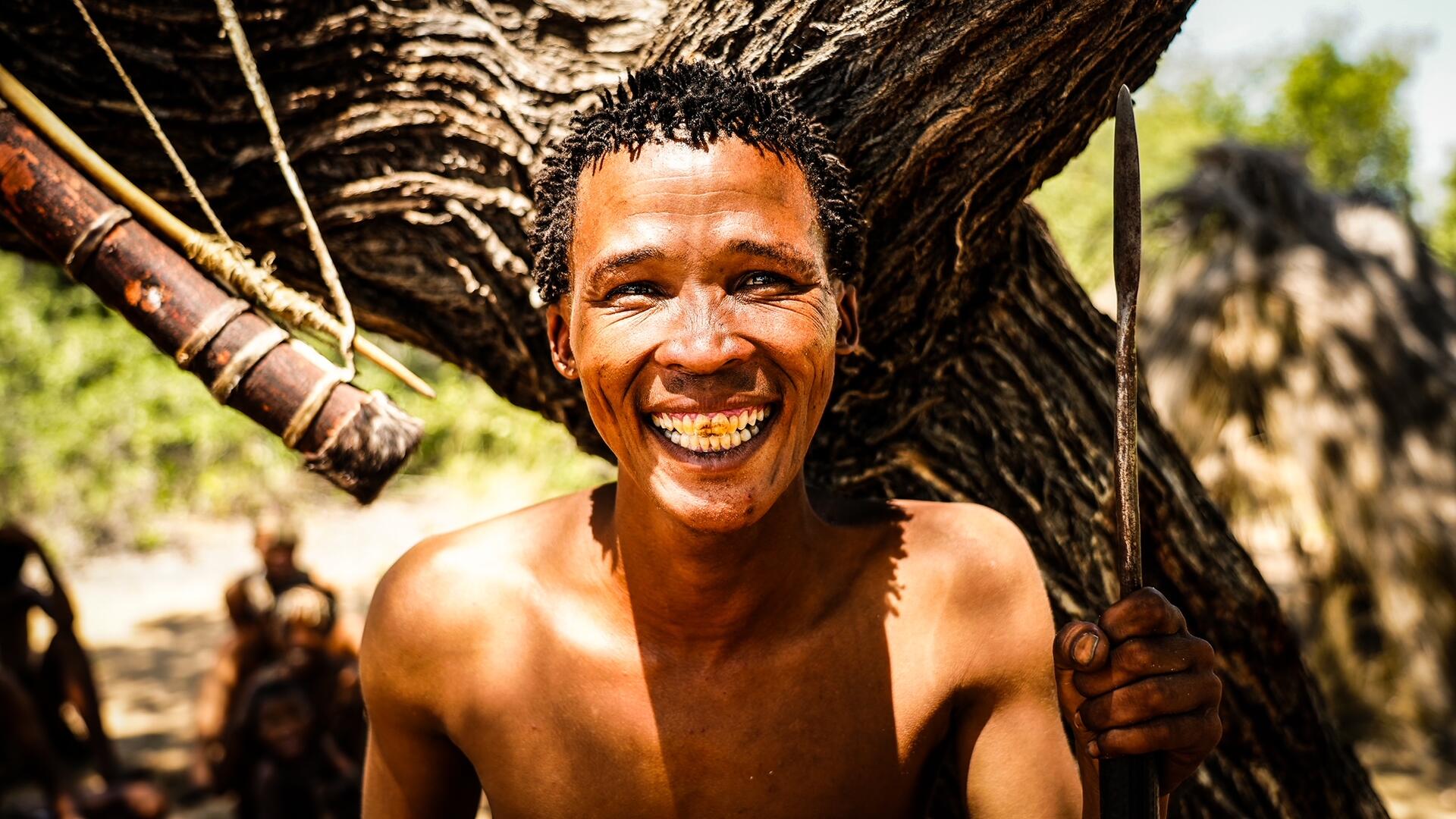
A cluster of dome-shaped huts stood beneath scattered trees. Women tended cooking fires while children played nearby in the dust. In the center of the village, several men sat quietly preparing for an afternoon hunt.
The Ju/’hoansi are among the oldest surviving hunter-gatherer cultures in the world. Some anthropologists believe their ancestors have occupied this region for as long as 100,000 years. Today, approximately 70,000 San people remain across southern Africa. Their language is unlike any other, filled with distinctive clicks and pops that seem almost impossible for outsiders to master.
As soon as we arrived, the atmosphere shifted. Villagers gathered around us, talking excitedly and trying to determine our purpose. I immediately sensed a degree of performance creeping into their behavior. They were accustomed to visitors, and I worried that I was seeing what they believed outsiders wanted to see rather than everyday life.
Trust, I discovered, is not given quickly.
It took many visits before people relaxed around me and returned to their normal routines. Gradually the cameras became less important, and my presence became less of a novelty. Over time I was able to observe life as it truly unfolded.
Many mornings began before sunrise as I followed groups of fifteen or twenty Bushmen deep into the bush. The men carried small bows and arrows, moving silently through the landscape while reading tracks invisible to my untrained eyes. Behind them, the women dug for edible roots and gathered wild plants, often stopping to offer me a taste of whatever they found.
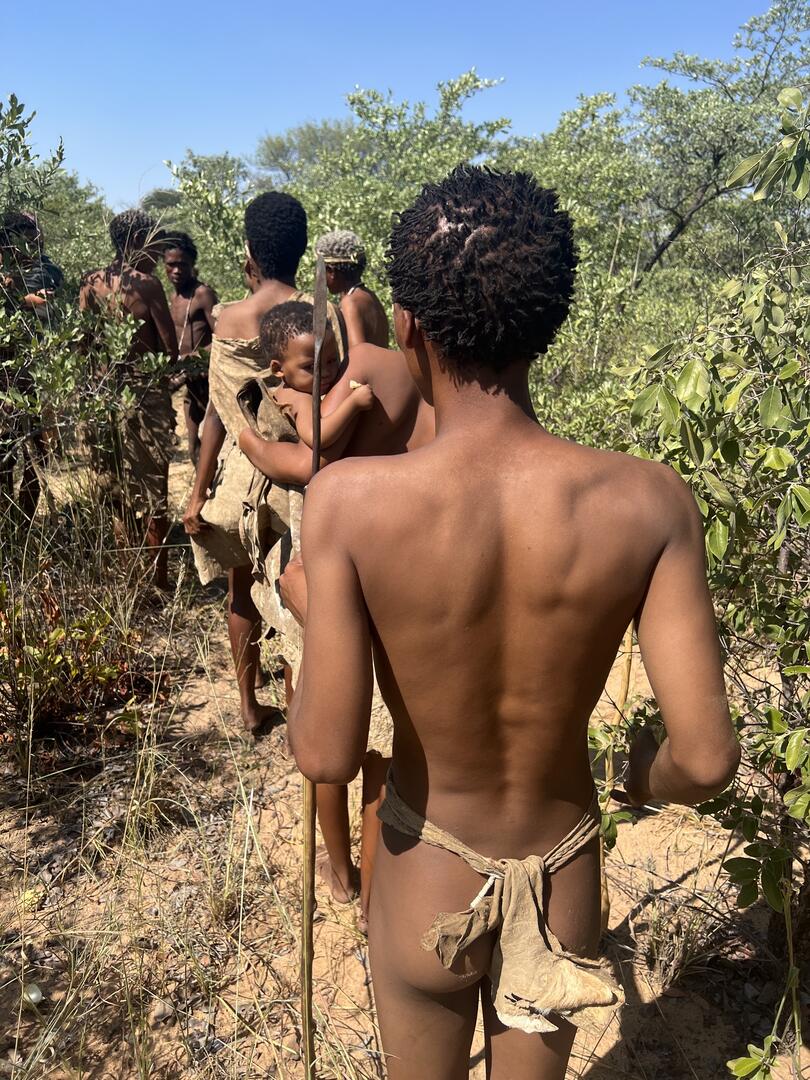
The Kalahari itself became our classroom. We discussed snakes, predators, droughts, and the constant challenges of survival in such an unforgiving environment. Within the conservancy, Bushmen are permitted to hunt using traditional weapons, and they also receive meat from wildlife management operations conducted by conservation authorities.
For generations they moved freely across the vast Kalahari, unconcerned with borders or national boundaries. Today that nomadic existence is fading, slowly becoming a chapter in history rather than a living reality.
The evenings were often magical.
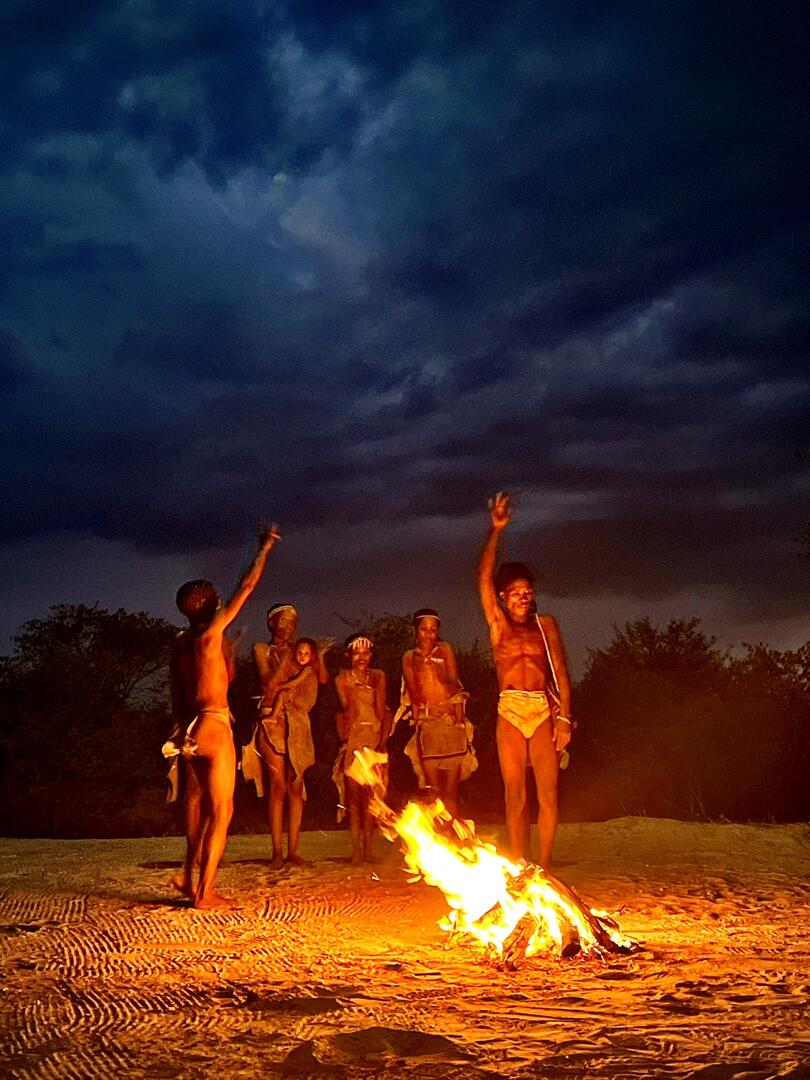
As the heat of the day finally released its grip, families gathered around fires beneath an immense canopy of stars. The Bushmen danced, sang, and shared stories late into the night. Sometimes distant thunderstorms flickered along the horizon, illuminating towering clouds with bursts of silent lightning. The storms rarely reached us, teasing the promise of rain before dissolving into the darkness.
The children eventually became comfortable around me as well.
Curious little faces would appear beside me as I sat near the fire. The younger children, with their copper-colored skin and tightly curled peppercorn hair, examined me with endless fascination. Some would touch my thinning hair, while others rubbed my arms as though trying to understand why my skin looked different from theirs. More than once a child attempted to wipe away my tan, convinced the color must somehow come off.
One experience remains particularly memorable.
During a visit to a remote village, I noticed a young girl running awkwardly across the clearing. Both of her feet were severely deformed, turned backward so that she walked on the outer edges while her legs curved unnaturally beneath her.
I understood immediately what such a condition often means in traditional communities. Deformities are frequently associated with curses, ancestral wrongdoing, or spiritual punishment. In many cultures, children born with such conditions face neglect or abandonment—not from cruelty, but from deeply rooted superstition.
Yet there she was—laughing, playing, and very much alive.
We wanted to help.
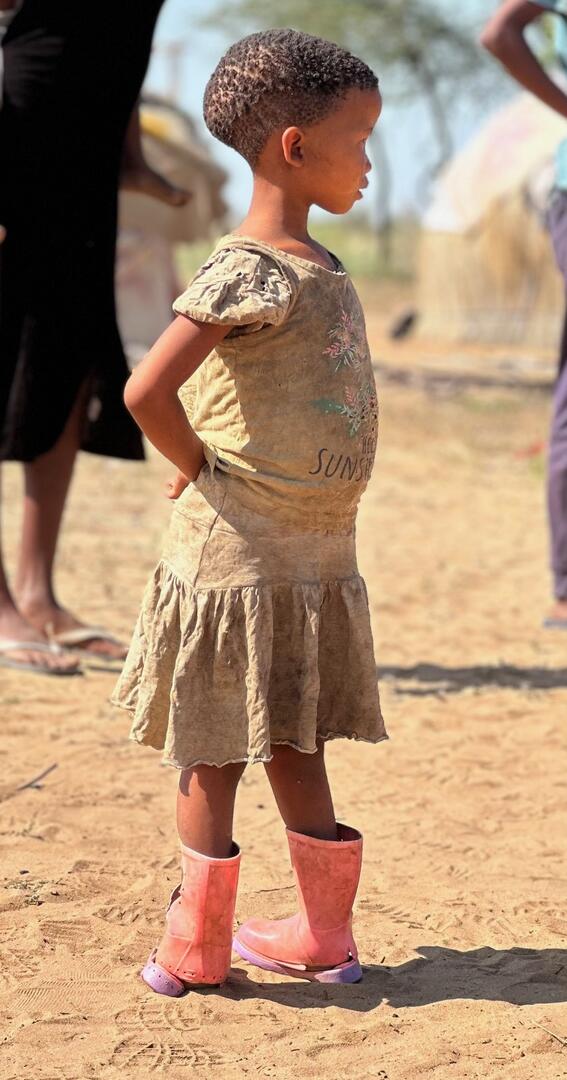
Over the next two years, with the assistance of a compassionate doctor in Windhoek, arrangements were made for surgery and physical therapy. The process was long and challenging, but it succeeded.
Today, that same little girl runs through her village on healthy feet.
It remains one of the most rewarding outcomes of all my time in the Nyae Nyae.
There is far more to tell about the Bushmen—their beliefs, their traditions, their remarkable knowledge of the natural world, and the challenges that threaten their future. I have written extensively on those subjects and hope to share them in greater detail one day.
For now, I remain grateful for the years I have spent among these extraordinary people. In a rapidly modernizing world, they stand at a crossroads between preserving an ancient heritage and adapting to the demands of the present. My hope is that they can do both—that they can retain the customs that make them unique while finding a path toward prosperity and dignity in the modern age.
Its important to mention the non profit that dedicates it time and resources to preserving the Bushmen Culture as well are wildlife conservation efforts in the Nye Nye. ” River Deep Club” also facilitated and funded the surgeries, and transportation and lodging for the young girl mentioned.
[Bushman of the Nyae Nyae]
Copyright © 2026 by D. Jason Miller
All rights reserved. No part of this publication may be reproduced, distributed, or transmitted in any form or by any means, including photocopying, recording, or other electronic or mechanical methods, without the prior written permission of the publisher, except in the case of brief quotations embodied in critical reviews and certain other noncommercial uses permitted by copyright law.

