Jason Miller
Whenever work takes me to a new corner of Africa, I try to carve out time to visit as many wildlife areas as possible. My professional life revolves around helping African communities, but my passion for adventure and wildlife often fills the spaces between projects.
Rwanda is not usually the first country that comes to mind when people think of African safaris. That, however, is beginning to change.
A small country with a large population, Rwanda’s wildlife has faced enormous challenges over the years. Its mountainous terrain, rapid development, tragic history of genocide, and decades of poaching meant that conservation was not always a priority. Today, that story is changing. Rwanda now boasts some of the strictest wildlife protection laws on the continent. More importantly, a younger generation increasingly sees wildlife not as bush meat, but as a source of national pride and sustainable economic opportunity. For the first time in decades, many species have a genuine chance to thrive once again.
One of the places where this transformation is most visible is Nyungwe National Park.
Nyungwe is one of the largest remaining tropical forests in Africa. Originally designated a forest reserve by the German colonial administration in 1903, it became a national park in 1933. Despite its protected status, decades of human pressure took a heavy toll on the ecosystem. In the late 1960s, hundreds of elephants roamed these forests. By 1974, the last buffalo had been killed by hunters, and in 1999 the final elephant was poached, leaving the forest eerily empty of its largest inhabitants.
Today, under the management of African Parks, plans are underway to reintroduce the forest elephants that once wandered these dense jungles. It is a hopeful chapter in a place that has seen its share of loss.
Located in southwestern Rwanda, near the borders of Burundi and the Democratic Republic of Congo, Nyungwe sits above the shores of breathtaking Lake Kivu. Its location is extraordinary: the mighty Congo River watershed lies to the west, while the Nile watershed begins to the east. Combined with elevations reaching nearly 9,800 feet above sea level, the result is a unique ecosystem and one of the best remaining habitats for wild chimpanzees.
And chimpanzees were exactly what I had come to see.
My journey began in Kigali, Rwanda’s immaculate capital city, often referred to as the “Singapore of Africa.” The drive south toward Nyungwe was one of the most beautiful road trips I have ever experienced.
The winding roads twisted through rolling green hills that have earned Rwanda another nickname: the “Switzerland of Africa.” Tea plantations blanketed entire mountainsides, coffee farms clung to steep slopes, and mist-covered ridges stretched endlessly into the distance. Every turn revealed another postcard-worthy landscape. As the morning progressed, the fog slowly burned away, exposing layer upon layer of emerald mountains.
The farther south we traveled, the higher we climbed. The air became cooler and thinner. Dense forests lined the roads, while birds and small monkeys watched passing vehicles with what appeared to be mild curiosity and occasional judgment.
In the distance, green hills melted into the blue horizon beneath towering white clouds. Rwanda has a way of making you stop talking and simply stare out the window.
As darkness fell—quickly, as it always does near the equator—I stopped at a small inn for the night. The temperature surprised me. For a country sitting almost on the equator, it was downright chilly. After dinner, I fumbled my way through the darkness to my little bungalow and turned in early.
The following morning rewarded me with a view I will never forget.
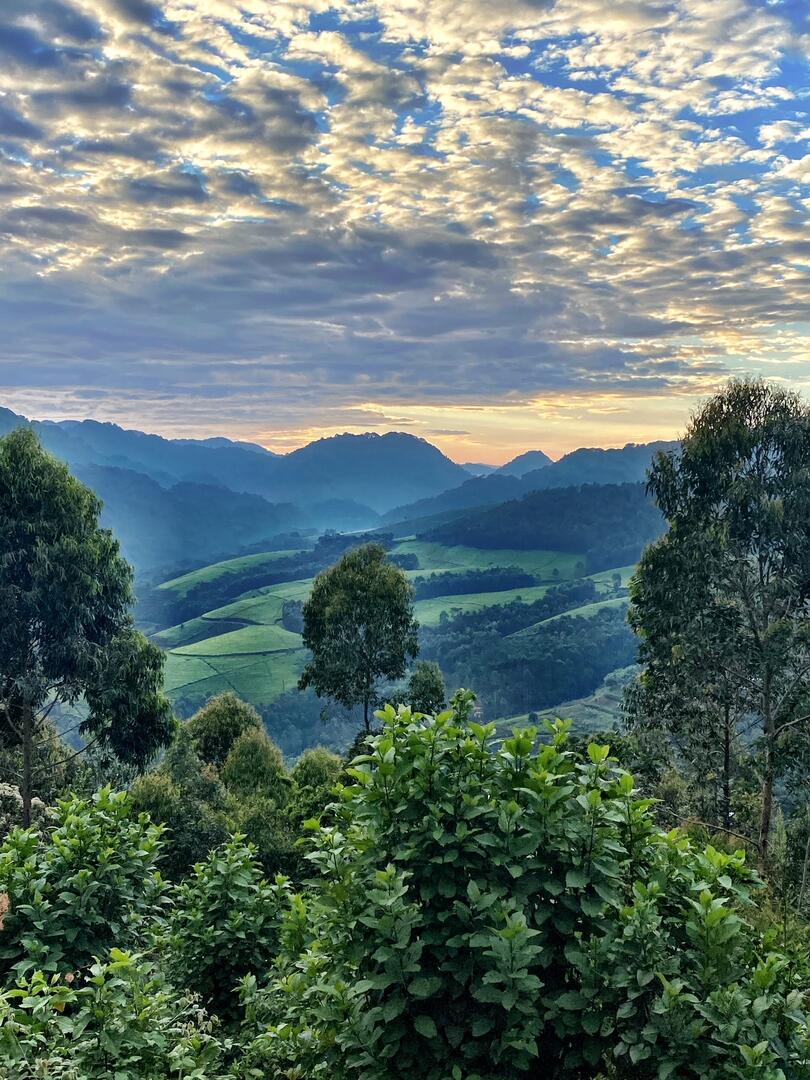
My balcony faced north toward an endless sea of mountains draped in tea plantations. Sitting on the veranda with a steaming cup of strong ginger tea, I watched small monkeys appear like uninvited breakfast guests. They seemed convinced that every tourist arrives carrying snacks specifically for them. Their disappointment when I refused to share was obvious.
After breakfast, I hired a local guide, who in turn recruited several sturdy gentlemen armed with machetes. Their mission was simple: keep us moving through terrain that seemed determined to keep humans out.
I would never venture into a place like this alone. Dense tropical forests have an alarming ability to make every direction look exactly the same. Besides, I am fairly certain that getting hopelessly lost in Nyungwe is not considered an approved tourist activity.
We parked along a dirt road and, without ceremony, stepped directly into the jungle.
Almost immediately, the forest swallowed us.
Vines and creepers formed tangled walls in every direction. Moisture dripped from leaves overhead, soaking us before we had gone more than a few hundred yards. Every step involved mud, roots, slippery rocks, or some combination of all three. I quickly realized this was going to be less of a leisurely nature walk and more of a full-scale jungle expedition.
The climb was relentless.
Every thirty minutes we stopped to catch our breath. The humidity was astonishing—worse than Houston on its worst day. The dense canopy blocked nearly all airflow, turning the forest into a giant green sauna.
Massive trees towered above us, some over 150 feet tall and more than 30 feet across. Standing beneath them, I found myself wondering how many generations of humans had come and gone while these giants remained exactly where they stood. Some were already old when Henry Stanley crossed central Africa more than 150 years ago.
More than 200 species of trees thrive here. My guide pointed out enormous African mahogany trees worth well over $100,000 each on the international market. Tree ferns rose from the forest floor like props from a 1950s dinosaur movie. Ebony trees, prized for their dark hardwood, seemed to appear everywhere.
The forest felt ancient.
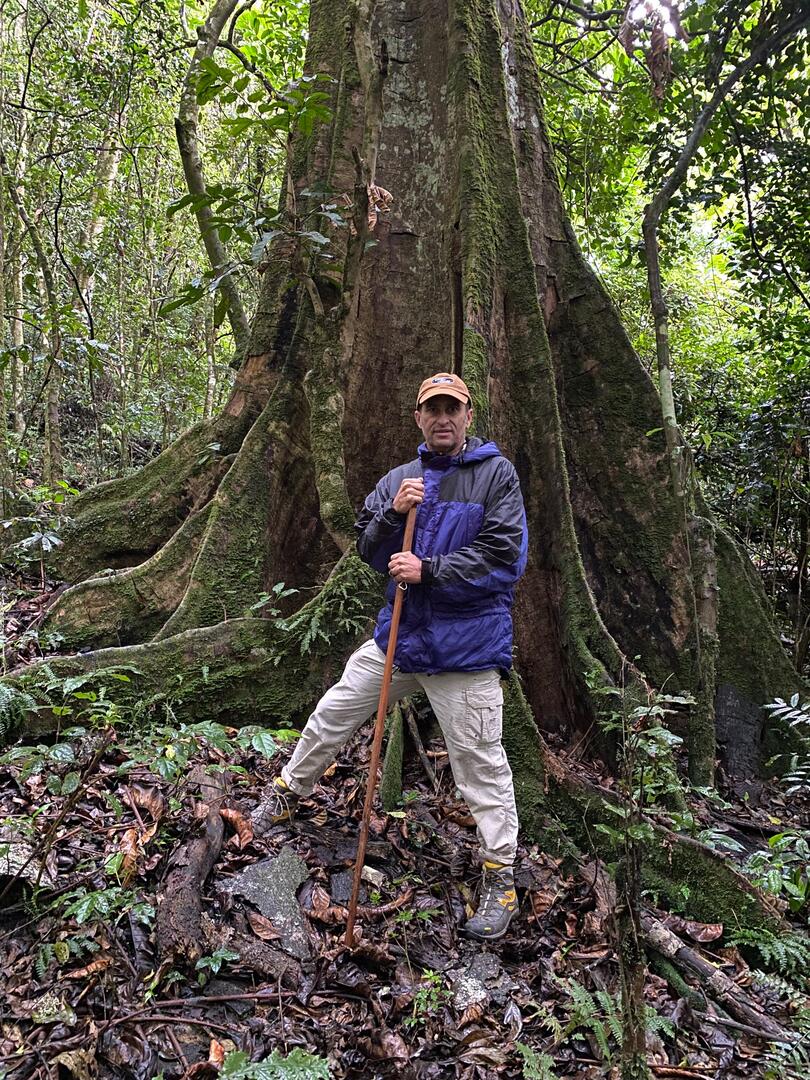
We continued climbing, slipping, sliding, and occasionally performing unintended acrobatics in the mud. At some point I abandoned my waterproof jacket. Remaining dry was impossible; the only question was whether I preferred rainwater or sweat.
Eventually my guide stopped and pointed toward what looked like a large bird’s nest tucked high in a tree.
“Chimpanzee nest,” he explained.
This one appeared abandoned, but it was proof that we were getting close.
Before continuing, my guide reviewed chimpanzee etiquette.
“Stay quiet. Don’t run. No sudden movements.”
Reasonable enough.
Then he added, “And don’t hit on their wives.”
Also reasonable.
As we pushed deeper into the jungle, we began hearing them.
At first it was a distant call. Then another answered. Then another.
The sounds echoed through the forest canopy—a series of warning calls known as “alert hoos.” One chimp would sound the alarm, then others would repeat it farther away until the message disappeared into the distance.
It was both fascinating and unnerving.
The realization slowly sank in: we were no longer searching for chimpanzees.
The chimpanzees were tracking us.
These were not zoo animals. These were completely wild primates capable of hunting, defending territory, and protecting their communities. They knew exactly where we were long before we had any idea where they were.
Eventually we reached a small clearing. My guide instructed me to sit down and remain absolutely silent.
So we waited.
One hour passed.
Then two.
The mud beneath me gradually soaked through my pants, creating what could generously be described as an uncomfortable seating arrangement. Yet I couldn’t have been happier. I was sitting deep inside an African rainforest waiting for wild chimpanzees to reveal themselves.
Then, almost magically, the forest came alive.
Chimpanzees were everywhere.
Somehow they had surrounded us without making a sound. They moved effortlessly through the canopy above. Mothers carried young through the treetops. Others rested in nests or foraged for food. A few descended to the ground and casually investigated the strange visitors sitting below.
Once they determined we posed no threat, they simply went about their daily lives.
For several unforgettable hours, I watched a society unfold around me.
One chimpanzee carried the remains of an unfortunate colobus monkey through the trees. Others attempted to claim a share, resulting in an impromptu tug-of-war that ended badly for the monkey and inconclusively for everyone else.
The forest’s other residents also appeared. Brilliant birds flashed through gaps in the canopy. Various monkey species paused to examine us, seemingly unsure what kind of strange creatures had wandered into their world.
Eventually my guide informed me that unless I intended to spend the night sleeping in a chimpanzee nest, we should probably begin our journey back.
Reluctantly, I agreed.
The return hike was easier, thanks to gravity and the path our machete-wielding companions had already cleared. As we emerged from the jungle and headed back toward civilization, I reflected on how fortunate I had been.
Few people ever experience truly wild chimpanzees in one of their last great strongholds. Fewer still get to sit quietly among them as they carry on with their lives, completely indifferent to human observers.
For one extraordinary day in Rwanda’s ancient forest, I was allowed a glimpse into their world.
It is a memory I suspect will stay with me forever.
.
.
Chasing Chimpanzees in Rwanda’s Ancient Forest
Copyright © 2026 by D. Jason Miller
All rights reserved. No part of this publication may be reproduced, distributed, or transmitted in any form or by any means, including photocopying, recording, or other electronic or mechanical methods, without the prior written permission of the publisher, except in the case of brief quotations embodied in critical reviews and certain other noncommercial uses permitted by copyright law.

