From The River Mapuera by D.Jason Miller
We’ve been stuck in Cachoeira Porteira longer than expected—one of those small, half-forgotten river towns that feels more like a dream than a place. It’s not somewhere you plan to stay; it’s somewhere you end up. Our little wooden barco is tied up along the muddy bank, rocking gently with the slow pull of the current, and everything hinges on a single piece of paper that hasn’t arrived yet. Permission to go north into Wai Wai territory. Out here, even deep in the Amazon, movement isn’t about distance—it’s about approval.
Time stretches in a strange way. The days don’t exactly drag, but they don’t move forward either. They just… sit.
By late morning, the heat is already overwhelming—thick, unmoving air that presses down on you like weight. It seeps into everything: your clothes, your skin, your thoughts. Sweat doesn’t evaporate; it soaks in the humidity. Most of the time we retreat to our hammocks, strung under the boat’s patched canopy, letting the fabric cradle us while we wait for the worst of it to pass. There’s not much else to do. Even conversation feels like effort.
The Trombetas River slides by beside us, wide and opaque, its brown surface giving nothing away. The forest on either side rises dense and unbroken, a wall of green that feels impenetrable. Every so often you hear something from within it—a crack of a branch, a distant call—but it’s never enough to reveal what’s there. The jungle doesn’t present itself. It stays just out of reach.
Evenings are the only real shift in the day. The heat loosens its grip slightly, enough to breathe a little easier, but it brings something else in its place—clouds of insects that seem to materialize all at once. They swarm the lights, cling to your arms, find every inch of exposed skin. You get used to brushing them away without thinking.
But this is when the town comes alive.
Music drifts across the water—sometimes a radio, sometimes something live. People gather along the riverbank, voices overlapping in easy conversation. Kids run barefoot through the dust and along the shallows, chasing each other, shouting, laughing. There’s a rhythm to it, something communal and unhurried. Food is shared, drinks passed around. For a few hours, the stillness of the day gives way to something warmer, more human.
Eventually, it fades. One by one, the lights go out, the voices quiet, and the jungle begins to reclaim the soundscape—frogs, insects, distant nocturnal calls. By midnight, it feels like the village has dissolved entirely.
Early mornings are my favorite. Before the sun climbs too high, the air feels almost light—cool enough to notice, quiet enough to think. The river is calmer then, or maybe it just seems that way. Fishermen push off in narrow boats, their silhouettes cutting across the water as they head upstream. Smoke rises in thin columns from cooking fires. There’s a sense of purpose to everything—small, steady movements that mark the start of another day.
It’s brief. Within an hour or two, the heat returns, and everything slows again.
After two days of waiting, we finally get word: we’re cleared to continue.
There’s no ceremony to it. Just a message passed along, a nod, and suddenly we’re moving again.
We head north, and not long after, the river begins to change. Technically, it becomes the Mapuera, though nothing about the transition is obvious on the surface. What you do notice is the current—it sharpens, tightens, starts to move with intention. The water grows louder.
This is where we leave the barco behind.
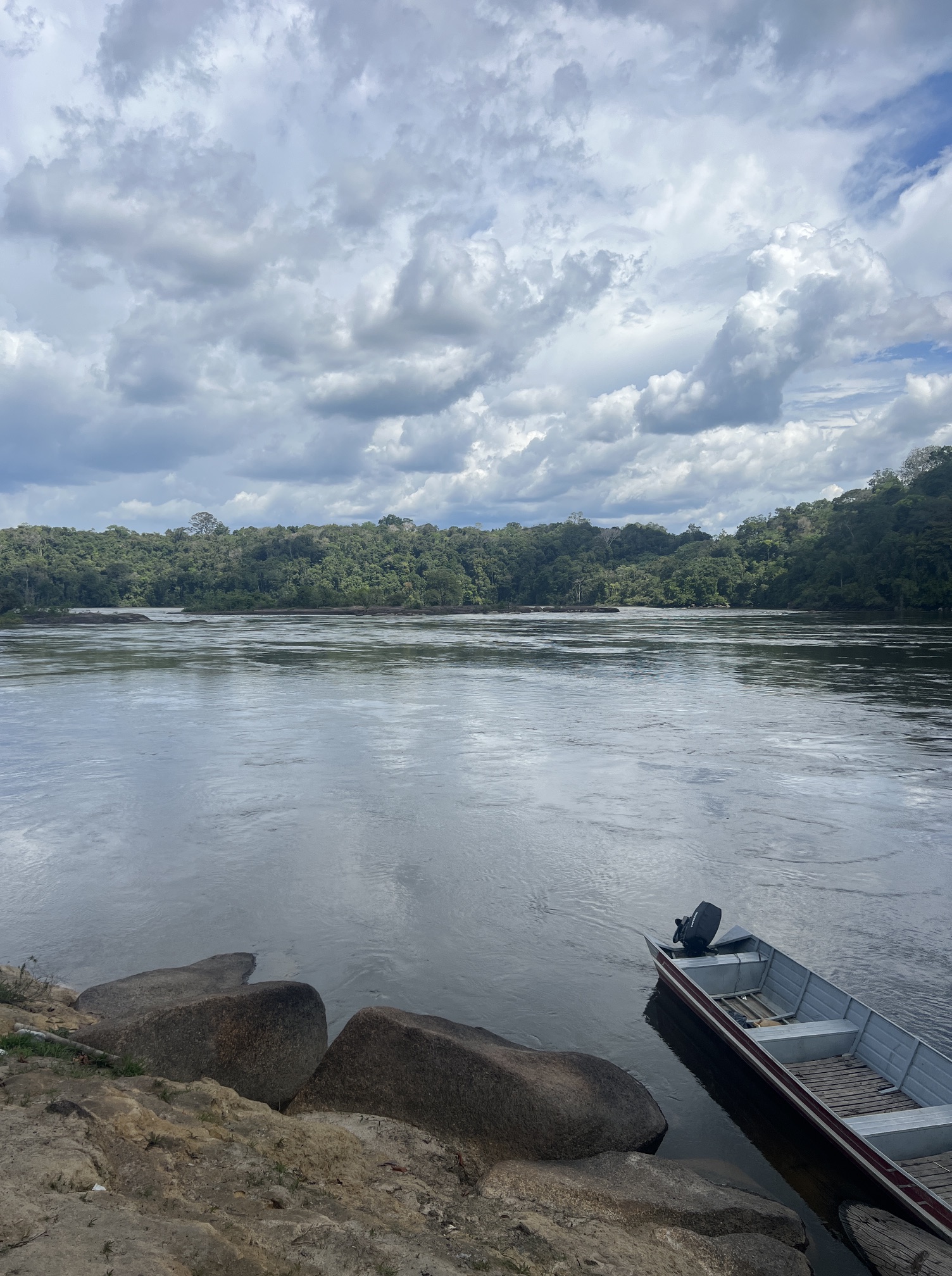
We transfer into long, narrow dugout canoes fitted with small outboard motors. They sit low in the water, unstable at first, every shift in weight noticeable. There’s no real room for error here.
The ride is immediate and relentless.
We hug the banks where the current is weaker, then suddenly cut across the river to avoid rougher channels. The driver stands at the back, reading the water in a way I can’t fully understand—subtle changes in texture, color, movement. In the rapids, we grab onto overhanging branches to steady ourselves while he scans ahead, choosing a line that seems invisible until we’re already committed to it.
Water crashes over the sides more than once. Within minutes, we’re soaked. It doesn’t matter. Nothing dries out here anyway.
And still, it’s stunning.
This stretch of river feels different—deeper, quieter, less touched. The forest crowds closer to the banks, thicker somehow, as if it’s been left alone longer. There are no signs of settlements, no boats passing, no distant sounds of engines. Just water, trees, and the occasional flash of movement along the shore.
You get the sense that very few people come this way.
We’re heading to one of the southernmost Wai Wai villages. I’ve spent time with different indigenous communities before, and it’s something I always look forward to—but there’s always a layer of uncertainty too. Not about the people, but about the experience as a whole. Especially when it comes to food. You don’t know what will be offered, and turning it down isn’t really an option. It becomes less about preference and more about respect.
The Wai Wai are known as skilled hunters, so I’m expecting a meal built around that.
There are only about 2,600 Wai Wai across this region of northern Brazil and Guyana. They’ve remained relatively isolated, and it shows—not just in how they live, but in how access is handled. Visits aren’t casual. You don’t just arrive. You need permission, an invitation, a reason to be there.
I’m here as part of a project—helping with a census connected to a clean water initiative. It’s work that’s opened doors, made repeat visits possible. Still, being allowed in feels like something that could just as easily not happen.
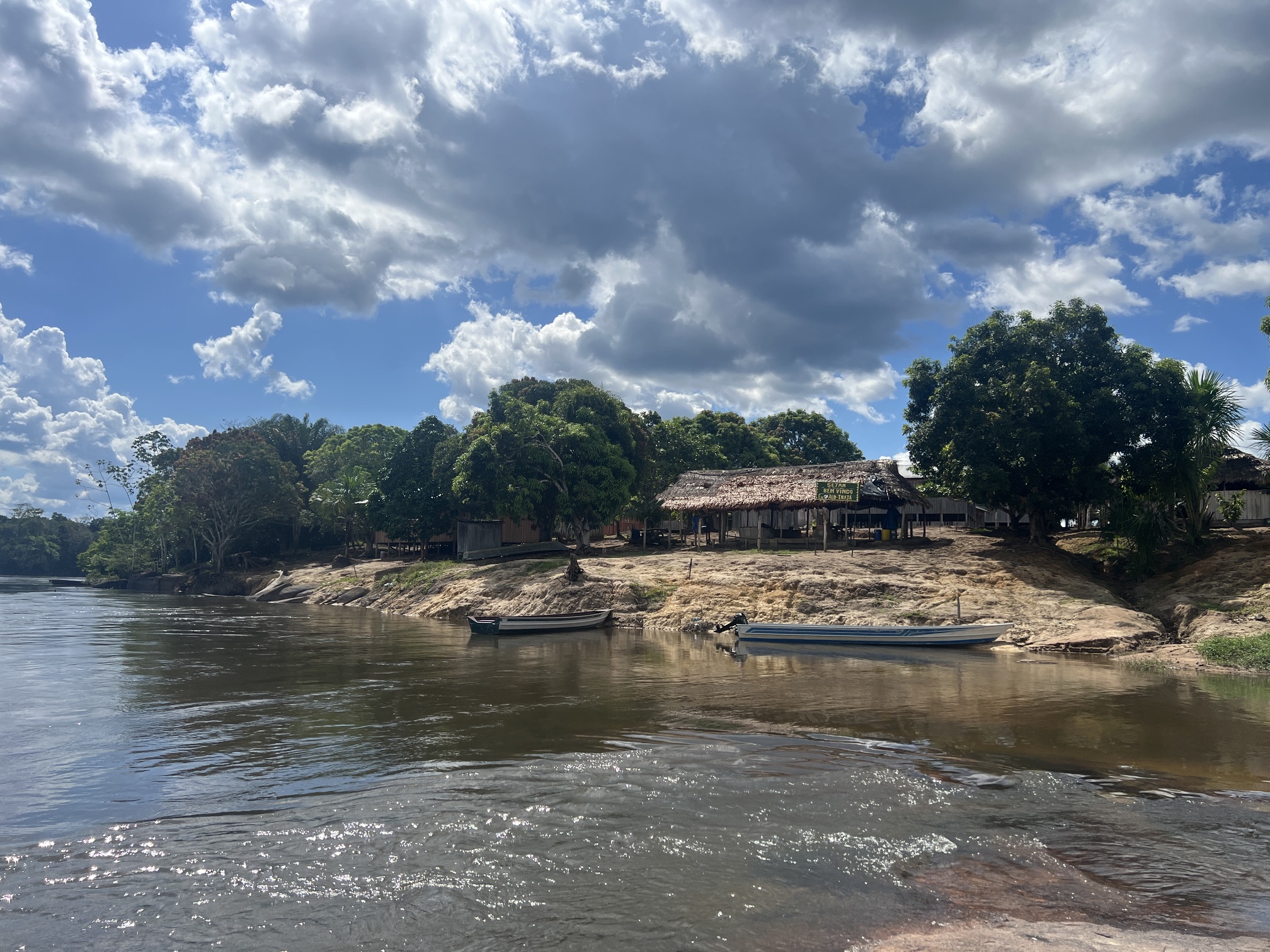
When we finally reach the village, it doesn’t announce itself. It reveals itself slowly as we round a bend in the river—a clearing carved out of the forest, a handful of structures, movement along the bank.
People are already waiting.
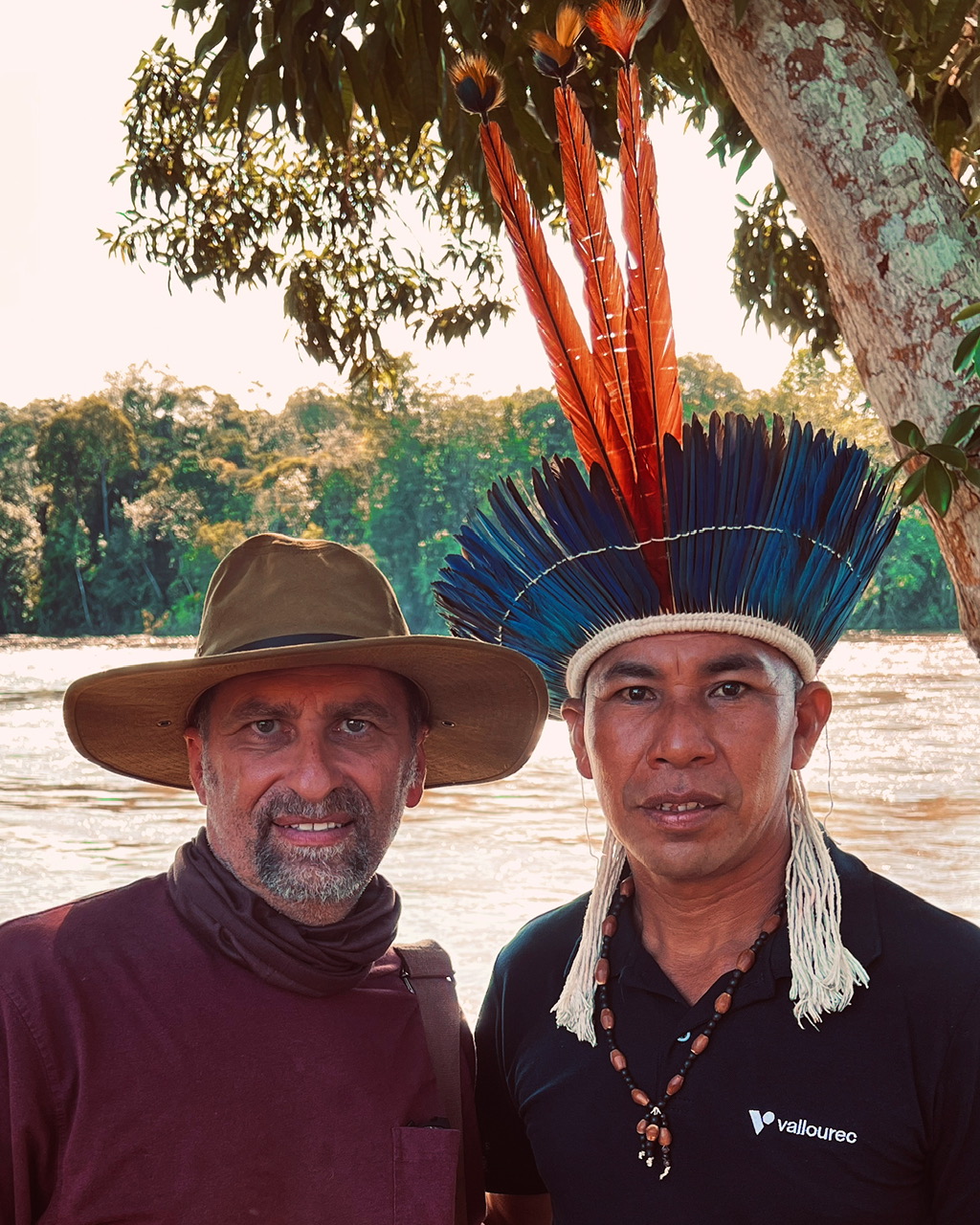
A man stands near the water wearing a bright blue feathered headdress, the color striking against the muted tones of the river and trees. Around him, children gather, watching us approach with open curiosity.
As we get closer, the kids don’t hesitate. They wade straight into the water, laughing, grabbing onto the canoe, pulling us toward shore. There’s no distance, no caution—just energy.
It’s an unexpectedly warm welcome.
From there, everything accelerates. Music starts—rhythmic, steady. There’s dancing, movement, people guiding us toward a large circular structure at the center of the village. It’s open on all sides, supported by wooden beams, with a wide thatched roof overhead. The space feels communal, lived-in, important.
Inside, there’s a constant hum of activity. People move in and out, talking, smiling, watching without staring. There’s curiosity, but it’s relaxed. No pressure, no performance. I’m free to walk, to observe, to take things in at my own pace.
Down by the river, I find where the meal is being prepared.
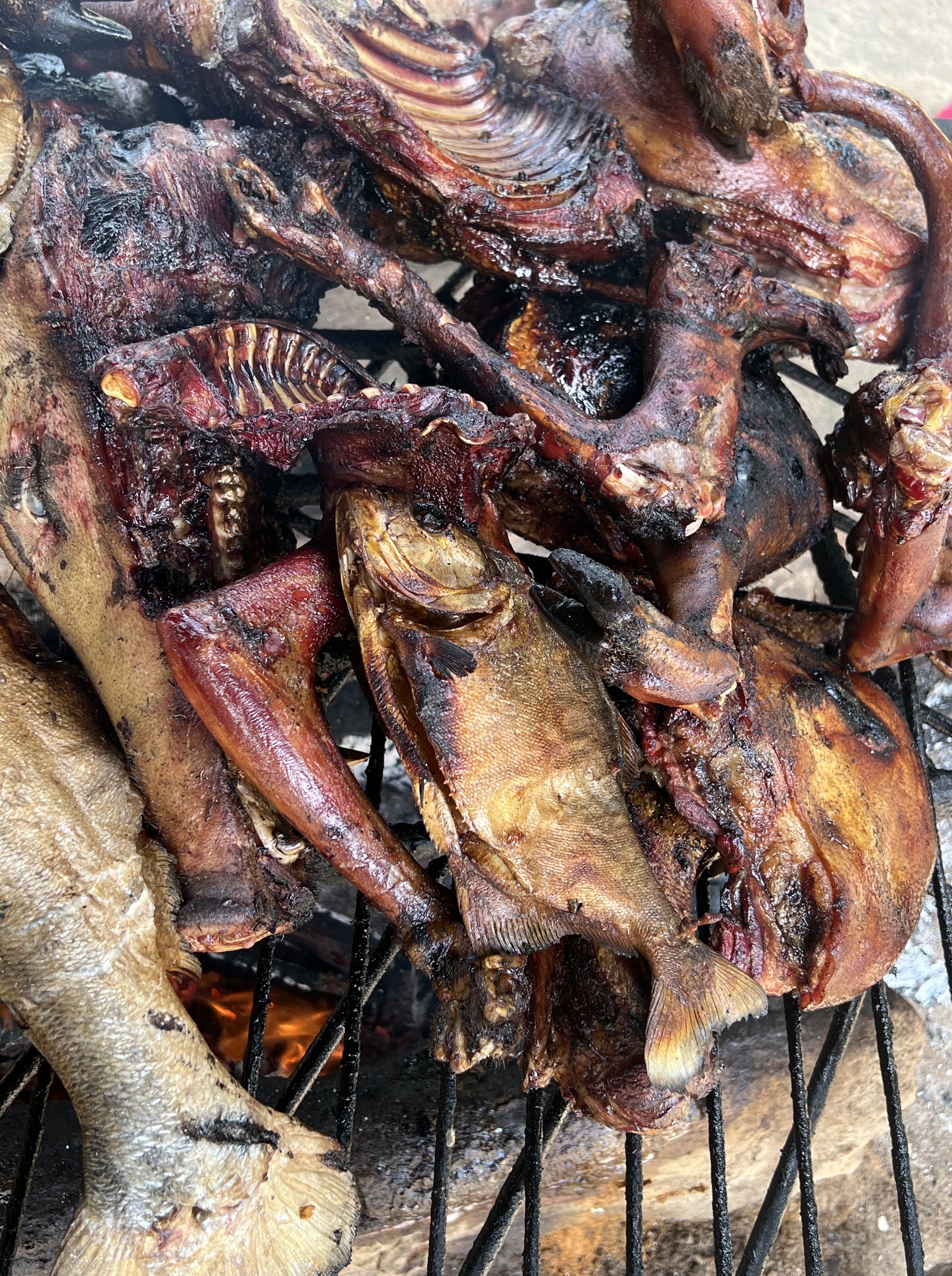
A fire burns low and steady beneath a large metal grate, and on top of it is a dense pile of meat—easily three feet high. At first, it’s hard to make sense of what I’m looking at. Everything is darkened, layered, obscured by smoke and heat.
But as I look closer, details emerge.
Fish. Sections of wild pig. Caiman. And monkeys—whole ones, their forms unmistakable once you notice them. At one point, a tail curls upward from the pile, stiff from the heat.
It’s a lot to process, but there’s no reaction from anyone around it. This is normal. Practical. Necessary.
Everything cooks together, slowly smoking, blackening. There’s no visible seasoning, no separation—just fire, time, and technique. Nearby, a woman works quietly, pressing and flipping thin rounds of corn-based flatbread over another heat source, her movements precise and practiced.
When the food is ready, everyone gathers back inside the main structure.
We sit in a wide circle, the space filling quickly. The food is placed in the center, and for a moment, everything settles.
As the guest, I’m invited to go first.
There’s a brief pause where I register the weight of the moment—and then I just move. I take a portion, something manageable, and give it a try.
The taste is dominated by smoke, by the intensity of the cooking process. It’s uniform in a way—different meats, but similar outcome. It’s not unpleasant, just unfamiliar.
But more than that, it’s symbolic.
I eat enough to show respect. No one is watching closely anyway. The focus is collective—people talking, laughing, sharing. The energy in the space builds again, light and communal. This isn’t about the food alone—it’s about the act of gathering around it.
And that’s what stays with me.
The sense of connection, of effort shared and enjoyed together.
I spend some time walking through the village afterward, noticing details I missed before. The layout of the structures, the tools, the quiet interactions between people. There’s a simplicity to it, but not in a lacking way—in a complete way. Everything has a place, a function, a reason.
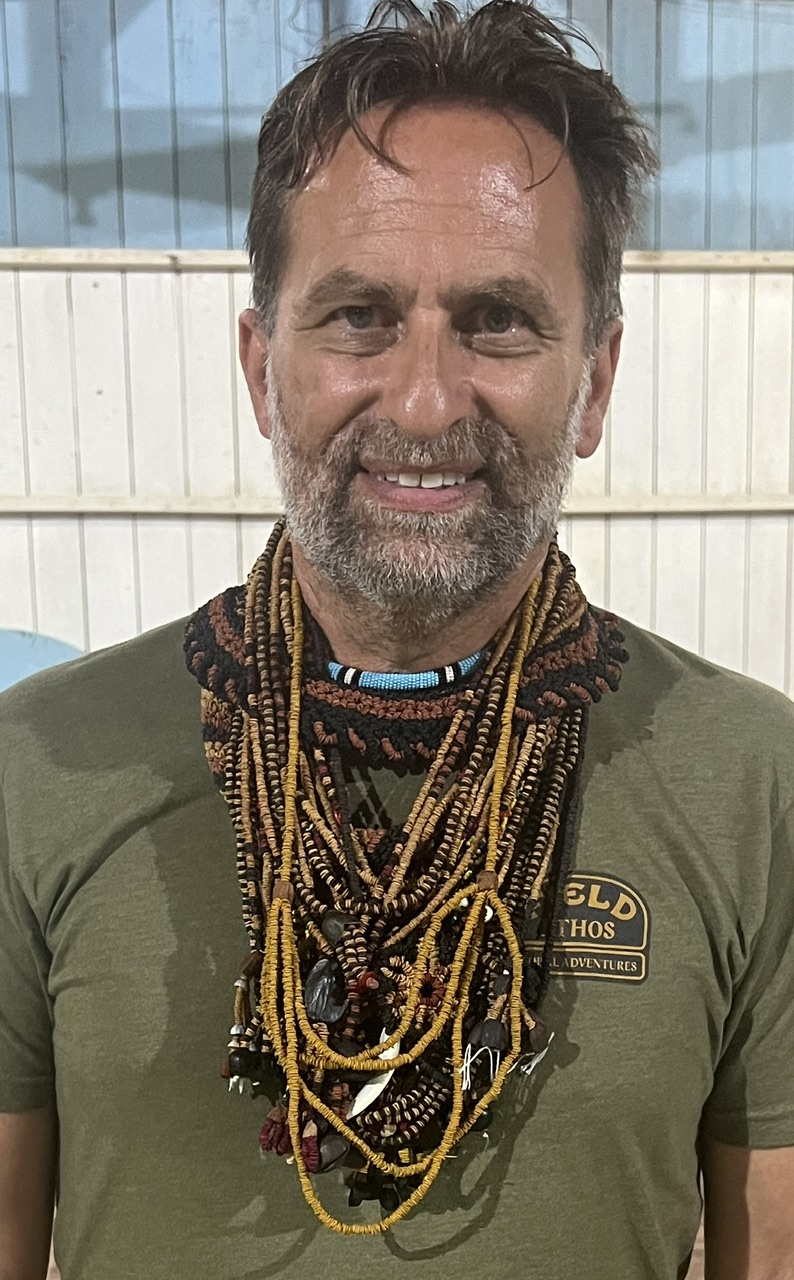
Nothing feels excessive. Nothing feels missing.
But my time there is limited. Permission only extends for the day, and before long, it’s time to leave.
We head back the way we came, retracing the river’s twists and turns, navigating the same rapids now with a bit more familiarity. The journey feels shorter this time, though just as physical.
By nightfall, we’re back on the barco.
I sit there with a simple meal—rice, a cold Coke pulled from the cooler—and watch the river move in the dark. Somewhere upstream, maybe twenty miles away, the village carries on in its own rhythm, unchanged by our brief presence.
It’s a strange contrast.
Not better. Not worse.
Just different.
And for a short time, I was allowed to step into it—and then step back out again and over the next few years was fortunate enough to work very closely with the Wai Wai and visit each of their villages extensively.
.
.
Guest of the Wai Wai
Copyright © 2026 by D.Jason Miller
All rights reserved. No part of this publication may be reproduced, distributed, or transmitted in any form or by any means, including photocopying, recording, or other electronic or mechanical methods, without the prior written permission of the publisher, except in the case of brief quotations embodied in critical reviews and certain other noncommercial uses permitted by copyright law.

