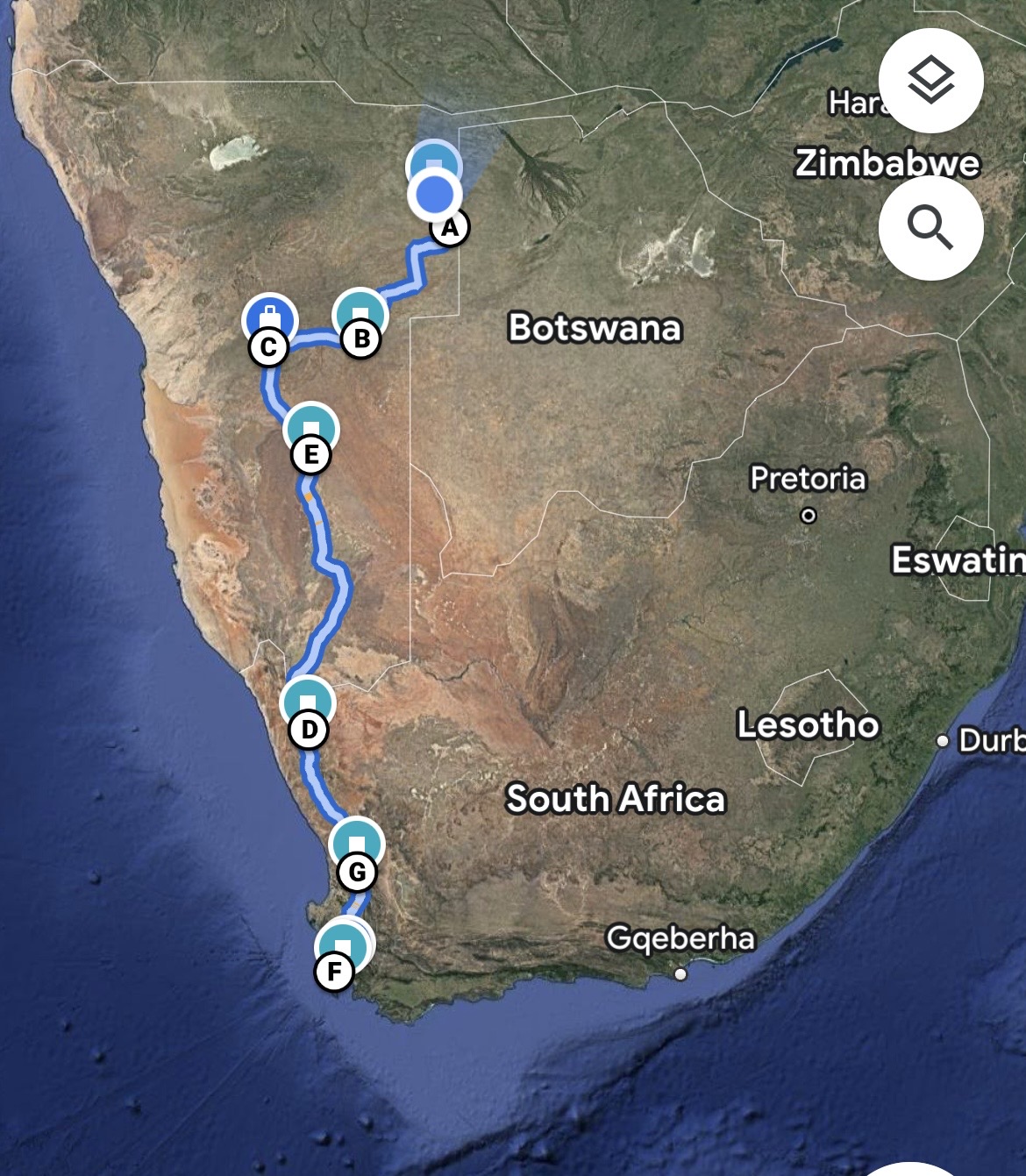
August 2023 – First part of the journey
There are men who are driven to test the endurance of their bodies and minds, and the way they may choose to do this in unimportant and often foolhardy, but the real truth of that they do is they must prove themselves able to do it. An unknown gentleman with the last name of Lund ventured out of Capetown in 1905 under much different circumstances to travel overland to Cairo. What drove this man do take on such a dangerous adventure? Perhaps the same desire to prove to himself simply that he could do it. He wound his way through the bush, month after month until being separated from his guides and team of porters. While suffering from the grip of Malaria on the side of the path a chance meeting with another explorer by the name of John Jordon took place.
John offered food, and quinine to help the Malaria but Lund declined additional help and to join John on his journey stating that his men should be along shortly. Reluctantly John left Lund on the side of the path. Later in life John describing Lund as a man refusing a lift in your car because a bus would be along soon. Lund made it as far as the Lado area of modern-day Uganda where he died.
Ewart Grogan was the first man to have recording the journey of successfully traveling overland from the Cape to Cairo. At the age of 24 he left Cape town traveling two and half years to arrive in Cairo Egypt in 1900. His journey was an epic adventure probably best read from his own account “The Nile As I Saw it” published in 1905.
My journey from Cape to Cairo was stirred in my spirit over the last 25 years by reading of the earlier account of Adventures and Explorers, of course today I can drive across instead of walk and after traveling extensively in Africa in a Land Rover or automobile decided for speed and safety a motorcycle would be the best form of transportation.
Today the journey begins — a trip that has spent 20 years living rent-free in my imagination has finally been released into the wild. Whether this adventure ends in triumph, disaster, or an expensive lesson ditching a motorcycle and flying home, there’s no turning back now.
The first leg, from Colorado Springs to Atlanta, immediately decided to set the tone. Hurricane storms were sweeping across Atlanta ahead of our arrival, so instead of a graceful descent, we were sent wandering over Tennessee. After 45 minutes of circling, the pilot gave landing a sporting attempt before abruptly deciding, at the very last second, that perhaps survival was the better option.
Thus, I experienced my second-ever aborted landing and “go around” on a commercial flight — always exciting when the engines suddenly roar back to life just as you’ve mentally committed to the runway. We bounced through stormy turbulence for another lap around the airport before finally landing safely from a different heading, with only mildly elevated blood pressure and a renewed respect for people who do this for a living.
My primary concern during all this aerial improvisation was missing my connecting flight: the Delta Air Lines direct to Cape Town — a 15-hour serpentine crawl that somehow manages to thread the exact middle of the Atlantic Ocean the entire way south. Looking at the flight map, it appeared the pilot had discovered the one route guaranteed to maximize the amount of water beneath us at all times.
Fortunately, the same storm system wreaking havoc on my nerves had also delayed the connecting flight. Against the usual laws of airline travel, I made the connection with minutes to spare, and even more miraculously, my luggage made it too. At that point, I considered the trip an operational success.
Many months of planning had already gone into this journey, though in hindsight, “planning” may have been a generous term for what was essentially a series of increasingly questionable decisions made with confidence.
I purchased the motorcycle — a Kawasaki KLR 650 — online from what I was assured was a reputable seller. To be fair, the seller himself confirmed he was reputable, which apparently satisfied my due diligence requirements at the time.
I happened to be working in Kenya when I found the bike listed in the classifieds and contacted him. His response had all the comforting urgency of a minor hostage negotiation: “I have a lot of interest in the motorcycle and if you are interested you must wire the money ASAP.” I explained that I was overseas for work and couldn’t access my bank until returning home. Generously — or strategically — he agreed to hold the bike.
In the meantime, he mentioned that he was also a local motorcycle mechanic and could customize the bike specifically for my journey, which sounded incredibly convenient and only slightly suspicious. After conducting several minutes of highly professional internet research, I confidently concluded that everything was perfectly safe and proceeded accordingly.
Over the following weeks, this gentleman and I exchanged countless messages about how best to prepare the bike for such an ambitious journey. I made requests; he made suggestions; together we spent money with the confidence of two men who would never have to explain any of this to an accountant. Spare tires, pannier boxes, tools, center stand — every rugged adventure accessory short of a mounted harpoon seemed to make the list.
He assured me I could pay for the motorcycle once I returned home, and settle the cost of the upgrades when I arrived in Cape Town. He also explained that South Africa would not allow a foreigner to register a vehicle locally, so he would handle the paperwork necessary for crossing multiple international borders. At the time, this sounded wonderfully helpful and not at all like the opening chapter of a cautionary documentary.
I promptly wired payment for the motorcycle and requested a bill of sale, which somehow never quite materialized. Still, I did possess a copy of the wire transfer information — the financial equivalent of keeping a napkin receipt and calling it legal protection.
Undeterred, we spent the next several exciting weeks discussing upgrades and modifications for the motorcycle, my imagination racing far ahead toward dusty roads, distant borders, and the kind of adventure that always sounds more romantic before it actually begins.
I then began the genuinely entertaining task of mapping the route and planning the journey — researching insurance, permits, permissions, visas, and the countless tiny bureaucratic details capable of ruining an otherwise glorious trip at a border crossing somewhere far from civilization. Adventure travel, it turns out, is roughly 30% exploration and 70% paperwork.
Not long after making the first payment, I received another message from the seller while I was still working in Kenya. He explained that in order to purchase the additional equipment and begin work immediately, I should wire the remaining balance as soon as possible.
RED FLAG.
Not a subtle one either — more the kind waved frantically by a man standing beside a burning vehicle. I expressed my concerns and felt, deep in my gut, that I might be making a serious mistake. Unfortunately, by this point the flights were booked, plans were in motion, and common sense was losing ground to momentum.
I once again requested a bill of sale along with an itemized list of the agreed-upon upgrades and prices. A few days later, the documents finally arrived via email, followed almost immediately by renewed requests for the wire transfer. Soon my phone filled with photos of motorcycle parts, accessories, and ambitious plans for the bike — clearly designed to keep my excitement high and my skepticism sedated.
Eventually, against the better judgment that had been trying desperately to intervene, I relented and wired the remaining balance.
June, July, and August drifted by with remarkably few updates from the motorcycle front. Shockingly, the man who eagerly accepted multiple wire transfers was suddenly less enthusiastic about communication.
Whenever I asked for progress photos or updates, I was assured the bike would be finished “tomorrow” or that work would definitely begin “Monday.” In fairness, he did send photos — tires, pannier boxes, tools, assorted motorcycle parts — just never any of those items actually attached to the motorcycle itself. A small but increasingly significant detail.
Meanwhile, I stayed busy planning the trip and preparing work for my absence, so time slipped away faster than my remaining confidence. Before long, departure was only a week away. I was repeatedly assured everything would be completed in time and that I would be able to leave immediately upon arriving in Cape Town. He even offered to pick me up from the airport, which at the time felt reassuring rather than ominous.
Then, on the Sunday before my departure, I received a text explaining that none of the paperwork would be complete and asking whether some local friends of mine could step in to help sort things out.
At this point, I finally lost what remained of my composure.
I reminded him — in terms considerably less diplomatic than these — that I had relied entirely on his supposed expertise to manage the paperwork and logistics. I demanded that he step up and honor his word. We could sort out the remaining details once I arrived, but with my already tight schedule, I insisted the motorcycle be fully ready for departure the morning after I landed.
Nothing says “adventure” quite like beginning the trip with a near nervous breakdown before even reaching the continent.
I arrived on Tuesday evening, checked into my room in Cape Town, and arranged to be picked up the following morning.
What I discovered on arrival home, however, landed somewhere between disappointment and disbelief: nothing had been done to the motorcycle. Not a single upgrade. No spare tires, no tools, no pannier boxes — not even the comforting illusion of progress. Just the original bike sitting there like it had been waiting for this conversation the entire time.
Before we could even process that, we had to stop at a police station to sort out paperwork on the way to his home, which, somewhat miraculously, went off without incident. From there, we launched into emergency-mode logistics: calling friends, welders, anyone who might be able to fabricate or source the missing pieces so I could still get on the road.
Those calls, unsurprisingly, produced very little beyond polite sympathy and vague promises. No sudden garage miracles materialized. No heroic last-minute fabrication saved the day.
At some point, pragmatism finally overtook optimism. I made the decision to cut my losses and proceed with what I had, rather than what I had paid for. The upgrades, tools, and “planned essentials” would remain firmly in the realm of theoretical motorcycle travel — purchased, discussed, and never actually installed.
Other than the logistical chaos, we actually did hit it off. He began to show genuine concern for my route and the trip ahead, even admitting at one point that he had assumed I would never actually show up. Apparently, many people dream about these kinds of journeys and very few ever turn them into something more than enthusiastic conversation. Fair enough — I suppose I was now statistically interesting.
Regardless, I was there, the bike was what it was, and I had a deadline: the shores of Lake Malawi in two weeks’ time.
So I did the only thing left to do — I loaded up my gear, filled the tank, and added my “auxiliary fuel system,” which consisted of a reused 5-liter plastic oil container. Not quite the crash-bar mounted fuel solution I had paid for, but it did technically hold liquid and optimism in roughly equal measure.
With that, I hit the road.
And at that point, mentally at least, I was done with the seller. From here on out, the story belonged to the journey.
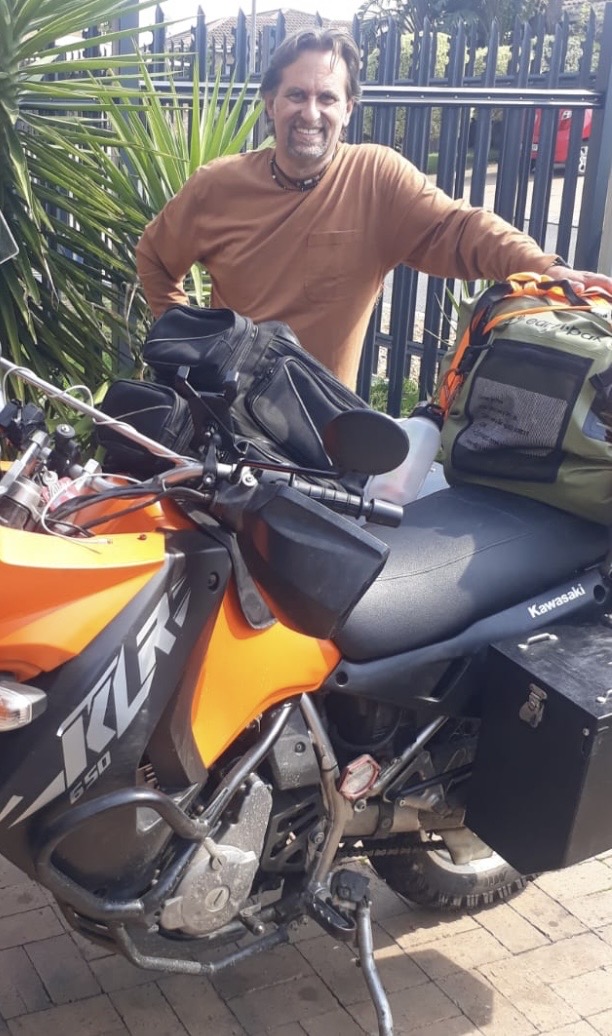
I wasn’t used to something this heavy beneath me — most of my riding life had been spent on small European vintage bikes. This, by contrast, felt like steering a determined refrigerator. I wobbled my way westbound along the M15 (Cape Town), aiming to connect with the M7 (Cape Town) northbound through the edges of the city.
Traffic was mercifully light for a midday run, a rare kindness from a place that usually prefers to keep you politely trapped in place. Still, I found myself impatient — not with the road, but with the city itself, as if it were a long introduction I was ready to skip ahead of. I wanted open space, wind, distance; the beginning of the northern stretches of Northern Cape pulling me forward like a promise.
It was winter in the southern hemisphere, and the air carried that crisp clarity only colder climates manage to produce — clean, sharp, and slightly humbling. I was grateful for my heavy leather jacket and gloves, which suddenly felt less like gear and more like basic survival equipment.
To my left, the great Table Mountain loomed through a shifting veil of fog, its flat summit half-swallowed by cloud like a thought not fully formed. The city stretched beneath it in layered grays and muted blues, gradually dissolving behind me as I moved outward.
And then, almost without ceremony, the urban sprawl began to loosen its grip. Buildings thinned, roads opened, and the rhythm of the ride changed — slower in traffic, but wider in meaning. I was finally beginning to leave the city behind, trading concrete for horizon.
The motorcycle actually handled better than expected, settling into a steady rhythm as we moved through a stretch of road construction that had everyone cruising at a calm 80 km/h. Not exactly the pace of legends, but perfect for me — a chance to get acquainted with the machine and how it behaved fully loaded down the way I had it. Everything felt deliberate: the weight shifting slightly with every lane change, the suspension working a little harder than it probably wanted to, and me sitting on top of it all like a cautious passenger in my own decision-making process.
I was also hyper-diligent — partly from respect for the unknown machine beneath me, and partly because I had only landed the night before in Cape Town, and jet lag was doing its best impression of mild cognitive interference. Every movement felt slightly delayed, like my reactions were arriving half a second after reality had already moved on.
That’s probably why the first mishap came early.
Without much warning, my right-hand pannier box worked itself loose, then detached completely and crashed onto the road, skidding and bouncing across a single-lane stretch of highway traffic. For a moment it was just there — an absurd piece of my journey now traveling independently at highway speed.
To the credit of the drivers behind me, they reacted quickly, swerving around it as it ricocheted down the lane. In a different set of circumstances, it could have easily become something far worse than an expensive inconvenience.
Because of the ongoing roadworks, there was no proper shoulder to pull off onto, so I eased the bike as far left as I could and then sprinted back along the edge of the road to retrieve it, acutely aware that my “adventure” had now briefly turned into a roadside obstacle course.
Getting it back on the bike was its own challenge. I burned my hand on the exhaust in the process — a small but immediate reminder that motorcycles have no sympathy for enthusiasm. Eventually I managed to get it somewhat reattached, though it was clear it was not going to stay put without supervision.
So I did the only sensible thing left: I awkwardly placed it on my lap and rode forward like that, looking for a safer spot to properly sort it out.
Eventually I pulled over, reset everything from scratch, and this time secured it with straps — not trusting fasteners, physics, or optimism any longer than necessary.
I didn’t have any real goal for the day beyond simply riding — getting reacquainted with the bike, the weight of it, and the rhythm of long-distance travel again. No deadlines, no urgency, just movement.
The countryside unfolded in a way that made it easy to forgive the earlier chaos. It had been a wet winter in South Africa, and everything seemed to carry that after-rain richness — fields were vivid and green, trees full and heavy with life, the air itself almost fragrant as it passed through open windows in my helmet.
The grassy hills rolling alongside the highway had a familiar softness to them, something reminiscent of the California Central Coast in spring — that same mix of green slopes, open space, and a quiet sense that the land is still breathing after the rains.
As I continued north, the road began to wander closer to the coastline before drifting inland again, like it couldn’t quite decide whether it belonged to the ocean or the interior. With each approach toward the sea, I could feel the air change — cooler, heavier, carrying that faint salt sharpness that signals proximity to the Atlantic.
The skies followed suit, turning softer and more overcast, the light diffused and muted in a way that made everything feel slightly slower, more reflective. It wasn’t dramatic weather — just a steady atmospheric shift, the kind you only notice when you’ve been riding long enough for the landscape to start speaking in transitions rather than landmarks.
Passing through Piketberg just before Citrusdal, the landscape began to tighten and rise in a way that felt strangely familiar — a long escarpment climb not unlike the approaches into the Great Rift Valley west of Nairobi. The road didn’t just ascend so much as it gathered itself, folding upward into a series of deliberate bends and steepening gradients.
Trucks were strung out along the climb like slow-moving markers of gravity’s authority, engines working hard, heat shimmering faintly behind them. In contrast, the 650cc beneath me — modest on paper, but willing when asked — pulled cleanly up the grade. There was a satisfying simplicity to it: throttle, lean, hold the line, repeat. Each overtake felt like a small negotiation between patience and momentum.
As the road wound higher, the scenery began to open in sweeping arcs. The mountains didn’t feel distant; they felt arranged around the road, as if the route had been drawn through them rather than carved into them. The air grew clearer, the light more textured, shadows stretching across rock faces in long, slow gradients.
This was the edge of the Cederberg Wilderness Area — a place where the terrain starts to feel older than the idea of roads themselves. The curves tightened and loosened in rhythm, each one revealing another angle of rugged ridgelines and folded stone.
It was, in every sense, a beautiful climb — not dramatic in a forced way, but steady and expansive, the kind of riding where the landscape does most of the talking and you mostly just try to keep up.
By this point, the accumulated excitement, frustration, and general sensory overload of the past 36 hours had started to catch up with me. I was tired in that very specific way that comes from too much novelty in too short a time — where even simple decisions start to feel oddly heavy. So I began looking for a place to stop for the night as the next town, Clanwilliam, came into view ahead.
I rolled into town just as the sun was beginning its slow descent, casting that warm, low-angle light that makes everything look calmer than it probably is. Oddly, for a sleepy-looking place, there was a surprising amount of traffic and movement — a kind of quiet bustle that didn’t match the size of the town.
I stopped at the first guesthouse I could find, only to be told everything was fully booked. According to the owner, the entire town was likely full due to a flower show event. It was the kind of detail that feels almost fictional when you hear it at the worst possible time. After everything that had already gone wrong and sideways, it was hard not to laugh at the timing — first day on the road, jet lag still clinging to me, unfamiliar bike beneath me, and now apparently a town-wide accommodation shortage.
I tried a second option on the outskirts, but couldn’t even locate it properly as daylight began to fade faster than my patience. The light dropped quickly, shadows stretching long across the road, and I found myself increasingly aware that I really did not want to be riding unfamiliar roads in the dark on day one. Exhaustion was setting in fully now — not dramatic, just persistent and dull, the kind that narrows your world down to immediate survival and basic comfort.
Circling back through town, I happened to pass the Clanwilliam Lodge — a restored historic government building converted into a boutique hotel. It stood out immediately, both for its presence and for the simple fact that it still had lights on and doors open.
That moment felt like landing after a long day of bad weather and worse timing. I checked in without hesitation.
Once inside, everything softened quickly: a shower, a proper meal, and then the quiet return downstairs to check on the bike. Oil levels, fasteners, general condition — the small rituals that suddenly matter a lot more when you’re alone on the road and everything you own is strapped to a machine outside. Day one had been enough of a test.
Of course, I dropped off to sleep early and was wide awake at 2:00 a.m. My mind immediately began its restless arithmetic — miles to cover, hours on the road, weather, road conditions — all circling around the day’s objective: Nkotakota, stretched quietly along the shores of Lake Malawi. Sleep never really stood a chance after that.
Finally, daylight began to bleed across the horizon and I quickly dressed before heading down to top up the bike with oil and fuel for the day’s ride. Breakfast brought the usual mix of strong coffee, road talk, and chance encounters — a few welcoming locals and several fellow travelers passing through from different directions. One of my favorite parts of life on the road is meeting other travelers; they are almost always the most interesting people, carrying the best stories.
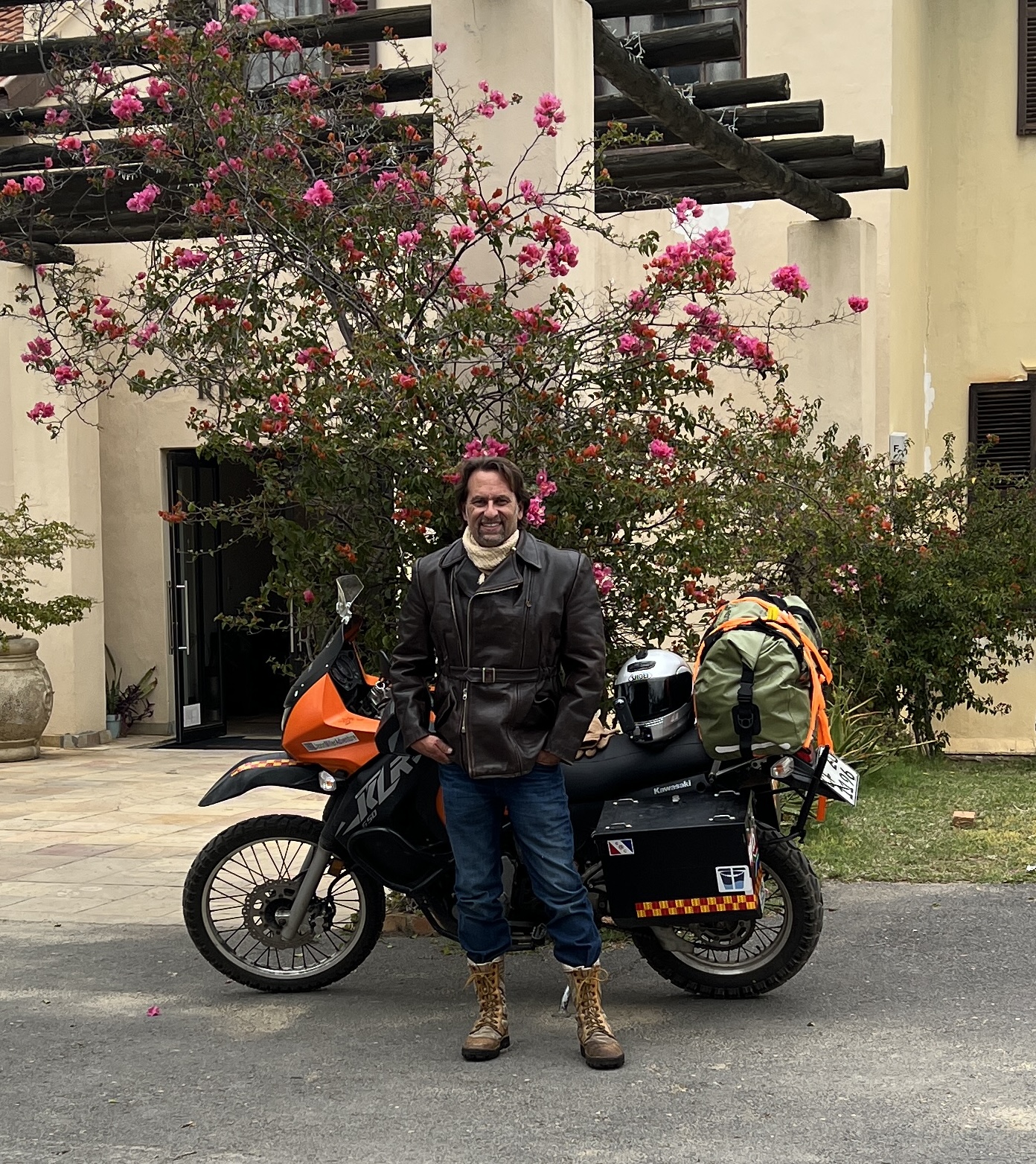
One couple, heading south while I pushed north, overheard me asking a local gentleman about a quieter route off the beaten track. They immediately chimed in, saying they had just come from that very road and strongly recommended it — a beautiful dirt track winding alongside the river that feeds the Clanwilliam Dam.
Once packed, I said my farewells and pointed the bike north-east out of Clanwilliam along the R363. As much as I wanted to make good time heading north, I also wanted to slow down, absorb the scenery, and stay far away from the main highways.
I don’t believe I saw another person along the R363. The road runs quietly beside the Olifants River, winding through long gentle curves lined with towering eucalyptus trees, vast farms, and endless orchards. Gravel stretched beneath the tires for most of the route, though every so often patches of loose sand would suddenly demand my full attention.
The motorcycle was heavy — weighed down with gear, fuel, and the small comforts of long-distance travel — and it became increasingly clear that my riding skills would need to evolve quickly. Until now, most of my experience had been on road motorcycles and pavement. Dirt, gravel, and sand were beginning to teach their lessons one kilometer at a time.
The R363 eventually came to an end, reconnecting with the main highway near Klawer. Although the detour had probably cost me a couple of hours, it never once felt wasted. The solitude, the river valley, and the slow rhythm of that gravel road had been worth every extra kilometer.
As I continued north, the landscape began to change. Heavy clouds rolled in from the north-east, swallowing the blue sky that had followed me through most of the morning. The air turned sharp and cold, and with every passing mile the temperature seemed to fall another degree. Despite wearing a thick leather jacket, denim jeans, and leather gloves, the cold slowly worked its way through every layer. My hands stiffened on the handlebars and the wind found every small gap in my gear.
Today’s goal was Okiep, a small mining town not far from the border between South Africa and Namibia. The plan was simple: reach Okiep before nightfall, get a proper night’s rest, and be ready to cross the border early the next morning before the long road north truly began.
I rolled into Okiep late in the afternoon already knowing where I intended to stay. Cold, tired, and stiff from the day’s ride, I pulled into the compound only to discover that, once again, the place was completely booked due to a motorcycle event happening the following day. It seemed almost unbelievable — midweek, off-season, in a tiny town in the far north of South Africa, and still there wasn’t a room to be found.
The staff kindly offered me a meal in the restaurant after hearing I hadn’t eaten all day, and gently explained that my only real option for accommodation would be to head back south to Springbok. This time I decided not to leave it to chance. Sitting there in my riding gear, still chilled to the bone, I called ahead and eventually found a room at a quaint little place called Kliprand Guest House.
By then the weather had deteriorated badly. Rain began to fall as I rode toward Springbok, but the temperature had dropped so low it felt closer to ice than rain. The cold cut straight through my gear. My gloves were soaked, my hands numb, and I found myself shivering uncontrollably by the time I arrived.
I checked in quickly and went straight for a scalding hot shower, standing under the water far longer than necessary just trying to feel human again. The room itself offered little warmth and I could not find any kind of heater, so I climbed into bed fully exhausted, burying myself beneath the blankets until sleep finally took over. I woke briefly later that evening, thought about finding dinner, then decided against it. Staying warm and sleeping felt far more important than food.
Early the following morning I woke to a sky still thick with clouds, though thankfully the rain had passed sometime during the night. The air remained cold and damp, but according to the forecast the weather further north in Namibia was clear and warm. The thought of sunlight and desert heat after the previous day’s freezing ride was enough to lift my spirits immediately.
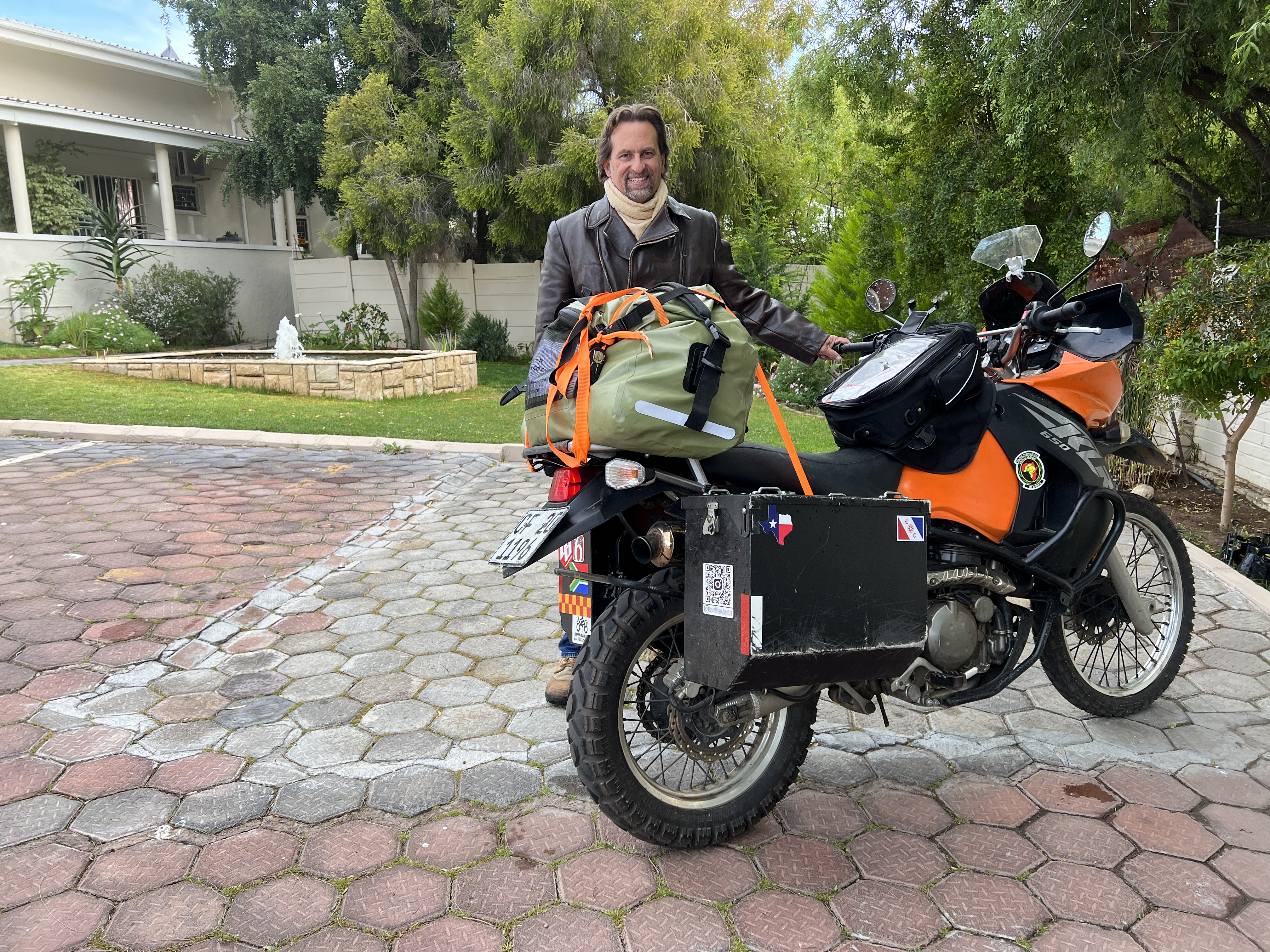
For anyone planning a similar journey, it is worth explaining the process of taking a motorcycle across international borders in southern Africa, as it can become complicated very quickly. In South Africa, a foreign visitor generally cannot register a vehicle in their own name unless they are legally working or residing in the country. At the same time, a motorcycle that is not properly registered and documented cannot legally leave the country either, creating a frustrating catch-22 for overland travelers.
After a great deal of research, I discovered there was really only one practical way to do it. I had to purchase the motorcycle outright, obtain a bill of sale from the seller, and arrange for the bike to remain legally registered and licensed in their name. From there, we went to the local South African Police Service station to complete an affidavit granting me permission to take the motorcycle across international borders. The document needed to be as detailed as possible, listing the countries I intended to enter along with estimated travel dates.
In addition to that affidavit, I carried notarized copies of both my passport and the seller’s South African identification, certified by the SAP. I also kept copies of the original bank transfer used to purchase the motorcycle, along with my international driver’s license. Border crossings in Africa often depend less on a single official requirement and more on your ability to confidently produce whatever piece of paper an official suddenly decides they want to see.
While eating breakfast that morning at the guest house, the owner casually asked where I was headed and offered to look through my paperwork. After flipping through the stack of documents, permits, and photocopies, he paused and mentioned the one item I was missing — a “ZA” country sticker showing the motorcycle was registered in South Africa. According to him, it was mandatory for crossing into Namibia.
Unfortunately, he had sold out of them, and after searching around town I found that nearly every shop in Springbok was out as well. Eventually, after several frustrating hours, I finally located one tucked away in a small auto parts store. Relieved, I bought it immediately.
I already had a small plan forming in my mind though. Rather than attach the sticker directly to the motorcycle, I quietly slipped it into my paperwork folder before finally getting back on the road toward the border.
Continuing north, I passed through Okiep once again as the landscape slowly began to transform around me. The mountains that had shadowed much of the journey gradually fell away behind me, replaced by wide open country that reminded me strongly of the American Southwest — especially parts of Utah. Massive red rock formations rose from the earth, surrounded by dry brush and sparse vegetation clinging stubbornly to the desert terrain.
The sky remained heavy with clouds overhead, but far to the north I could see breaks of sunlight piercing through in the distance, illuminating sections of desert like spotlights. It felt as though better weather — and perhaps the next chapter of the journey — was waiting just ahead.
Eventually the border post appeared on the horizon.
I had crossed here once before, but this time felt entirely different. Walking across a border is one thing; attempting to bring a motorcycle through with a stack of complicated paperwork and a registration situation balanced somewhere in a legal gray area was another entirely. As the buildings grew larger ahead of me, I could feel the nervous tension building in my stomach. Suddenly every document in my folder felt critically important, and every possible question from a border official began replaying itself in my head.
“When in doubt, walk with confidence” became one of those quiet rules I repeated to myself often while traveling and working throughout Africa. Over time I learned that people — even those with questionable intentions — can change remarkably quickly when they feel respected, included, or needed.
I remember one particular afternoon unloading materials from a truck in a rough village where a group of teenagers had begun gathering nearby. Their intentions did not seem especially innocent, and it was obvious they were watching for an opportunity. Rather than confront them or show concern, I loudly announced that I needed their help unloading the truck and explained that the cargo was fragile and valuable, so we would all need to be extremely careful.
The change was immediate.
Instead of circling like opportunists, they fell into line beside me, carefully unloading each item with surprising pride and attention. Before long they were not only helping, but actively protecting the very things they had initially been sizing up as potential targets. It was one of those moments that quietly reinforced something I had learned many times over on the road: people often rise to the role you invite them into.
As I rolled into the border station, I immediately noticed the pace was slow and unhurried — which, in Africa, can either work for you or against you. Wanting to gently control the conversation from the beginning, I reached into my folder, pulled out the ZA sticker, and approached the officials with questions instead of answers.
Do I need this attached to the bike? Where exactly should it go?
The change in tone was immediate. Rather than scrutinizing paperwork, the border guard became focused on helping me. He patiently explained where the sticker needed to be placed and even found me a rag so I could wipe the dust and grime off the pannier before attaching it properly. I thanked them sincerely for their assistance, and within minutes both my passport and the motorcycle were stamped through without a single question about ownership papers, affidavits, or the complicated details I had spent weeks preparing for.
Sometimes confidence opens doors. Sometimes asking for help does.
I breathed a long quiet sigh of relief as I crossed the mighty Limpopo River, leaving South Africa behind and entering the vast open beauty of Namibia.
About five kilometers beyond the Namibia border post sat a lonely fuel station and a small Wimpy restaurant — the first real stop inside the country. I filled the motorcycle, forced down a rather terrible hamburger, and took a short break before continuing across the long desert road toward Keetmanshoop.
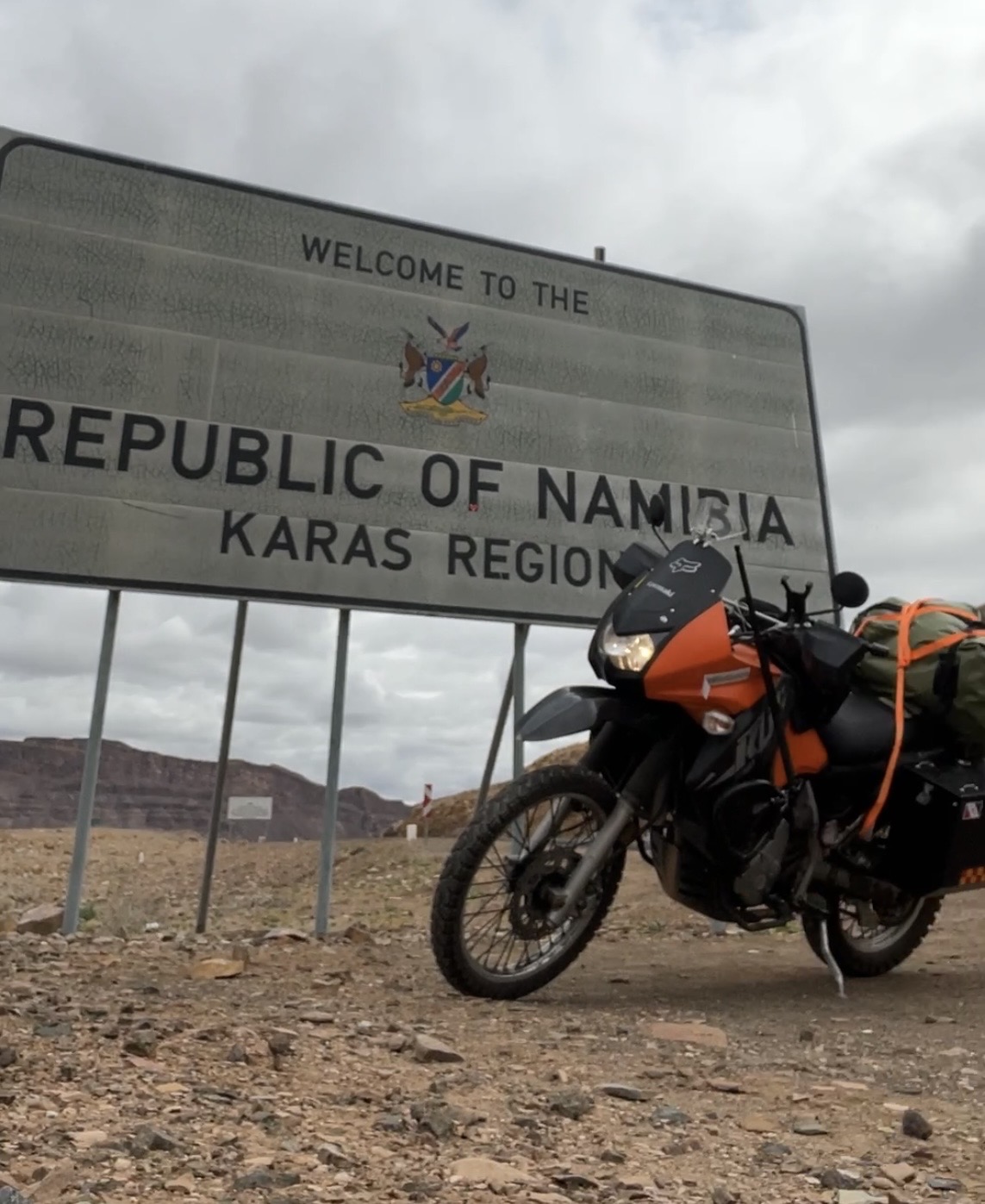
By now I was beginning to settle into the motorcycle properly. The weight, the handling, even the wind buffeting at speed all felt less foreign than they had only days earlier. I found myself moving at a much better pace, comfortably averaging around 120 km/h across the open roads.
Not long after crossing into Namibia, I finally emerged from beneath the gray cloud cover that had followed me for days. Suddenly the sky opened into brilliant sunshine, illuminating the desert ahead in deep reds and golds. Traffic was sparse, the air dry and warming quickly, and for the first time in days I felt fully comfortable again. There was a quiet excitement building inside me now — the feeling that the real adventure was beginning.
Progress north, however, came in waves. Long sections of road were under construction, controlled by flagmen holding traffic at either end. More than once I would finally work my way past a line of lumbering trucks after a delay, only to arrive at the next construction stop and find myself trapped behind another convoy all over again. It became an almost comical rhythm to the day.
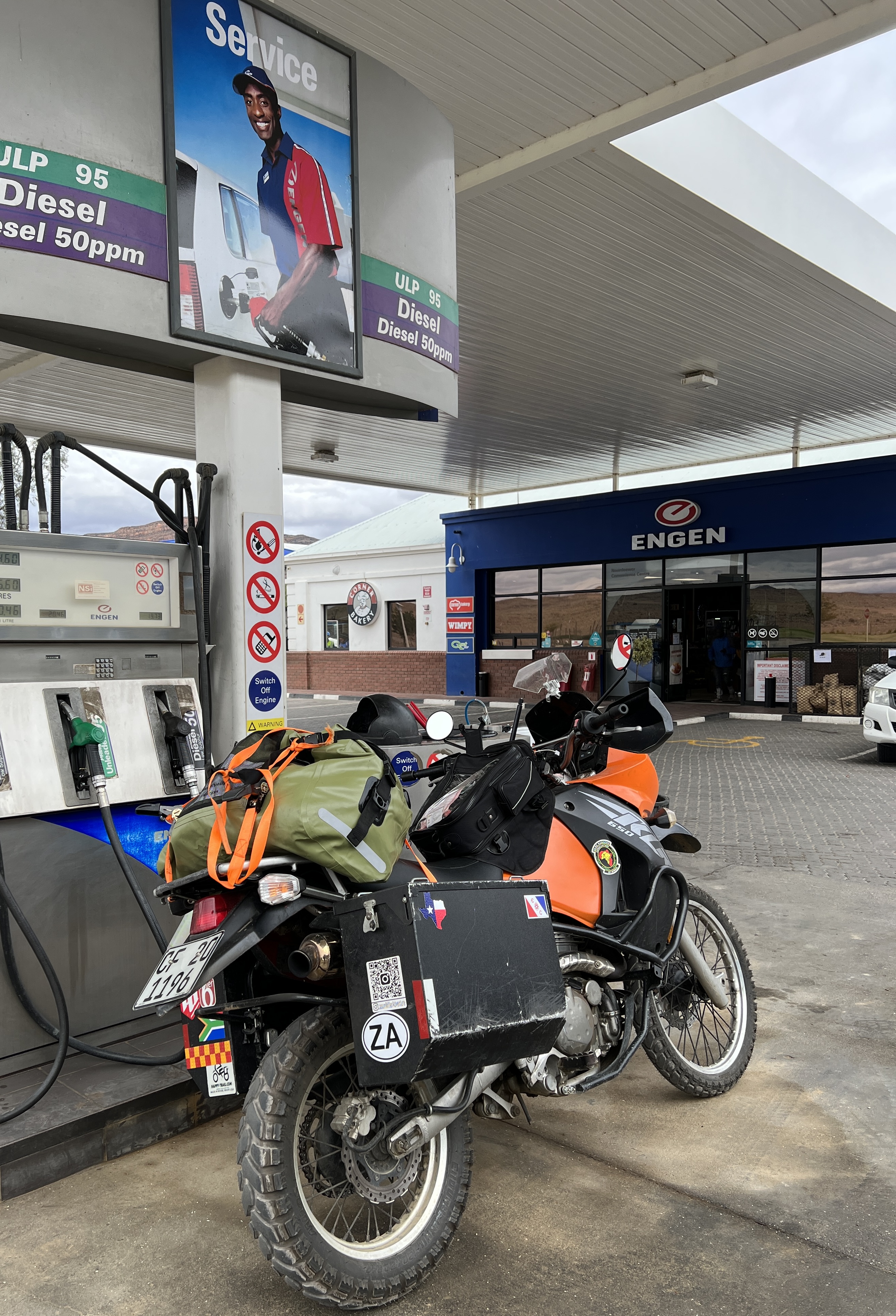
Like much of the infrastructure development across Africa, the roadworks were being overseen by Chinese contractors, their presence visible even in these remote stretches of desert highway.
At one of the construction stops I noticed what appeared to be liquid dripping onto the ground beneath the motorcycle. Still, I wasn’t overly concerned. By that point I had become meticulous about checking the bike at nearly every stop — oil level, coolant, fuel, luggage straps — even pulling into isolated rest areas now and then simply to stretch my back and inspect everything once again. Nothing had seemed out of place.
So I continued north.
Hour after hour the road carried me deeper into the barren beauty of southern Namibia. The landscape possessed a strange stillness to it, vast and sun-bleached, where distance became difficult to judge and the horizon seemed permanently out of reach. The motorcycle droned steadily beneath me as heat waves shimmered across the highway ahead.
Every so often the silence would suddenly break with movement — a baboon loping awkwardly across the roadside or a small antelope darting through the brush before vanishing again into the desert. Otherwise there was very little to interrupt the endless rhythm of road, wind, engine noise, and sky.
Making far better time than I had expected, I realized by early afternoon that I was covering serious distance across the open desert roads. The motorcycle and I were finally beginning to work together instead of against one another, and with the dry weather and long empty highways it became easy to simply keep going. Rather than stopping earlier as originally planned, I set my sights on Mariental, a small farming town in central Namibia.
As the kilometers rolled beneath the tires, the day slowly stretched into evening. The harsh desert sunlight softened into deep amber tones and long shadows crept across the road ahead. I calculated that if everything held together — both the motorcycle and myself — I would arrive just as darkness fell, after riding a little over eleven hours that day.
There is a peculiar mental state that comes after that many hours alone on a motorcycle. Time begins to blur into fuel stops, wind noise, engine vibration, and the hypnotic rhythm of the road. You stop thinking in minutes and start thinking only in distance remaining, daylight left, and the next place to rest.
By the time I rolled into Mariental, darkness had already begun settling over the town. Tired, dusty, and stiff from the long day in the saddle, I turned onto the main street and pulled into the first guest house I could find — Tahiti Guesthouse.
The place had a warm, welcoming feel to it. Its small restaurant was alive with conversation, filled with local families and workers finishing dinner while soft light spilled out onto the street. After an entire day alone on the highway, the sound of people talking and plates clattering felt strangely comforting.
But the moment I shut the motorcycle off, I noticed fuel pouring onto the ground at an alarming rate.
Suddenly exhaustedness gave way to concern. I quickly pushed the bike away from the other parked vehicles, not wanting gasoline spreading across the lot or beneath someone else’s car. In the dim light I could see it steadily dripping from somewhere low on the bike, though after eleven hours on the road I no longer had the energy to investigate properly.
At that point there was little I could do besides deal with it in the morning.
So I checked into a room, sat down in the restaurant, and finally ate a proper meal while the motorcycle cooled quietly outside in the Namibian night.
The locals at the restaurant turned out to be an exceptionally friendly group, and before long the questions started flowing — where had I come from, where was I headed, how long had I been on the road? Motorcycle travel seems to invite conversation almost everywhere, and soon the table felt less like strangers and more like old acquaintances swapping stories over dinner.
When I mentioned the fuel leak, one gentleman immediately began helping. He gave me directions to a mechanic friend across town and even called ahead to explain my situation, assuring me they would take care of whatever problem I had when I arrived in the morning. That simple willingness to help, offered so casually and generously, was something I encountered time and time again while traveling through Namibia.
Later that evening I crawled underneath the motorcycle with a flashlight to investigate for myself. The fuel appeared to be leaking from somewhere deep beneath the tank — never an encouraging discovery on a fully loaded adventure bike. In the dim light, surrounded by dust and cooling engine metal ticking softly in the night air, I remember thinking this could either be something very simple or something capable of ending the trip entirely.
There was little to do until morning.
After an enjoyable evening spent meeting new friends, I finally turned in for the night, placing an empty coffee tin beneath the motorcycle to catch the dripping fuel. The lodge itself was charming in its simplicity — small thatched roofs, clean rooms, warm lighting, and the quiet comfort of a place built more for rest than luxury. For the first time in days, I slept soundly all night long.
Early the following morning I wiped the dust and fuel residue from the motorcycle with a rag, gathered my helmet and important documents, and rode carefully across town to find the mechanic. When I arrived, he was already waiting for me outside, exactly as promised. Without hesitation he assigned one of his mechanics to the bike and the two of us immediately began stripping it down in the yard.
It did not take long to find the problem.
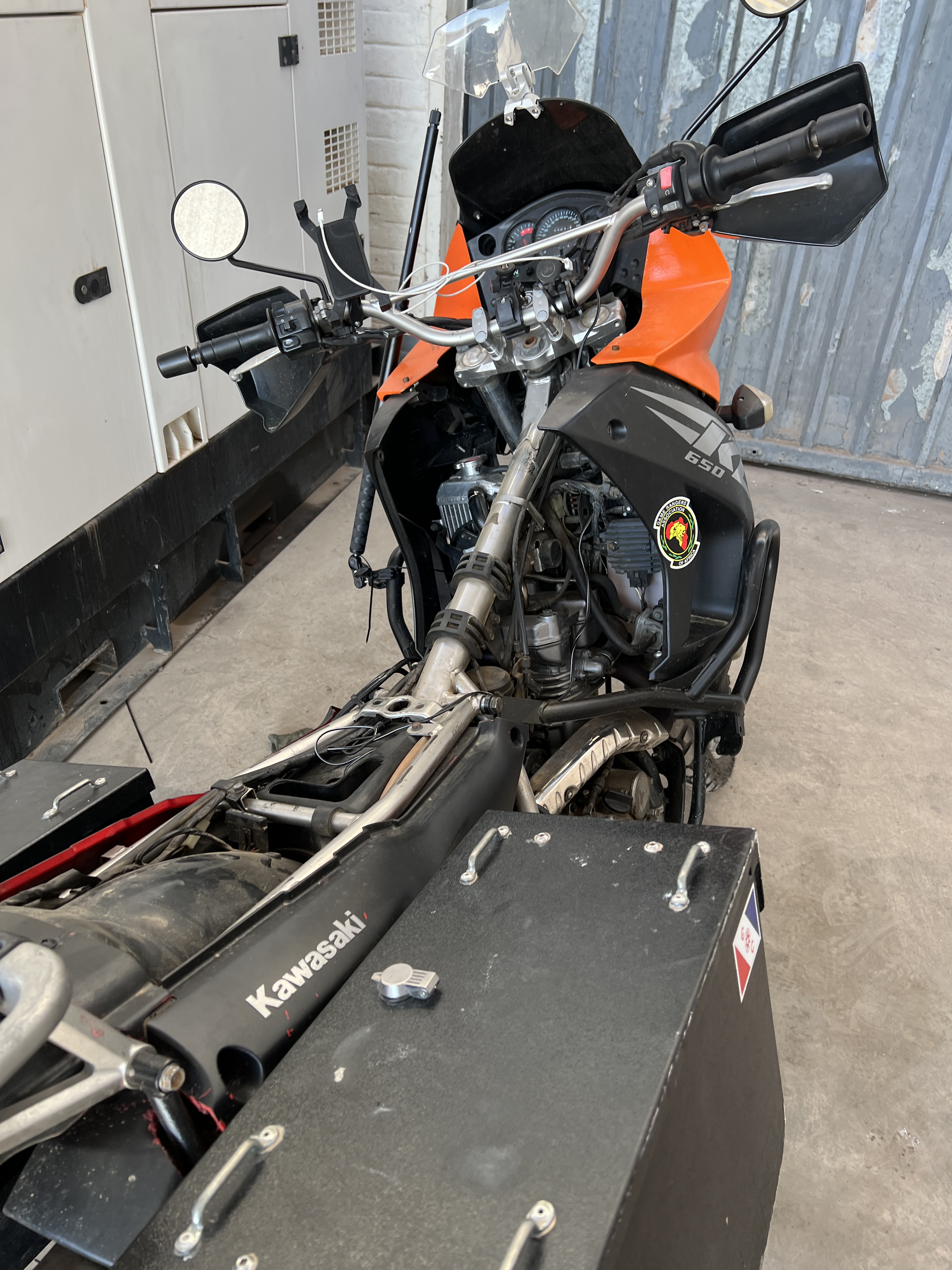
After removing the fuel tank, we discovered that the endless corrugated gravel roads and rough construction sections had slowly shaken loose the bolts securing the crash bars beneath the tank. One of the mounting bolts had actually broken entirely, allowing part of the crash bar assembly to rub repeatedly against the underside of the fuel tank until it eventually wore a small hole through the inner section, causing the leak.
Standing there looking at the damage, I realized the journey was already beginning to leave its marks — not only on me, but on the motorcycle as well. More than a thousand kilometers of rough roads, vibration, gravel, and endless pounding had already started taking their toll.
As we examined the damage more closely, it became obvious the only real solution was to weld the hole in the tank closed and somehow deal with the broken crash bar bolt. The problem was that the broken section remained lodged deep inside the mount, preventing the crash bar from tightening properly. Left loose, it would simply vibrate again against the tank and repeat the entire problem somewhere further down the road.
For several hours we tried extracting what remained of the bolt — drilling, probing, heating, and coaxing it out with increasingly creative methods — but eventually we gave up and decided to repair it the “African way.”
Rather than chase perfection, we focused on reliability.
The mechanic simply aligned everything properly and tack welded the mount securely into place so it could no longer vibrate loose. It was not elegant, factory-correct, or particularly pretty, but it was strong — and strength mattered far more than originality on a journey like this. This motorcycle was going to endure thousands more kilometers of rough roads, corrugation, sand, and abuse before the trip was over. By now I had already stopped worrying about keeping it pristine.
Adventure travel has a way of changing your priorities. Function becomes beauty.
Once the motorcycle was repaired and back together, I decided to stay another day in Mariental. After days of constant movement, border crossings, cold weather, and mechanical stress, it felt good to slow down for a while, wander around town, and simply enjoy being still for an afternoon.
While relaxing at the restaurant that afternoon, I noticed a young Chinese couple at the counter struggling with a credit card that kept being declined. I quietly watched from my table, half preparing myself to step in and cover their meal if necessary. Eventually the issue was sorted out, and shortly afterward they approached me and asked, in very broken English, if the motorcycle outside belonged to me.
When I told them it did, their faces lit up.
They shyly asked if they could sit on the bike and take a few photographs, which of course I welcomed them to do. Afterward, they surprised me by asking for a marker and carefully writing a message in Chinese characters across my fuel tank wishing me safe travels on the journey ahead. Somehow it felt fitting — another small mark added to a motorcycle already collecting scars and stories from across the continent.
We ended up having lunch together despite sharing almost no common language. Their English was limited, my Chinese nonexistent, yet somehow we managed to communicate anyway through gestures, maps, laughter, and the shared understanding that all travelers seem to possess.
They told me they were six months into a backpacking journey from Cairo to Cape Town — essentially the exact opposite route I hoped to complete myself. Amazingly, they were hitchhiking the entire distance.
They explained that Ethiopia had been the only country where they truly felt unsafe, recounting a few close calls along the way, though they also spoke about the incredible places and people they had encountered throughout the journey south. I found myself deeply impressed by their resilience and quiet determination. Long-distance travel strips people down to something simpler and more honest, and they carried that unmistakable spirit of adventure.
Eventually we parted ways, each continuing toward opposite ends of Africa, wishing one another luck on the long roads still ahead.
The people of Mariental are known throughout Namibia for their hospitality and quiet friendliness, and after spending even a short amount of time there it becomes easy to understand why. The town carries a fascinating mixture of cultures and history layered together over generations. Founded in 1912 by German Lutheran missionaries, Mariental soon became an important railway stop linking Keetmanshoop and Windhoek during the colonial period, bringing traders, farmers, missionaries, and travelers through this otherwise isolated stretch of desert country.
The name itself comes from Maria, the wife of early settler Hermann Brandt, and traces of the town’s German and Afrikaans roots are still visible everywhere — from the architecture and churches to the food and language spoken in the streets. Mariental is also home to one of the oldest Dutch Reformed Church congregations in Namibia, standing as a reminder of the region’s long and complicated colonial history. Yet alongside those European influences lives a much older heritage tied to the Nama-speaking people, descendants of the indigenous Khoi communities who inhabited southern Africa long before colonial borders ever existed. That blend of cultures gives the town a character all its own.
What I remember most, though, was not the history but the people themselves. Conversations seemed to begin effortlessly there. Whether at the mechanic shop, fuel station, or restaurant, people were curious, welcoming, and genuinely eager to help a stranger passing through town on an overloaded motorcycle. There was none of the suspicion or guardedness common in larger cities. Mariental felt relaxed, grounded, and authentic in a way that is becoming increasingly rare in the world. By the time I left, it already felt less like a stopover and more like a place I hoped someday to return to.
Back in the saddle, I continued north toward Windhoek, the road stretching endlessly across wide open desert plains broken by scattered mountains and dry riverbeds. Somewhere along the route I crossed the Tropic of Capricorn just before reaching Rehoboth, one of those quiet geographic moments travelers always pause to appreciate. Standing there in the middle of southern Africa, looking at the endless road ahead, it struck me how far from home I truly was.
The scenery grew more beautiful the further north I rode. Much of central Namibia reminded me strongly of the American Southwest — particularly parts of Arizona and New Mexico around Prescott or Santa Fe — with rugged desert mountains glowing red in the afternoon sun, dry open valleys, and enormous skies that seemed to go on forever. The high desert light had that same crystal clarity unique to elevated arid climates, where distant mountains appear almost close enough to touch.
At roughly 5,400 feet above sea level, Windhoek shares a climate surprisingly similar to Denver. Days are warm but rarely oppressive, while evenings cool rapidly after sunset beneath the thin dry air. After the humid coastlines and tropical heat found elsewhere in Africa, Namibia’s climate felt almost perfect for long-distance motorcycle travel — comfortable, clear, and expansive, as though the country itself was encouraging you to keep riding north.
Arriving in Windhoek, I discovered the highway I needed to take east toward Gobabis was closed for construction. After stopping several times to ask directions from friendly locals, I was redirected onto the older route winding through the city itself. In truth, I welcomed the detour.
Traffic was light in the middle of the day, giving me the rare opportunity to simply ride and observe the city at a relaxed pace. Windhoek has always struck me as surprisingly clean, organized, and attractive compared to many capitals I have traveled through in Africa. Wide streets curved through the hills beneath dry mountain backdrops, while cafés, small shops, and shaded sidewalks gave the city an easy, comfortable atmosphere. There is something distinctly European lingering in Windhoek’s architecture and layout, yet still unmistakably African at its core.
As I worked my way through town, I passed several other motorcyclists enjoying the afternoon. One rider in particular caught my attention — someone on a beautiful vintage European motorcycle, polished and elegant against the dusty backdrop of Namibia. I tried to catch up for a closer look and perhaps a photograph, but traffic lights and twisting streets quickly separated us before I had the chance. Moments like that seem to happen often on the road: brief glimpses of people and stories that vanish almost as quickly as they appear.
This was my fifth visit to Windhoek, but for the first time I truly felt free to experience it properly rather than simply passing through on a tight schedule. Having both time and mobility changes a place completely. Instead of rushing between destinations, I could wander, get lost occasionally, stop where something looked interesting, and absorb the rhythm of the city itself. I found myself hoping it would not be my last visit.
Eventually, with continued assistance from patient locals pointing me in the correct direction, I found the B6 and finally began heading east for the first time. The road stretched outward across open country toward Botswana and beyond, carrying me deeper into parts of Africa I had never explored before.
My route toward Kenya is intentionally indirect. Rather than taking the faster central highway routes north, I chose to spend more time exploring Namibia before eventually crossing the narrow Caprivi Strip into Zambia and continuing northeast across the continent. In many ways the journey itself mattered more to me than the destination.
I had previously driven by car from Cape Town to Zambia through the center of southern Africa, a far quicker trip consisting mostly of long highways and efficient transit days. But speed was no longer the goal. This time I wanted to drift further from the main routes, spend time in smaller towns, meet people, and experience the quieter corners of the continent — the places most travelers simply drive past on their way somewhere else.
The B8 east of Windhoek is a beautiful highway, cutting across the wide open landscapes of eastern Namibia toward the Botswana border and the frontier town of Gobabis, my next destination. The road rolls endlessly through dry grasslands and scattered acacia trees beneath enormous skies, the kind of country where distances feel measured more by sunlight than kilometers.
As I rode east, I found myself thinking back to a journey along this same road nearly three decades earlier.
Back in 1998, Angie and I had traveled this very route while making our way toward the Kalahari Desert in Botswana. What had started as a straightforward travel day slowly unraveled as daylight faded and we realized we were running out of options. The border station had already closed for the evening, leaving Gobabis as our only realistic stop for the night.
By the time we rolled into town it was fully dark, and we were exhausted.
Eventually we found an old run-down hotel with vacancies. In fact, we appeared to be the only guests staying there. The place felt gloomy and forgotten, echoing hallways dimly lit and strangely silent. Hungry after the long drive, we ordered a pizza from the hotel restaurant, but when it finally arrived it was so terrible neither of us could bring ourselves to eat more than a bite or two.
Still starving, we decided to venture back out into town in search of something better. The streets were quiet and dark, but eventually we came across a small welcoming restaurant glowing warmly against the night. Inside, the atmosphere could not have been more different from the hotel we had just left — friendly staff, laughter, warm lights, and the smell of real food cooking.
As we explained our situation to the owner, he smiled sympathetically and mentioned that they also operated a small guest house behind the restaurant. He offered us a clean, cheerful room if we wanted to move over immediately.
Leaving Angie happily finishing dessert at the table, I drove back through the quiet streets to the dreary old hotel, gathered our bags as quickly as possible, and returned to what felt like an oasis. Even now, years later, I still remember the relief of walking into that bright little guest house after the strange loneliness of the first hotel. Travel often works that way — one miserable hour can suddenly transform into one of the memories you remember most fondly years later.
Well, here I was again — twenty-five years later — riding a motorcycle into Gobabis searching for accommodations once more. The town felt both familiar and entirely different, as though time had quietly reshaped it while still leaving traces of the memories Angie and I had made there years before.
This time I stayed at Gobabis Guest House as the guest of Kobus and Cheryll Pienaar, whose property sat peacefully on the outskirts of town. It was a quiet little hideaway shaded by trees, the kind of place where travelers immediately feel at ease after long days on the road. The atmosphere was relaxed and personal, far removed from the anonymous feel of larger hotels.
They did not serve dinner at the guest house, so Kobus recommended I ride a bit farther out of town to Goba Lodge for the evening meal. After a long hot shower and a short rest, I climbed back on the motorcycle and rode out through the cool evening air toward the lodge.
The setting could not have been more pleasant. The restaurant patio overlooked a softly lit swimming pool surrounded by palms and desert landscaping, while the last warm colors of sunset faded across the Namibian sky. After days of border crossings, mechanical problems, cold rain, and endless kilometers of desert highway, simply sitting there quietly with a good meal and a warm evening breeze felt like a luxury beyond measure.
My plan for the journey from Gobabis to Tsumkwe seemed straightforward enough on paper. According to my GPS — which, importantly, only functions with maps downloaded in advance over Wi-Fi and does not update once out on the route — I would leave Gobabis heading north, navigate a series of smaller secondary roads, and eventually connect with the D3301, following it north for roughly 460 kilometers through some of the most remote country in Namibia.
What the GPS did clearly indicate, however, was that nearly the entire route consisted of gravel, dirt, and deep sand roads.
Fuel immediately became the primary concern. Under ideal conditions I could safely manage around 320 kilometers on a tank, but “ideal conditions” rarely exist in remote Africa, especially riding loaded through sand. To compensate, I strapped an additional ten liters of fuel onto the motorcycle in two separate five-liter containers, hoping that would provide enough margin if conditions worsened or I became lost somewhere along the route.
Oil consumption had also become something I monitored carefully after the rough riding earlier in the trip, so I packed an extra two liters of oil as well. Weight was increasing steadily, but so was the distance between reliable services and civilization.
As for survival supplies, my setup was fairly simple: three bottles of water, a compact water filter gifted to me by a friend and co-founder of GA2030, and one carefully protected bottle of Coca-Cola reserved almost like emergency equipment — less for enjoyment than for the quick sugar and caffeine boost if exhaustion or dehydration began setting in during the ride.
That morning I ate an enormous breakfast, wanting as many calories in reserve as possible before entering the bush. My calculations seemed reasonable enough at the time. Four hundred sixty kilometers, even on rough roads, should take perhaps six hours if everything went smoothly and I maintained decent pace.
I would soon discover just how badly I had underestimated both the terrain and the reality of riding northern Namibia alone.
Leaving Gobabis, I almost immediately encountered deep sand and the motorcycle began sliding unpredictably beneath me. The front tire wandered constantly while the rear fishtailed from side to side, the heavy bike feeling far less like a machine under control and more like something barely negotiating with gravity.
I remembered advice a friend had once given me about riding in sand: when the bike starts sliding, power through it. Keep momentum. Stay loose. Let the motorcycle move beneath you rather than fighting it.
In theory, it sounded perfectly reasonable.
In reality, every instinct I possessed screamed the exact opposite.
I had very little confidence riding in these conditions, but at the time I convinced myself there was no better way to learn — or perhaps even master — sand riding than simply throwing myself directly into it. Sink or swim. Learn by doing.
That, I would soon discover, was an incredibly stupid thought.
Within the first few kilometers the motorcycle was already moving around violently enough to keep my heart rate pinned high. Every patch of deeper sand felt like it wanted to pull the handlebars out of my hands entirely, and the added weight of fuel, tools, luggage, and supplies only amplified every mistake. There was no easing into these conditions, no gradual learning curve — the road demanded competence immediately, whether I possessed it or not.
I exhausted myself quickly from the sheer tension of it all. My hands locked into a death grip on the handlebars while every unexpected slide triggered an exaggerated correction, causing the motorcycle to fishtail wildly and wander across the road from side to side. Instead of flowing with the sand, I was fighting it constantly — and losing.
Eventually I decided the only solution was simply to slow down to a crawl and inch my way through it.
It was still early morning. The sun was rising off to my right, casting long golden light across the bushveld while the air remained cool and perfectly clear. Under any other circumstances it would have been a beautiful ride. But beauty has a way of disappearing when you are wrestling a fully loaded motorcycle through deep sand while mentally calculating how difficult it will be to pick it up if it falls over.
Of course, experienced motorcyclists know that riding slower in sand often makes things even worse.
The momentum disappeared, the motorcycle began sinking into the loose surface. The front tire behaved less like a wheel and more like a rudder on a boat, digging and darting unpredictably while the handlebars jerked violently in every direction. The slower I rode, the more unstable the bike became, yet the faster I attempted to go, the more terrifying the entire experience felt.
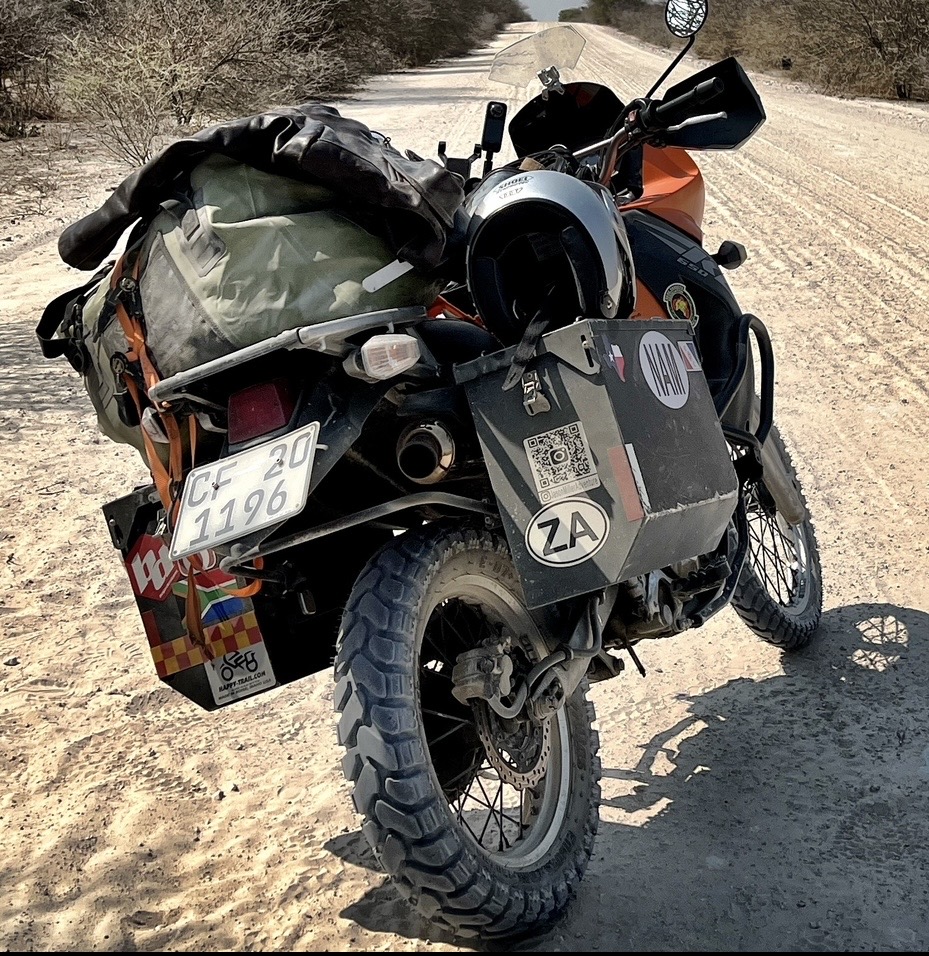
I briefly considered airing down the tires for better flotation, but quickly dismissed the idea. The road was littered with washboard corrugations, hidden rocks, and deep potholes capable of pinching a tube instantly. Worse yet, the seller back in Cape Town had never supplied me with a pump or even the motorcycle’s center stand. If I punctured a tube out there alone, changing it on the side of the road would become an exhausting and miserable ordeal.
So I kept going.
Slowly, awkwardly, and with far less confidence than I had imagined only a few hours earlier.
Gradually, I began gaining a small amount of confidence. When I forced myself to stay on the throttle and keep the motorcycle “on top” of the sand rather than sinking into it, the bike actually became more stable. For brief stretches I could feel everything begin to work together — the engine pulling steadily, the front wheel floating lightly, the motorcycle carving through the loose surface instead of fighting it.
Then, without warning, the front tire would hit a patch of especially deep sand.
Instantly the handlebars would snap violently left or right, nearly tearing themselves from my hands and threatening to throw me off the bike entirely. More than once the motorcycle lurched toward the edge of the road so abruptly I was certain I was about to crash into the bush. Each sudden correction sent adrenaline surging through me all over again.
The road played constant tricks on my optimism.
Occasionally the deep sand would suddenly transition into hard-packed gravel, and for a few glorious kilometers I could finally relax my shoulders, increase speed, and begin making up for lost time. The motorcycle would settle smoothly beneath me again and I would convince myself the worst was finally behind me.
Then, just as quickly, the road would plunge straight back into another seemingly endless stretch of deep sand — sometimes fifty kilometers or more at a time.
Each time it happened felt mentally defeating. Every brief moment of confidence would evaporate almost instantly as the bike resumed its drunken weaving through the loose surface. It became less a motorcycle ride and more a continuous physical and mental wrestling match between rider, machine, and terrain.
On and on I crawled through the sand, kilometer after exhausting kilometer, frustration slowly building with the heat. Progress felt painfully slow, and every section of deep sand demanded complete concentration. There was no opportunity to relax — not mentally, not physically. My shoulders ached from fighting the handlebars and my legs were beginning to cramp from constantly standing on the pegs trying to balance the motorcycle beneath me.
As the morning wore on, the sun climbed higher and the desert heat began settling over everything. What had started as a cool beautiful morning was rapidly turning harsh and unforgiving. The air shimmering above the road carried that dry furnace-like heat unique to the African interior.
Even my water was becoming unpleasant to drink.
Stored inside the metal pannier box, the bottles had been slowly baking in the sun for hours until the water was nearly hot. The filtered water bottle given to me by my friend at GA2030 was no better, sitting exposed to the heat and warming almost beyond refreshment. Still, I forced myself to keep drinking. Out there dehydration was not something to ignore simply because the water tasted miserable.
So I drank the hot water anyway and continued north, alone in the sand and heat, the motorcycle weaving endlessly beneath me while the vast empty landscape stretched out in every direction.
Far ahead in the middle of the track I eventually spotted what appeared to be a small white pickup truck stopped in the road, with an older man standing in the back scanning the horizon. As I slowly approached through the sand, he began waving both arms for me to stop.
It turned out to be an elderly German man traveling with his wife, completely lost somewhere in the bush.
In broken English he asked if I knew the way to Tsumkwe. I told him I did — or at least hoped I still did — and said they were welcome to follow me north. The relief on his face was immediate. He explained they had been driving slowly and cautiously for hours, unsure if they were even still on the correct road.
The truth was, I was moving slowly too.
But suddenly the situation felt entirely different. Until then I had been alone out there, struggling through deep sand in extreme heat with limited water, no cell signal, and very little margin for mechanical trouble. Now, at the very least, there was another vehicle nearby if something went wrong. If I crashed, became injured, or the motorcycle failed completely, someone would know where I was.
We set off again with me leading the way through the sand while the little white rental pickup bounced along behind. Every so often I would glance in my mirrors and see the truck still there, weaving through the dust clouds in the distance.
Oddly enough, that simple sight brought an enormous sense of relief.
The only problem was that he was somehow going even slower than I was.
I would slowly fight my way a few kilometers ahead through the sand only to stop again and wait for the little white pickup to appear in the distance. Several times he missed turns entirely, forcing me to backtrack through the deep sand to find him wandering down the wrong track somewhere in the bush. Under normal circumstances it probably would have frustrated me, but out there he had become my security blanket.
At that point I was perfectly content if we rolled into Tsumkwe together at midnight, so long as neither of us was stranded alone along the road.
So onward we crawled.
Most of the time we were completely out of sight from one another anyway, separated by dust, distance, and the endless twisting tracks through the bushveld. My focus remained almost entirely on surviving the sand beneath the motorcycle. The bike wandered constantly, threatening to throw me off balance every few seconds while I wrestled the handlebars and fought exhaustion creeping steadily into my arms and shoulders.
The country itself felt harsh and almost lifeless. Endless dry scrub stretched across flat barren terrain beneath a merciless sun, the temperature climbing toward one hundred degrees Fahrenheit. Heat radiated upward from the sand and road surface while the wind itself felt hot against my face.
I drank water constantly despite how warm it had become, stopping regularly beneath whatever small shade I could find simply to calm myself, stretch aching muscles, and recover mentally from the relentless stress of riding. Every kilometer felt earned out there.
Around one in the afternoon I pulled off beneath the thin shade of a small tree and ended up waiting nearly thirty minutes for my new German friend to catch up. The silence out there was immense — just heat, wind, and the occasional ticking of the motorcycle cooling in the sun.
While waiting, I decided to check the bike again and quickly realized something troubling.
I was burning through fuel at a far faster rate than I had calculated.
The constant on-and-off throttle required to navigate the sand was consuming gasoline rapidly. Instead of cruising efficiently at steady highway speeds, the motorcycle was working hard every second — revving, spinning, correcting, clawing its way through deep sections of loose sand. I had planned my fuel carefully based on distance, but sand completely changes the equation.
That realization immediately tightened the knot already forming in my stomach.
Then came the second problem.
When I checked the oil level, I discovered the bike was consuming oil as well. Not catastrophically, but enough to concern me. I added a bit from the reserve bottle I had packed and sat there staring at the motorcycle in the heat, mentally recalculating everything: remaining fuel, remaining oil, remaining distance, remaining daylight.
Out there, far from towns or cell service, even small mechanical concerns begin to feel much larger.
Whenever my new German friend and his wife finally caught up, we would both step out into the heat and attempt small conversations beside the road, communicating mostly through gestures, broken English, smiles, and maps spread across dusty vehicle hoods. Despite the language barrier, there was something comforting about not being entirely alone out there.
Every so often I checked the GPS on my phone against the offline maps I had downloaded before leaving Wi-Fi behind. At one point I noticed my little location arrow drifting slightly away from the track shown on the screen. It did not concern me much at first. GPS signals occasionally wander, even in cities, and out in the bush there were few landmarks anyway.
But after another couple of hours of riding, I finally had to admit something to myself.
I had missed a critical turn.
Somewhere earlier in the journey I should have turned left, heading directly north toward Tsumkwe. Instead, I had unknowingly continued northwest, slowly drifting toward the border of Botswana on a dirt track that was becoming progressively worse with every kilometer.
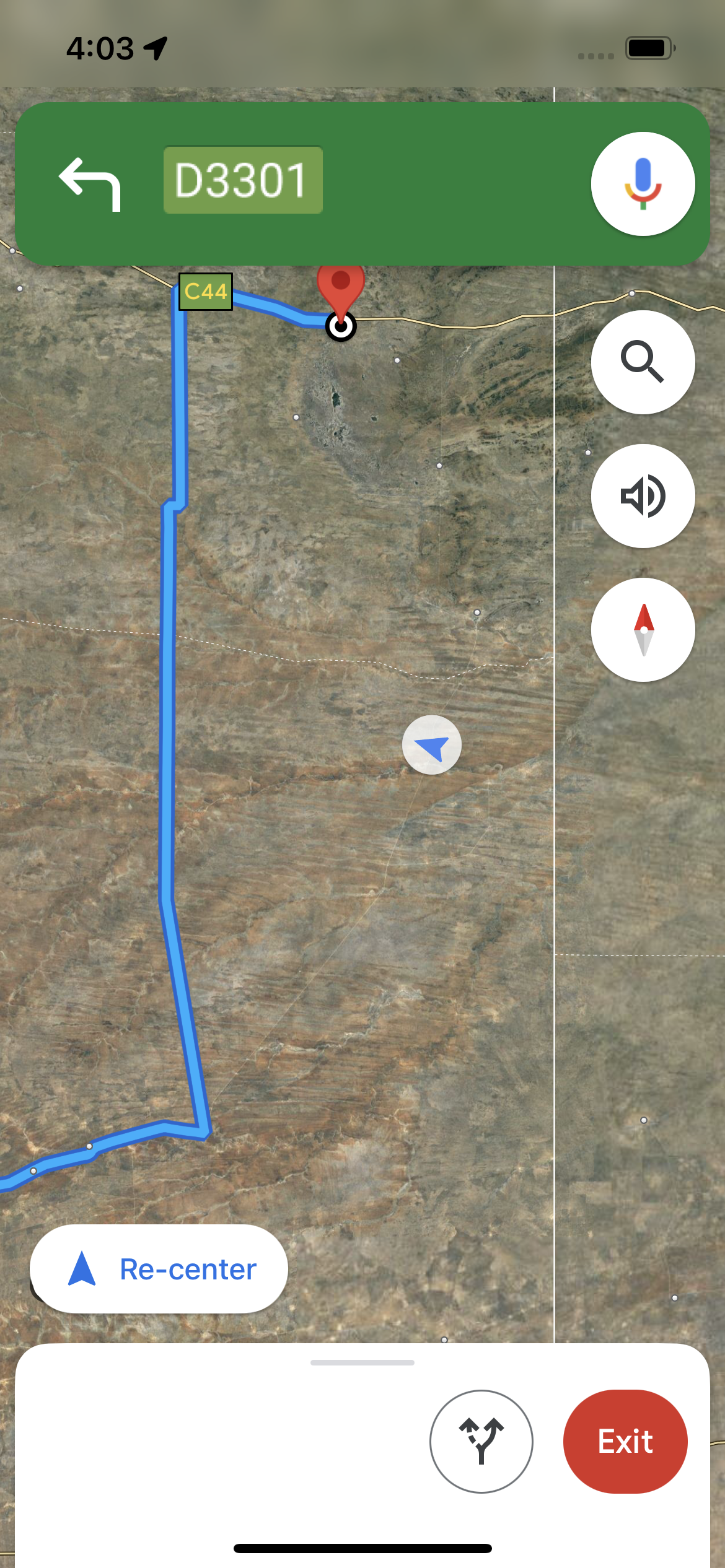
When I finally stopped and unfolded my printed maps in the shade, the situation became clearer. The road I was now following was known by some locals as the Gom Road, named after a small settlement called Gom that lay somewhere further ahead. Although the route was smaller, rougher, and far less traveled, it did eventually reconnect with Tsumkwe — approaching from the east rather than the west after winding through remote bush country near the Botswana border.
In theory, I was still heading in roughly the correct direction.
In reality, the road conditions were deteriorating badly and I had no real understanding of how difficult the remaining route might become.
During one of our rest stops I attempted to explain the situation to my German backup crew, pointing at maps and trying to describe the missed turn and alternate route. He listened politely, nodded several times, and then climbed back into the truck with a cheerful smile that made it painfully obvious he had understood almost none of what I had said.
So we simply continued onward into the increasingly remote bush, me leading and the little white pickup trailing somewhere behind in a cloud of dust.
Around three in the afternoon I finally pulled off the track again, exhausted and overheating. I forced myself to drink some of the water I had been carrying, but by now it was nearly scalding from sitting inside the metal panniers all day. The hot water immediately made me nauseated. Sweat poured down my face as I stripped off my heavy jacket and gloves, desperate to cool down even slightly beneath the brutal afternoon sun.
When the little white pickup finally rattled into view behind me, I asked my German companion if he happened to have any cool water left.
To my immense relief, he reached into an ice chest and handed me a cold bottle.
It tasted incredible.
I drank deeply while standing there in the dust beside the motorcycle, the cold water instantly reviving me despite the heat radiating off the road and surrounding bush. Within minutes I could feel myself sweating it right back out again.
Then he kindly offered to place my remaining water bottles — along with my carefully protected Coca-Cola reserve — into his cooler so they could stay cold for the remainder of the journey.
At the time it seemed like an excellent idea.
In hindsight, it was very nearly a fatal mistake.
Thankfully, sometime later the track finally bent back toward the north, and for the first time in hours I felt a genuine sense of relief. Even though progress remained painfully slow, at least we were no longer drifting farther west toward the Botswana border. Every kilometer north felt like a small victory.
At our next stop I spread the paper maps across the motorcycle seat once again and carefully showed my German companion exactly where we were and where we were headed. This time, after much pointing and tracing fingers along the route, he finally understood that the complicated navigation was essentially over. From here on, all we had to do was remain on this single track until reaching Tsumkwe. No more hidden turns. No more junctions to miss.
The relief on his face was obvious.
Out there in the remote bush, simplicity becomes comforting.
Of course, understanding the route and completing it were still two very different things. We still had many long kilometers ahead of us across rough isolated country, and by now both exhaustion and heat were taking a steady toll. But mentally, knowing we could simply keep following the same track northward made the situation feel far less uncertain.
Once again I slowly pulled far ahead of my German companions, the little white pickup disappearing somewhere behind the endless hills and bends of the track. The road had become relentless — a constant series of rises and dips cutting through deep sand and scrub bush.
The tops of the hills were usually hard-packed gravel or firm dirt, allowing me to finally gain a little traction and speed. For a few brief seconds the motorcycle would feel stable again and I could relax my grip slightly. But every single time, waiting on the backside of the hill, was another stretch of deep loose sand.
Sometimes it was so thick the motorcycle could literally stand upright in it without a kickstand.
I found myself trapped in an impossible rhythm. I would accelerate hard climbing the hill, only to crest over and instantly lose control as the front tire buried itself in the sand below. If I slowed down too much, the bike immediately wanted to tip over and sink. But if I powered aggressively through the sand, the motorcycle fishtailed violently from side to side, sliding and bucking beneath me so unpredictably it felt constantly on the verge of crashing.
There seemed to be no correct answer — only varying levels of barely controlled chaos.
The deeper into the bush I rode, the more physically and mentally brutal the situation became. Every muscle in my body ached from tension and constant corrections, while the heat and exhaustion slowly wore down my ability to react smoothly. The motorcycle was simply too heavy, too overloaded, and piloted by someone with far too little sand experience for the conditions we were facing.
And honestly, I had nobody to blame but myself.
The road was not unfair. Namibia was not unfair. I simply had not prepared properly for terrain like this. I had underestimated the sand, overestimated my abilities, and pushed into one of the most remote parts of southern Namibia carrying far more confidence than experience.
At one point I came charging up the crest of a long hill, finally able to gain some speed and make up a little of the time I had been losing all day. The motorcycle felt stable for those few brief moments on the hard-packed surface near the top, and I remember thinking perhaps I could finally settle into a rhythm.
Then I crested the hill.
On the opposite side lay the deepest sand I had encountered yet.
The road itself had almost completely disappeared beneath it, replaced by what looked less like a roadway and more like the backside of a sand dune. There was no time to stop or reconsider. Momentum was everything in sand, so instinctively I rolled on the throttle and plunged straight into it, trying desperately to keep the motorcycle floating on top of the loose surface.
Instantly the front tire buried itself and snapped violently to the left, nearly throwing me from the bike. I fought to correct it, wrestling the handlebars back into line, but the moment I recovered the tire jerked just as violently to the right.
That was it.
The motorcycle launched me sideways into the sand bank as it buried itself almost halfway up the wheels, the frame settling solidly into the deep sand like an anchor. The engine stalled immediately, still locked in gear, leaving sudden silence broken only by my own breathing.
For a few moments I simply lay there in the sand staring at the sky, exhausted and angry at myself, knowing fully that this was the crash I had been flirting with for hours.
Frustrated, overheated, and completely exhausted, I sat there in the sand for several moments staring at the motorcycle in disbelief, wondering how I had managed to put myself into such a miserable situation. The silence out there somehow made it feel even worse. No traffic. No people. Just heat, sand, and a heavily overloaded motorcycle buried to its frame rails in the middle of nowhere.
Eventually I pulled off my helmet, wiped the sweat and sand from my face, and forced myself to start dealing with the problem.
I restarted the motorcycle, dropped it into first gear, and tried using the engine to claw itself free while I pushed alongside it. The rear tire spun uselessly for a moment before the bike stalled immediately in the deep sand. I tried again with more throttle, the engine revving loudly while the tire dug itself even deeper before dying once more.
Again and again I attempted to power it out, but each try only made the situation worse.
The motorcycle was becoming dangerously hot from the constant abuse and low-speed strain. Heat poured off the engine while the smell of fuel and hot oil hung in the still desert air. When I checked the oil sight glass again, my stomach tightened — the level had dropped noticeably once more.
I poured in my last remaining liter of oil, bringing the level barely back to normal.
Then came the second realization.
Fuel was disappearing just as quickly.
Between the endless sand riding, constant throttle work, and repeated attempts to free the bike, I had burned far more gasoline than expected. Reluctantly, I emptied my final five-liter reserve container into the tank, listening to the fuel glug down inside while realizing that from this point onward there would be no remaining backup supplies.
I cannot describe the relief I felt when I finally spotted the little white pickup far off in the distance behind me. Seeing that tiny shape moving slowly through the heat waves across the sand felt like rescue arriving. Five minutes later my backup finally rolled up beside me.
I walked over to the driver’s window exhausted and covered in sweat and sand, trying to explain that perhaps we could use the tow strap I had brought along to pull the motorcycle free. But between my tired English, his broken English, and the general confusion of the situation, it was obvious he did not understand what I was asking.
I turned around briefly to look back at the buried motorcycle.
Then, to my complete shock, I heard the pickup begin moving again.
I spun around just in time to watch them roll up the windows and slowly drive away northbound down the track, disappearing toward the horizon and the setting sun — leaving me buried in the sand, alone, with roughly 200 kilometers of brutal sandy roads still ahead of me.
At first I honestly could not process what had just happened.
Then the far worse realization hit me.
All of my remaining water was still inside their ice chest.
Not only was I alone now with almost no remaining fuel reserves, but every bottle of water I had left — including the filtered bottle and the precious Coca-Cola — was driving away into the Namibian bush inside a little white rental truck.
I stood there in stunned disbelief watching the dust cloud slowly disappear into the distance.
Why did they leave?
Even now I can only guess. Perhaps once they understood the route was straightforward from there onward, they simply believed they no longer needed me guiding them. Or perhaps they completely misunderstood my gestures and assumed I was telling them to continue ahead without me while I handled the motorcycle myself.
In hindsight, I can almost laugh imagining how absurd the scene must have looked:
“Please tow me out of the sand.”
What they perhaps heard instead was:
“Everything is fine. Drive on to Tsumkwe… and by the way, thanks for keeping my water cold.”
I must admit, I was furious.
And beneath the anger, genuinely scared.
The silence out there was overwhelming. No engines, no voices, no movement — just heat shimmering across the bush and the faint sound of wind moving through dry grass somewhere beyond the track. I was stranded in one of the most remote areas of Namibia, surrounded by wilderness, wildlife, deep sand, and very little chance of passing traffic.
For a few moments I simply stood staring in the direction the white pickup had disappeared.
Then I forced myself to calm down and focus on the immediate problem: getting the motorcycle free.
I dropped to my hands and knees in the burning sand and began digging around the wheels and frame with my bare hands. The motorcycle had buried itself deeply enough that the frame rails were resting solidly on packed sand beneath the chassis, completely removing weight from the tires. Every shovel of sand felt painfully slow in the heat.
Minute by minute. Handful by handful.
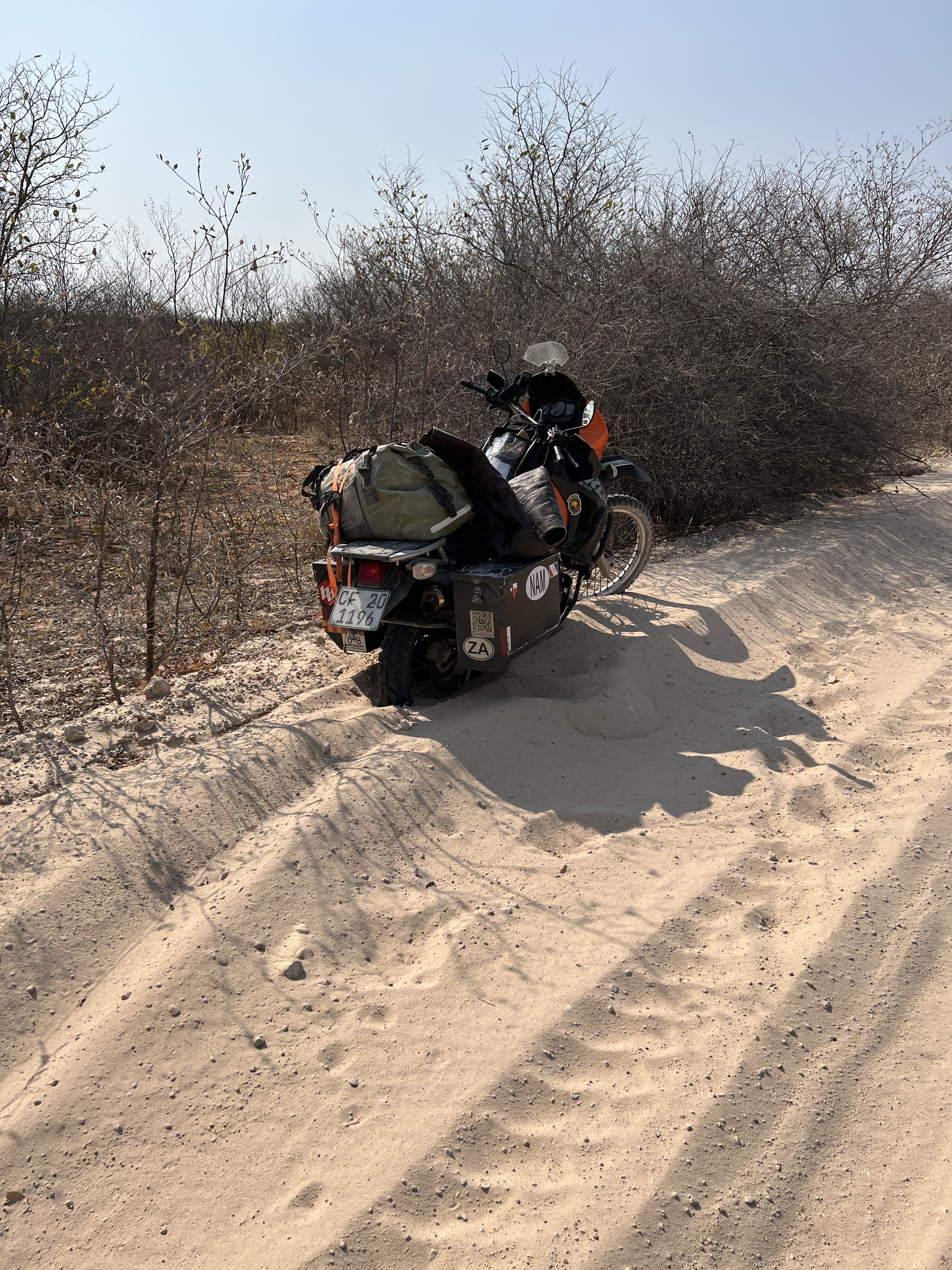
Nearly an hour passed before I finally reached the firmer gravel road hidden underneath the deep drifted sand. Exhausted and drenched in sweat, I lowered the kickstand carefully to keep the bike upright and hit the starter once again.
To my immense relief, the engine fired immediately.
I dropped it into first gear and began rocking the motorcycle back and forth while feathering the clutch. Slowly — almost reluctantly — the rear tire finally began clawing for traction and the bike crawled free from the hole it had dug itself into.
But the battle was not over.
The sand remained so deep the motorcycle could barely stand upright on its own. Even the kickstand simply sank into the loose surface without support. I ended up walking the motorcycle several hundred feet through the sand to reach a firmer patch of ground where it could finally remain standing without immediately falling over.
Only then did I trudge back through the sand to retrieve my helmet and scattered gear.
I reloaded the motorcycle slowly, mentally exhausted now as much as physically, and continued north once again — alone this time.
By now it was the hottest part of the afternoon, somewhere around four o’clock, and I could no longer ignore my thirst.
I do not believe I was truly in immediate danger yet, but dehydration has a strange effect on the mind. My tongue had begun swelling slightly from the heat and dryness, and it became almost impossible to think about anything except water. Not fuel. Not sand. Not distance. Just water.
The hot wind rushing across my body and the constant evaporation of sweat had masked how much fluid I was losing. Physically I was still moving, still functioning, but mentally something had shifted. My entire world narrowed into a single obsession.
Finding water.
The journey north was no longer about reaching Tsumkwe. It had become a search for something to drink.
Far ahead along the roadside I noticed a woman standing near a small path disappearing into the bush. I pulled the motorcycle over immediately and approached her, trying desperately to ask for water. Of course she spoke no English, and I spoke none of her local language, but human desperation translates surprisingly well. The moment I mimed drinking, she understood instantly.
Without hesitation she disappeared silently into the bush.
A few minutes later she returned carrying a metal pot filled with semi-cool water alongside a man who spoke a few words of broken English. The sight of that water honestly felt emotional at that point.
Every instinct in my body wanted to grab the pot and empty it in one enormous gulp, but I forced myself to slow down. I had no idea where the water had come from — a borehole, storage tank, river, or livestock well — and becoming violently sick out there would have been catastrophic. Thankfully the water filter given to me by my friend at GA2030 was still strapped to the motorcycle.
Carefully, trying not to waste a single drop, I filled the filter bottle and slowly drank through the straw.
The first mouthful tasted incredible.
I sat beneath a small patch of shade beside the road, feeling slightly nauseated from the heat and exhaustion, slowly filtering and drinking every bit of water she had brought while the two strangers stood nearby quietly watching me recover. I remember feeling humbled by the moment — stranded, filthy, exhausted, and dependent entirely upon the kindness of people whose language I could not even speak.
Out there in the bush, water had become more valuable than fuel, money, or pride.
I was completely exhausted.
Not ordinary tiredness, but the kind of deep physical exhaustion that strips away clear thinking and leaves you operating purely on instinct. In truth, I do not think I had pushed myself this hard in over twenty years. Wrestling the overloaded motorcycle through endless deep sand, repeatedly dropping and recovering it, fighting to stay upright while trying not to injure myself, all while carrying the constant stress of being stranded before dark in remote bush country — it had drained me far more than I had ever anticipated.
This was no longer adventure riding.
It had become survival mixed with stubbornness.
Thankfully, I had prepared for situations like this, at least in theory. I carried a tent, sleeping bag, tools, and enough equipment to spend a night alone if necessary. After slowly recovering some strength and finally drinking water again, I motioned to the local couple asking whether I could camp there nearby for the evening.
At that point I felt I needed to shut everything down.
Of course, in a place that remote I technically could have camped almost anywhere. There were no fences, no towns, no people for endless kilometers. But the reality of spending the night completely alone out in the African bush suddenly felt very different now that I was exhausted, dehydrated, and mentally worn down.
Before long the couple drifted away to continue with their own day, disappearing quietly back into the bush as naturally as they had appeared.
And once again, I was alone.
So, I sat there in the shade beside the motorcycle, listening to the distant wind moving through the dry grass, trying to decide whether to surrender to exhaustion and camp for the night — or somehow find the strength to continue north.
The sun was finally beginning to sink lower in the western sky, and with it the brutal heat eased ever so slightly. After resting in the shade and slowly recovering with the water the villagers had given me, I began to feel just strong enough to continue.
Stopping for the night no longer seemed like the best option.
I had no cell service whatsoever, and I knew Japsie was expecting me in Tsumkwe. More importantly, I would have no way to check in back home, which would almost certainly cause unnecessary worry if I simply vanished off the grid overnight somewhere in the bush.
After a long rest, I climbed back onto the motorcycle and pointed it north once again.
By now I had exhausted all reserve planning. The extra fuel was gone. The extra oil was gone. All the careful calculations and safety margins I had started the morning with had disappeared one difficult kilometer at a time somewhere in the deep sands of northern Namibia.
The evening light stretched long shadows across the track as I resumed battling through the sand, exhausted muscles protesting every movement while the motorcycle wandered and fishtailed beneath me. But mentally something had changed after being stranded earlier in the day. The fear had largely burned itself away, replaced instead by a quiet determination to simply keep going forward until either I reached Tsumkwe or the motorcycle physically refused to continue any farther.
A few more difficult kilometers down the track I arrived at a conservancy gate where a lone guard slowly stepped out to meet me. By then the lowering sun had painted everything in deep orange light, and the bush around us had taken on that quiet evening stillness unique to Africa.
To my relief, he was the first person all day who clearly understood my questions.
When I explained I was trying to reach Tsumkwe, he immediately advised me to stop instead at the next settlement, Gom. He explained there was a small guest house there where I could safely spend the night, though fuel would likely be unavailable.
Then his tone became more serious.
Beyond the gate, especially in the cool evening hours, he warned me to watch carefully for elephants along the road. He suggested strongly that I stop before dark rather than continue deeper into the bush after sunset. Occasionally local traders sold fuel from drums or containers beside the road, he explained, but by this hour most people would already be closed up for the evening.
Standing there in the fading light, exhausted and coated in dust, I opened the motorcycle tank expecting the worst.
To my surprise, I still had slightly less than half a tank remaining.
For the first time all day, something actually went in my favor.
Gom was only about seventy kilometers farther north. Under normal conditions that distance would be insignificant, but after the day I had endured it felt like one final mountain to climb. Still, with a little fuel remaining, a destination ahead, and fresh warnings about elephants waiting in the dark bush beyond, I decided to keep pushing north toward Gom before nightfall swallowed the road entirely.
Thankfully the road improved somewhat after the conservancy gate. It was still a mixture of gravel and sand, but the wind had not drifted the sand into the deep axle-swallowing banks I had battled all afternoon. I could also tell the route was traveled more frequently, the surface firmer and more defined in places. For the first time all day I was actually able to maintain close to 50 KMH, which felt incredibly fast after hours of crawling and fighting for balance.
As the sun dropped lower, the entire bush turned gold and deep red around me. Dust hung in the air behind the motorcycle while long shadows stretched across the road ahead. Despite the exhaustion, it was one of those moments where Africa becomes heartbreakingly beautiful.
I rolled into the small settlement of Gom just as the sun disappeared below the horizon.
The village was small and scattered, and after riding slowly back and forth through the sandy streets twice, I finally located the guest house the guard had mentioned earlier.
Only to discover it abandoned.
That realization hit hard.
By now daylight was gone, and every unnecessary kilometer spent circling the village consumed precious fuel and valuable time. I stopped several people trying to ask who managed the property or whether there was another place to stay, but answers were vague and confusing. Meanwhile the atmosphere of the village itself was beginning to change as darkness settled in.
After dark, the streets seemed to come alive.
Groups of people gathered near fires and roadside stalls while music and voices drifted through the warm evening air. I became increasingly aware that I was now the only obvious outsider in town — a lone white foreigner riding a heavily loaded adventure motorcycle through the settlement after dark. The bike itself drew attention everywhere it went, the headlight and engine noise announcing my presence long before I arrived.
And honestly, that concerned me more than the animals.
Wildlife in the bush follows certain rules. People can be far less predictable.
At that point I decided it was smarter to keep moving north and camp quietly in the bush if necessary rather than remain too visible in town after dark. So I turned the motorcycle back toward the track, switched on the headlight, and disappeared once again into the Namibian night.
Just beyond Gom stood another veterinary and conservancy gate, its floodlights glowing dimly against the darkness. I stopped beside the small guard shack and asked the attendant how far remained to Tsumkwe.
“One hundred kilometers,” he replied.
I sat there for a moment doing quick calculations in my exhausted mind.
At the pace I was now managing, that meant perhaps another hour and a half of riding.
Suddenly the finish line felt real again.
One and a half hours separated me from a secure guest lodge, a hot meal, Wi-Fi, a shower, a real bed, and the simple comfort of knowing I had survived the day. After everything that had happened — the sand, the crash, the dehydration, the mechanical worries, the disappearing German rescue crew — the thought of a safe room in Tsumkwe sounded almost luxurious beyond description.
Of course, there were still a few important variables.
The motorcycle had to survive another hundred kilometers.
The engine had to hold together despite consuming oil all day.
The remaining fuel had to somehow be enough.
And I still had to avoid crashing again in the dark while watching for elephants on the road.
I remember sitting there listening to the engine idle unevenly beneath me, dust-covered and exhausted, staring north into the blackness ahead.
Then I rolled back onto the throttle and pushed onward into the night.
In the darkness the road became even more difficult.
During daylight I could at least anticipate the sand drifts and read the terrain ahead, but now the motorcycle headlight only illuminated a narrow tunnel directly in front of me. The road itself was better than the brutal sections earlier in the day, yet riding at night introduced an entirely new level of strain. Hidden patches of sand appeared without warning, grabbing at the tires unexpectedly and forcing sudden corrections that jolted my already exhausted body awake every few seconds.
By then I was truly reaching the end of both my mental and physical reserves.
This region is heavily populated with wildlife, and although I thankfully saw no animals directly on the road, elephant dung lay scattered everywhere where herds had crossed earlier. Every few kilometers I would tense instinctively expecting to suddenly see a massive shape emerge from the darkness ahead. Striking an elephant, kudu, or even a warthog at speed on a motorcycle out there would have ended the journey instantly.
Still, I kept pushing north at roughly 70 kilometers an hour, completely fixated on the thin beam of light ahead of me.
I do not think most people truly understand darkness until they have experienced remote Africa at night far from any town, road, or artificial light. This was not ordinary darkness. There were moments before the moon rose when you literally could not see your own hand in front of your face beyond the motorcycle headlight.
The world outside that beam simply ceased to exist.
I was nothing more than a tiny moving point of light crossing an ocean of black wilderness alone, trying desperately to stay focused on the road directly ahead while trusting I was still traveling the correct direction. There were no landmarks, no distant lights, no horizon — only shadows and the ghostly skeletons of thorn trees flashing past at the edge of the headlight beam.
The isolation felt absolute.
All I could do was hold the throttle steady, stare into the darkness ahead, and hope that nothing alive suddenly stepped onto the road before I had time to react.
Finally — after what felt like an eternity inside that narrow tunnel of headlight and darkness — I arrived at a T-junction. This was the turn I had been waiting for all night. Left for the final twenty kilometers into Tsumkwe.
At that point I knew that once I reached town I could finally fuel the motorcycle, buy oil at the small station there, and then continue on to the lodge where Japsie was waiting.
Mentally, I was already there.
Physically, however, those final twenty kilometers seemed to last for hours.
Far ahead in the darkness I could occasionally see the blinking red light atop the large cellular tower outside Tsumkwe. That lonely flashing beacon became my guide through the blackness, proof that civilization — however remote — still existed somewhere ahead of me.
As I finally rolled into town, the scene reminded me immediately of Gom earlier that evening. Fires burned beside the roads while people moved through the darkness between small buildings and cooking areas. Voices, smoke, music, and scattered light drifted through the warm African night.
I pulled into the tiny fuel station and store — a place that honestly looked like something frozen in time from the 1920s — and instantly found myself surrounded by curious onlookers.
People appeared from every direction.
Some spoke languages I did not recognize. Some seemed to be asking questions, others offering help, while a few were clearly begging. Under normal circumstances I probably would have enjoyed the interaction, but at that moment my exhaustion had reached such a level that even simple conversation felt overwhelming.
My concentration was gone.
I was mentally fogged, physically drained, filthy, dehydrated, and still balancing a heavy overloaded motorcycle in the middle of a crowd after nearly crashing my way across the bush all day and night.
The fuel attendant stepped forward through the crowd, but I simply shook my head and muttered that I would come back tomorrow.
Then I rolled back onto the throttle and rode away through the hoots, laughter, and shouting of the crowd that had gathered to watch the fool on the motorcycle arrive out of the darkness.
Turning left at the fuel station, I rode slowly down the paved main street of Tsumkwe beneath the dim glow of the town’s scattered streetlights. For the first time all day the motorcycle tires rolled on pavement instead of sand, and even that simple sensation felt strangely comforting.
At the end of the lights I turned right onto a rough pothole-filled road, then finally left through the entrance toward Tsumkwe Lodge.
The gate was already shut for the evening.
For one terrible second my heart sank, but the guard quickly appeared from the darkness and swung it open without hesitation. I eased the motorcycle inside, rolled into the first parking area I saw, and shut the engine off.
Silence.
After nearly sixteen hours of fighting sand, heat, dehydration, exhaustion, mechanical problems, fear, isolation, and darkness, the sudden stillness felt surreal.
I stepped off the motorcycle unsteadily, legs weak and cramped, honestly feeling as though I wanted to kneel down and kiss the ground beneath me.
Against all logic, and perhaps a fair amount of stupidity, both the motorcycle and I had somehow made it through.
And with that, one of the most physically and mentally challenging days of my life finally came to an end.
Thankfully they had been expecting me — eventually.
My friend Jan had prepared a meal knowing I was somewhere out on the road, and when I finally staggered into the lodge, a cold Coca-Cola and several bottles of water appeared in front of me almost immediately. I do not think anything has ever tasted so good.
Only then did the reality begin settling in that the day was actually over.
After dinner I sat with several of the other guests answering questions about the ride. Retelling the events aloud almost felt surreal, as though I were describing something that had happened to someone else. The deep sand, the crash, losing my water, the endless darkness — after finally reaching safety it all already carried the strange distant feeling of a dream.
Eventually I took a long hot shower, washing away layers of dust, sweat, and sand that had become part of me during the journey north. I managed to make a phone call home as well as check in with Japsie, finally letting everyone know I had arrived safely after disappearing off the grid for the entire day.
Then, completely exhausted beyond words, I climbed into bed wrapped in the incredible comfort of safety, shelter, and stillness that only truly means something after hardship.
Throughout the night I could hear elephants outside the camp — distant trumpeting, branches breaking, and the heavy sound of animals moving through the darkness just beyond the lodge perimeter.
Normally it might have unsettled me.
That night, it was oddly comforting.
Up early the next morning, I walked stiffly back out to the motorcycle in the cool morning air. Every muscle in my body hurt. My shoulders, legs, hands, and lower back all felt as though I had spent the previous day in a fistfight with the Namibian bush — which, in many ways, was not far from the truth.
The first order of business was oil.
I bought what little oil was available in Tsumkwe and topped off the motorcycle once again before giving the bike a thorough inspection. Nearly everything on it seemed loose. Fairings rattled, straps had shifted, and several mounted items were barely hanging on after being violently shaken for hundreds of kilometers across washboard roads and deep sand. I tightened bolts, adjusted luggage, and generally tried putting the poor machine back together as best I could.
Surprisingly, though, the motorcycle itself was still running beautifully.
Despite all the abuse, no major mechanical damage appeared to have been done. The engine sounded healthy, the suspension remained intact, and somehow the bike had survived the punishment better than its rider.
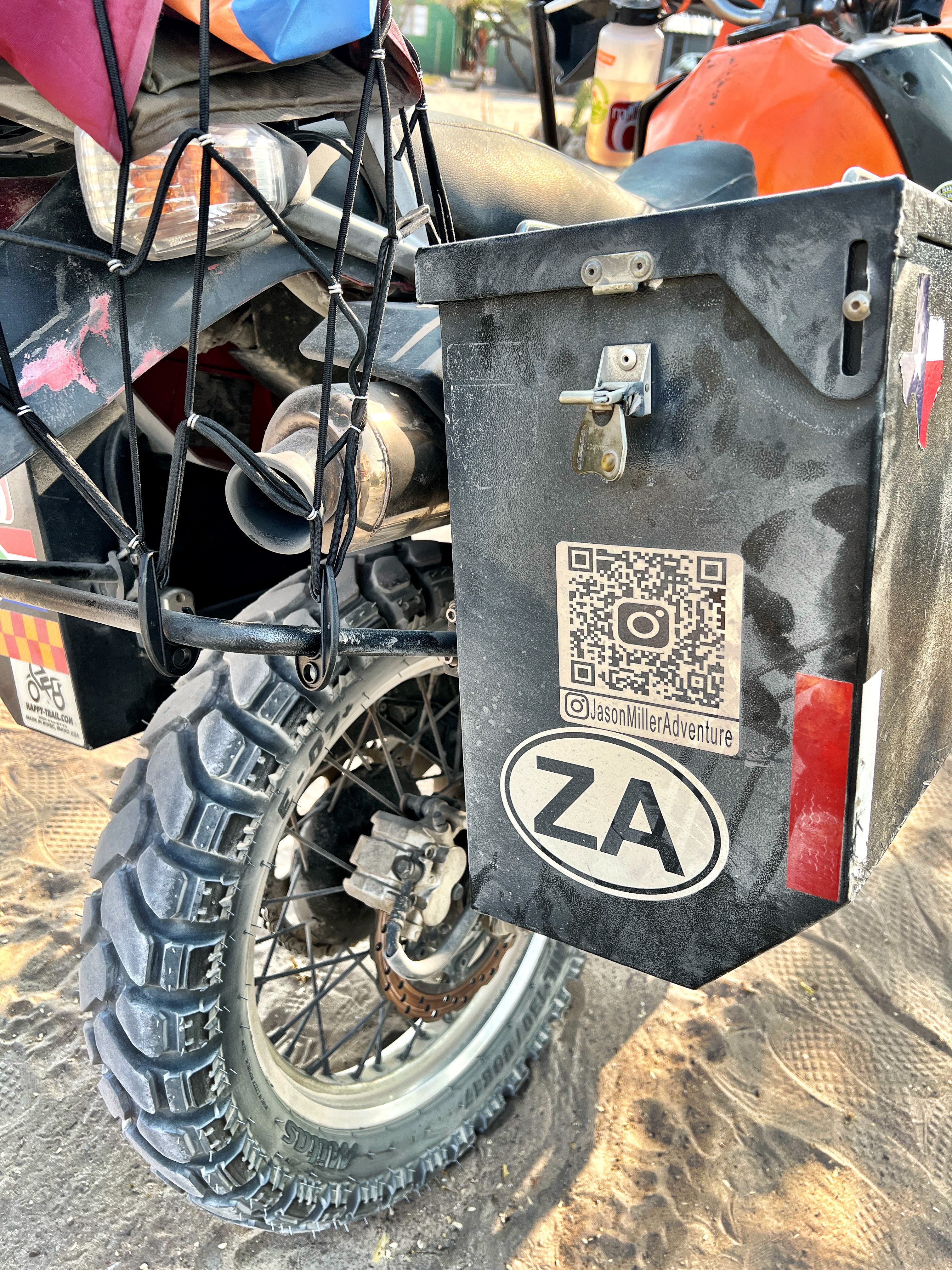
The original plan for the day was simple enough: after breakfast I would continue riding out to Japsie’s camp deeper in the bush. But as the morning progressed, I found myself struggling mentally to climb back into the saddle again. The previous day had drained me more deeply than I wanted to admit.
Then Japsie called.
He said he was already on his way into town with the truck and casually suggested I leave the motorcycle safely at Tsumkwe Lodge and ride out with him instead.
I did not argue for even a second.
In truth, the suggestion felt like a rescue.
Not only was I relieved to have a break from the motorcycle, but I genuinely do not think I had ever been that physically sore from riding in my life.
The purpose of this motorcycle journey was never simply to ride across Africa.
Adventure is certainly part of it, but the deeper reason for this trip has always been the people along the way — old friends, fellow travelers, colleagues running remarkable NGOs in difficult places, and the opportunity to spend time in regions and communities I have long wanted to know better rather than simply rushing through them.
That is what brought me to Tsumkwe.
My plan was to spend several days with my friend Japsie, whose non-profit organization, River Deep Club, works closely with the rural San Bushman communities throughout the Nyae Nyae Conservancy. In addition to community work, he is heavily involved in wildlife conservation, and I intended to spend a few days in his remote bush camp helping where possible and accompanying him as he tracked wildlife and worked alongside the Bushman communities in the conservancy.
After leaving Tsumkwe, the original route was to continue due north through the famous Caprivi Strip into Zambia and onward to Lusaka where I planned to visit another NGO operated by a friend from Texas. From there I intended to continue east, visiting additional friends and projects along the route before eventually reaching Malawi and finally my long-term destination of Nkotakota, where the motorcycle would remain stored until the next phase of the journey the following year.
It was an ambitious plan.
But somewhere between the deep sand, the endless kilometers, border crossings, mechanical issues, and the simple reality of African travel, it became increasingly clear that I had underestimated the amount of time required to move at a pace that still allowed me to actually experience the journey.
Every evening I found myself calculating distances, days, fuel, border schedules, and possible storage locations for the motorcycle instead of simply enjoying where I was.
The trip had slowly shifted from exploration toward trying to make time.
And that was never the purpose.
So after a great deal of thought, I finally accepted that Tsumkwe would likely become the finishing point for phase one of the motorcycle expedition.
There were practical reasons as well. Pine, the owner of Tsumkwe Lodge, kindly offered secure storage for the motorcycle along with access to a garage where I could properly service and prepare the bike before beginning the second leg of the journey at a later date.
The complication, however, was logistics.
To continue the remainder of my planned work and travel, I would still need to fly onward from Windhoek to Lilongwe — which meant traveling roughly four hundred kilometers back south again. Because of that, I also began considering whether storing the motorcycle in Windhoek might ultimately make more sense for future travel connections and maintenance access.
At this point, I am still not entirely sure how the details will unfold.
But for now, the plan is simple: return to Windhoek on Wednesday, fly out Thursday morning through Johannesburg, and continue onward to Lilongwe for the next stage of the adventure.
The next two days were exactly what I had hoped this journey across Africa would become.
Japsie and his wife Razan were wonderful hosts, and life immediately slowed into the rhythm of the bush. The stress of roads, fuel, breakdowns, and distances faded away as we spent our days tracking leopard and elephant through the vast wilderness of the Nyae Nyae Conservancy.
At one point we were also able to supply one of the local Bushman communities with a blue wildebeest, providing badly needed protein at a time when hunting in the area had been difficult and increasingly scarce. Watching the way the meat was carefully distributed and appreciated was a humbling reminder of how different life remains in remote parts of Africa where nothing is wasted and every successful harvest matters deeply.
Over those days, Japsie taught me a tremendous amount about the history of the conservancy, the challenges facing wildlife conservation in the region, and his long-term vision for helping the San Bushman communities maintain both opportunity and cultural identity while navigating the realities of the modern world. It became clear very quickly that his work extends far beyond conservation alone — it is equally about people, dignity, and preserving ways of life that are slowly disappearing.
The evenings were perhaps my favorite part.
As darkness settled across the bush, we would gather around the campfire listening to the distant sounds of animals moving somewhere beyond the trees — elephants breaking branches, jackals calling, and occasionally the haunting cry of something unseen far off in the night. Travelers and researchers from all over the world drifted through the camp, and conversations stretched late into the evening beneath unbelievably clear African skies filled with stars.
Places like that attract interesting people.
And somehow, after the chaos and struggle of the ride north, sitting quietly around a fire in the middle of the Namibian bush felt like exactly where I was supposed to be.
It was finally decided that I would leave the motorcycle behind in Tsumkwe under Pine’s care and ride back to Windhoek with Jan on Wednesday, as he needed to collect supplies in town anyway.
In many ways it felt strange preparing to leave the bike behind after everything we had already survived together on our journey from Cape town.
I secured the motorcycle inside a shipping container for storage, draining the fuel, disconnecting the battery, and carefully organizing all of my camping gear, tools, and travel supplies for the next phase of the expedition. It felt less like ending a trip and more like pressing pause on it for a while.
Tuesday evening turned into one of those memorable African bush gatherings that seem to happen naturally in remote lodges.
A large dinner was organized at Tsumkwe Lodge with guests and locals from all over the region joining around the table. Among them was a missionary who had lived and worked in the area for over twenty years, and I found myself deeply enjoying long conversations with him regarding the complexities of helping people effectively in rural Africa — the successes, mistakes, unintended consequences, and difficult balance between aid and dependency.
Honestly, the knowledge and stories that man carried could fill an entire book by themselves.
Also staying at the lodge was a documentary crew working on a project about the “Ghost Elephants of Angola,” tracking the historic migration routes elephants once used moving between Namibia and Angola before modern borders, fences, farms, and expanding settlements disrupted those ancient pathways. Their efforts focused on restoring portions of those migration corridors so wildlife could once again move more naturally across the region.
It was fascinating listening to people so passionate about the bush, conservation, and Africa’s future.
Pine and his lovely wife Dickie joined us as well, and the entire evening carried that rare feeling of warmth and camaraderie that often develops among travelers and bush people gathered together far from the modern world.
Eventually, knowing Jan and I planned an early departure the following morning, I excused myself quietly and returned to my room to finish packing and get some sleep before the long drive back to Windhoek.
Surviving the Sands: A Cape Town to Tsumkwe Tale
Copyright © 2026 by D. Jason Miller
All rights reserved. No part of this publication may be reproduced, distributed, or transmitted in any form or by any means, including photocopying, recording, or other electronic or mechanical methods, without the prior written permission of the publisher, except in the case of brief quotations embodied in critical reviews and certain other noncommercial uses permitted by copyright law.

