The sound of Africa is not the thundering rumble of a distant lion, nor is it the hollow trumpet of a bull elephant. If Africa has a voice, it is the hyena…From the first, faraway woooo-uppp of the pack gathering to the sniggering chitter of the kill, the hyena is telling you something you don’t want to be reminded of: you’re just meat after all and your day will come.
– Peter Hathaway Capstick, Death in the Long Grass
Walking along the crowded dirt path, five-year-old Njoroge Gitau clutched a few coins tightly in his small hand. His mother had sent him to the roadside market to buy vegetables for the evening meal, a task he had done many times before. In the fading light of a Kenyan evening, the world around him felt ordinary — familiar voices drifted through the air, bicycles rattled past under impossible loads of firewood, and women balanced baskets of produce on their heads as they hurried home before darkness swallowed the road.
To young Njoroge, there was nothing to fear.
But hidden beyond the edge of the path, where the scraggly bushes twisted among stripped, lifeless trees, something watched.
The area was heavily urbanized, scarred by litter, plastic bottles, and the endless signs of human life. People were everywhere. Yet as the sun bled red across the western horizon and darkness rose with terrifying speed, all unseen eyes were fixed on the little boy walking alone.
Every step he took was measured.
Every stumble was studied.
And in the shadows, patience waited.
The predator moved silently through the thin brush, almost invisible against the coming night. A fisi — a hyena — lean, hungry, and calculating. Though people passed within yards of it, the animal remained perfectly still, waiting for the one moment when the noise, the movement, and the chaos of the evening would hide its attack.
Then it struck.
Without warning, the darkness exploded.
A blur of fur and teeth launched from the bush with horrifying speed. In seconds, Njoroge was ripped from the path and swept off his feet before anyone could react. His terrified screams shattered the evening air as the hyena dragged him violently into the shadows.
People dropped their bags and ran.
Men shouted.
Women screamed.
But the bush swallowed both predator and child almost instantly.
No amount of struggling could loosen the beast’s jaws. No desperate cry could summon help fast enough. By the time villagers fought their way into the darkness, the terrible silence had already begun to settle over the night.
The little boy who had left home to buy vegetables for dinner would never return.
And as the village gathered beneath the cold African night, grief spread from one family to an entire community — another heartbreaking reminder that even at the edge of civilization, the wild still waits patiently in the dark.
The horror of Njoroge Gitau’s death was not an isolated tragedy. It was the third fatal hyena attack in the region in September 2024 alone, and by the following morning, grief had turned into fury.
Crowds gathered beneath the pale morning light, their anger boiling over as devastated residents demanded immediate action from the Kenya Wildlife Service. Mothers clutched their children tightly. Fathers shouted in frustration. Elders warned that if the killings continued, riots would erupt across the region.
For the people living in these villages, fear had become part of daily life.
According to residents, entire clans of hyenas had been roaming through communities including Nyacaba, Maraba, Athi, Jujafarm, Muthaara, Magomano, Kiahuria, and Mukuyu, moving like ghosts through the darkness. Night after night, livestock disappeared, terrified screams echoed from homes, and villagers spoke of glowing eyes watching from the bush just beyond their doors.
The attacks had transformed ordinary evenings into scenes of dread.
Parents no longer allowed children to walk alone. Doors were bolted before sunset. Fires burned through the night in desperate attempts to keep the predators away. Even the rhythms of school life had changed under the shadow of fear. Schools now opened after 8:00 a.m. and closed by 4:00 p.m., giving children enough daylight to make it home before darkness fell across the villages.
Because once the sun disappeared, nobody felt safe.
What had once been scattered sightings of wildlife had become a full-scale nightmare unfolding on the edge of human settlement — a terrifying collision between expanding communities and predators growing bolder with every passing night.
And after the death of little Njoroge, many residents believed the situation had crossed a line from fear… into war.
What made the attacks even more chilling was how rare such incidents are in modern Kenya. In a country densely populated with farms, villages, highways, and expanding towns, fatal hyena attacks are considered highly unusual. For generations, people and wildlife have existed in uneasy balance, with most hyenas avoiding direct confrontation with humans whenever possible.
But something had changed.
Over the past two years, these predators had allegedly claimed the lives of multiple residents — especially children and the elderly, the most vulnerable members of the community. Stories spread from village to village of people vanishing after dark, of livestock dragged from compounds, and of eerie laughter echoing through the night just beyond the glow of cooking fires.
Fear was no longer fueled by rumor alone.
The same names kept appearing in whispered conversations: Nyacaba. Maraba. Athi. Jujafarm. Muthaara. Villages where residents claimed entire clans of hyenas had grown frighteningly bold, moving through human settlements with little fear.
And that was the question that refused to go away:
Why?
Why would hyenas begin targeting humans so aggressively in one of the most populated regions of Kenya? Was it hunger? Habitat destruction? A collapse of natural prey? Or had these animals simply adapted to life among people in ways no one fully understood?
Determined to uncover the truth behind the growing terror, I decided to investigate this particular pack of hyenas and the region they haunted — to follow the stories into the darkness and search for answers hidden somewhere between human expansion and the ancient instincts of a predator that has survived Africa for thousands of years.
On a cool August evening, Esther — not her real name — failed to return home, sending a ripple of fear through her family and friends.
Esther was a proud businesswoman who owned and operated a small kibanda, a roadside food kiosk located just four kilometers from the busy Thika Highway. Known for her hard work and determination, she spent long days serving customers from dawn until dusk, earning a living one meal at a time.
But on this particular evening, something felt wrong.
As darkness settled over the villages and traffic along the highway slowly faded into the night, Esther still had not returned home. Her phone went unanswered. Relatives began calling neighbors, friends, and nearby shop owners, desperately searching for any sign of her. Hour after hour they waited, clinging to hope as anxiety spread through the family home.
No one slept that night.
By the following morning, troubling details began to emerge. Witnesses reported that Esther had closed her kiosk around dusk and left to purchase cabbage and other supplies for her business — a simple errand she had likely made countless times before.
But this time, she never came back.
Authorities arrived at first light, combing through the surrounding bush as the rising African sun cast long shadows across the landscape. Before long, the search revealed the heartbreaking truth: Esther had fallen victim to the jaws of a hyena sometime during the night.
Her belongings were scattered just a few meters from the attack site and the Hyenas devoured her head, stomach and waist leaving her body and belongings in the hot African sun. Her family is currently seeking legal action against Kenya Wildlife Service who they claim continues to put wildlife above the lives of the local population.
Today, Juja and Thika stand as sprawling industrial cities—vastly transformed from what they once were. Not long ago, this region, just about 30 kilometers from Nairobi, was a place of wild escape. People would travel out to hunt, camp, and immerse themselves in open bushland filled with wildlife and adventure.
But over the past two decades, rapid population growth and relentless development have reshaped the landscape. What was once rich with natural habitats has been steadily replaced by concrete, high-rise apartments, expanding markets, and dense human settlement. Much of the wildlife has disappeared, and with it, large portions of the native flora and fauna have been lost.
Today, the visitor is met not by open wilderness, but by an overwhelming mosaic of buildings, traffic, and constant human activity—a landscape where nature has been pushed to the margins.
I work for an organization just east of Thika along the Garissa Highway, and I have spent considerable time in this region. Over the years, I have studied human–wildlife conflict in depth, witnessing firsthand the shifting balance between development and the natural world it has displaced.
What makes the hyenas of Juja particularly complicated is not only their behavior, but the way they are understood by the people who live alongside them.
In parts of the community, attacks attributed to Spotted hyena are sometimes interpreted through a lens of superstition—seen not simply as wildlife encounters, but as the work of evil spirits, witches, or curses, with explanations rooted in magic or spells rather than ecology and habitat pressure. These beliefs, while deeply culturally embedded for some, often blur the line between fear and fact, making an already difficult human–wildlife conflict even harder to address.
The name Juja itself is also wrapped in layers of folklore and superstition, adding to the sense that the landscape carries meanings beyond the physical—stories that persist alongside the rapid urban and industrial transformation of the area.
Originally, the area was known as “Weru Wa Ndarugu”—the Ndarugu plains, as translated from Kiswahili. Before the rise of modern towns and highways, this name described a wide, open landscape defined by grasslands, wildlife, and seasonal rhythms of the land.
What makes the history of this place especially fascinating is the story behind its transformation. Over time, the plains that once defined it were gradually reshaped by settlement, development, and changing human movement patterns. With each passing decade, the identity of the land shifted—its original name slowly giving way to newer associations, new boundaries, and new meanings imposed by growth and urban expansion.
Yet even now, the echoes of “Weru Wa Ndarugu” remain embedded in local memory, hinting at a landscape that once was very different from the dense and rapidly evolving region seen today.
Introducing Mr. McMillan
Born in 1872 in St. Louis, Missouri, William Northup McMillan came from a wealthy family, and like many young men of his class and era, he was drawn irresistibly to adventure. Restless and curious, he travelled widely across the globe, driven by the same impulse that pushes some to always seek what lies beyond the next horizon.
His first major journey to Africa came with an expedition into Ethiopia, aimed at exploring the Blue Nile and determining whether it was navigable toward its source. The mission combined ambition, science, and imperial-era curiosity about the continent’s great river systems. For his contributions during this expedition, he was reportedly awarded two medals by Emperor Menelik II, marking an early recognition of his role in a remarkable chapter of exploration.
William’s life unfolded as a continuous pursuit of movement, opportunity, and discovery. William Northup McMillan travelled extensively across continents, moving with ease between frontier economies and emerging industries. In the United States, he spent time ranching cattle in New Mexico and Texas, absorbing the rhythms and hardships of the American West.
His ambitions soon carried him further afield. He invested in and worked within the oil fields of Romania, engaging with one of the early centers of European petroleum development. Later, his interests extended into Southeast Asia, where he invested in Malaysian rubber plantations, aligning himself with the global commodity booms of the era.
Beyond commerce, McMillan was also drawn to exploration. He travelled along the coasts and inland waterways of West Africa, visiting remote communities and engaging with local cultures. During these journeys, he developed a strong curiosity about belief systems, particularly the role of superstition, witchcraft, and spiritual practice in daily life among various tribes.
On one occasion, after meeting a village chief in a remote settlement, he was presented with two small fetish statues. They were said to bring “good luck” and “safety” on his voyage across the sea. He was warned in no uncertain terms that if he failed to protect and cherish them, he would perish at sea—a message that, whether taken literally or symbolically, clearly left a lasting impression on him.
The chief also told him that the two statues were named—one “Ju” and the other “Ja.” To William Northup McMillan, the names likely carried little immediate weight beyond their novelty, another curious detail gathered on a life already filled with unusual encounters and distant customs.
Taking them as he had many other artifacts and mementos from his travels, he carefully packed the figures away and continued on his journeys, transporting them safely from one continent to another as his adventures carried him across the world.
We have all heard the term “juju,” commonly used to describe witchcraft or spiritual forces. In many contexts, it refers to an object that is believed to have been deliberately infused with supernatural or magical power.
Juju remains a living and widely recognized tradition in parts of West Africa, and it continues to hold influence in countries such as Benin, Togo, Ghana, and Nigeria. In these regions, juju practices are often deeply interwoven with cultural belief systems, spiritual life, and traditional healing practices.
The origin of the word itself is debated. One theory suggests it may derive from the French word joujou, meaning “toy” or “plaything,” possibly used by early European observers to describe ritual objects they did not fully understand. Another, often more locally grounded explanation links it to Hausa usage, where “juju” is associated with fetish objects or spiritually charged items. Given the historical timelines, some scholars argue the Hausa derivation may be more plausible, since French contact in parts of West Africa came later in many inland regions.
Like many terms shaped by cross-cultural encounter, “juju” likely carries layers of interpretation—filtered through language, colonial observation, and indigenous belief systems rather than a single clear origin.
Like many before him, young William Northup McMillan fell deeply in love with Africa and ultimately chose to settle in British East Africa, then known as the Kenya Colony.
He arrived on September 14th, 1904—exactly 120 years to the month before the death of young Mulwo, a detail that would later take on a symbolic resonance in the broader telling of this story. Accompanied by his wife Lucie, McMillan stepped into a rapidly changing colonial frontier at the port of Mombasa. From there, they boarded the famed Uganda Railway, the iron lifeline pushing inland through the vast landscape toward the highlands.
Their journey culminated in the rising colonial hub of Nairobi—at the time a young and ambitious settlement, already showing signs of becoming the administrative and commercial heart of the region. Here, amid dust roads, new buildings, and the restless energy of a growing town, they began the search for their new home, setting the stage for the next chapter of their life in Africa.
At that time, the land north of Nairobi stretched outward as a vast, open landscape—an expanse of grassland and bush alive with wildlife, silence, and a sense of untouched distance from the growing colonial town. It was a place that still felt raw and unclaimed, where settlement was thin and the rhythms of nature remained dominant.
In this setting, William Northup McMillan and his wife Lucie made a significant land purchase along what is now Thika Road, acquiring approximately 19,000 acres of this northern frontier. The scale of the holding stood in striking contrast to the formal regulations of the time, which typically limited settlers to around 5,000 acres of land and were governed by strict rules regarding ownership, allocation, and imperial oversight.
Their acquisition reflected both the ambitions of wealthy settler families and the broader colonial structures that shaped land distribution in British East Africa. In a region where land was rapidly becoming a contested and carefully controlled resource, such holdings marked not just privilege, but also the beginning of profound transformation for the landscape and those who lived within it.
One evening, while sorting through large crates of personal effects, William Northup McMillan came across something he had long forgotten—his two small carved figures, Ju and Ja, carefully wrapped in straw inside a wooden crate. He had carried them through years of travel, though without attaching much significance to them, and here they were again, returned quietly into his life.
Amused rather than sentimental, he placed them on the mantle as a curiosity and returned to his work of correspondence and paperwork regarding his new land purchase. To his satisfaction, and perhaps to his surprise, the application for his requested 19,000 acres (approximately 6,100 hectares) along what is now Thika Road was approved.
Whether coincidence, timing, or sheer bureaucratic outcome, McMillan chose to view the result through a more playful lens. In a moment of irony and personal mythology, he attributed his success—half in jest—to the presence of his two “lucky” figures. From that point onward, he named his sprawling estate “Juja,” combining the names of the statues that had followed him across continents and quietly re-entered his life at a pivotal moment.
William may have regarded the attribution of his success to Ju and Ja as little more than a personal joke—an eccentric story he told himself about fortune, timing, and circumstance. Yet within the surrounding communities, the interpretation was far more serious.
In a landscape where belief systems surrounding spiritual power and objects were deeply embedded in daily life, the presence of the two figures on his estate took on a different meaning entirely. What McMillan saw as harmless curiosities were, to many locals, easily associated with forces akin to Juju—objects not separated from belief, but actively part of it.
As a result, unease began to circulate around the estate that would come to be known as Juja. Stories and interpretations spread, shaped by fear, misunderstanding, and the cultural weight such objects could carry. For some, the statues were not inert decorations at all, but potentially charged items whose presence might influence misfortune or unrest.
Within this context, what McMillan considered a private amusement became something far more consequential in the eyes of those living nearby. The estate was no longer just a vast new landholding—it had acquired a reputation, one shaped as much by perception and belief as by anything its owner intended.
The land that would become Juja gradually gained a reputation among locals as being cursed or spiritually unsettled. Whether this was rooted in fear, cultural interpretation, or the unusual presence of foreign ownership and unexplained events, it created a kind of boundary around the estate. Many chose to keep their distance. For William Northup McMillan, that separation may not have been unwelcome at all—his world was one of privacy, vast space, and controlled access.
Yet despite its isolation in local perception, the estate was far from unknown in wider colonial and international circles. On May 28th, 1909, Juja became one of the sprawling ranches visited by Theodore Roosevelt during his post-presidency African expedition. He was accompanied by his son, Kermit Roosevelt, and the hunt took place as part of a broader journey across East Africa’s game-rich landscapes.
Roosevelt later recorded aspects of these experiences in African Game Trails, noting both the quality of hospitality extended by McMillan and the extraordinary abundance of wildlife in the region at the time. The estate, for all its local reputation, was clearly embedded in the era’s global fascination with Africa’s landscapes and game.
Over the years, Juja also hosted other prominent visitors, including Winston Churchill, who, like many figures of his time, travelled through British East Africa and engaged with its frontier society. In this way, the estate occupied a strange dual identity: locally surrounded by myth, caution, and superstition, yet internationally known as a place of privilege, hunting, and imperial-era exploration.
After the death of William Northup McMillan at the age of 52, the estate he had shaped—and the reputation that had grown around it—entered a more uncertain chapter. The ranch, already surrounded by local rumor and unease, carried stories of misfortune, death, and bad luck that continued to circulate long after his passing.
In the aftermath, his widow Lucie is said to have come across the two small idols—Ju and Ja—objects that had quietly followed her husband through years of travel and eventually into the identity of the estate itself. Disturbed by the weight of the stories attached to them, she took them from the house and carried them to a more remote part of the Ndarugu valley near what is today Thika.
There, in a private and deliberate act, she is said to have buried the figures deep within the earth, intending to bring closure to the growing reputation that had formed around them and the land they had come to symbolize.
And as the telling goes, history slowly hardened into legend. Legend blurred into myth. Yet memory and naming endured. The surrounding area gradually became known as Juja—a name tied to the old estate, the estate to the idols, and the idols to a long journey across oceans, frontiers, and belief systems before finally being laid to rest in the soil of the Ndarugu valley.
In 1967, the eastern portion of the former estate was officially acquired and designated as a protected area, later becoming the Ol Donyo Sabuk National Park.
The park takes its name from the solitary 7,037-foot mountain at its heart, Ol Donyo Sabuk, a name often translated from Maasai as “large mountain.” Rising abruptly from the surrounding plains, it dominates the landscape and anchors the region’s ecology and cultural significance.
Today, the park is home to troops of baboons, various species of monkeys, and a wide range of antelope and birdlife. It is also known for its ecological density and, according to local accounts, an unusually high population of hyenas that move along its lower slopes and surrounding foothills—part of the broader predator-prey balance of the region.
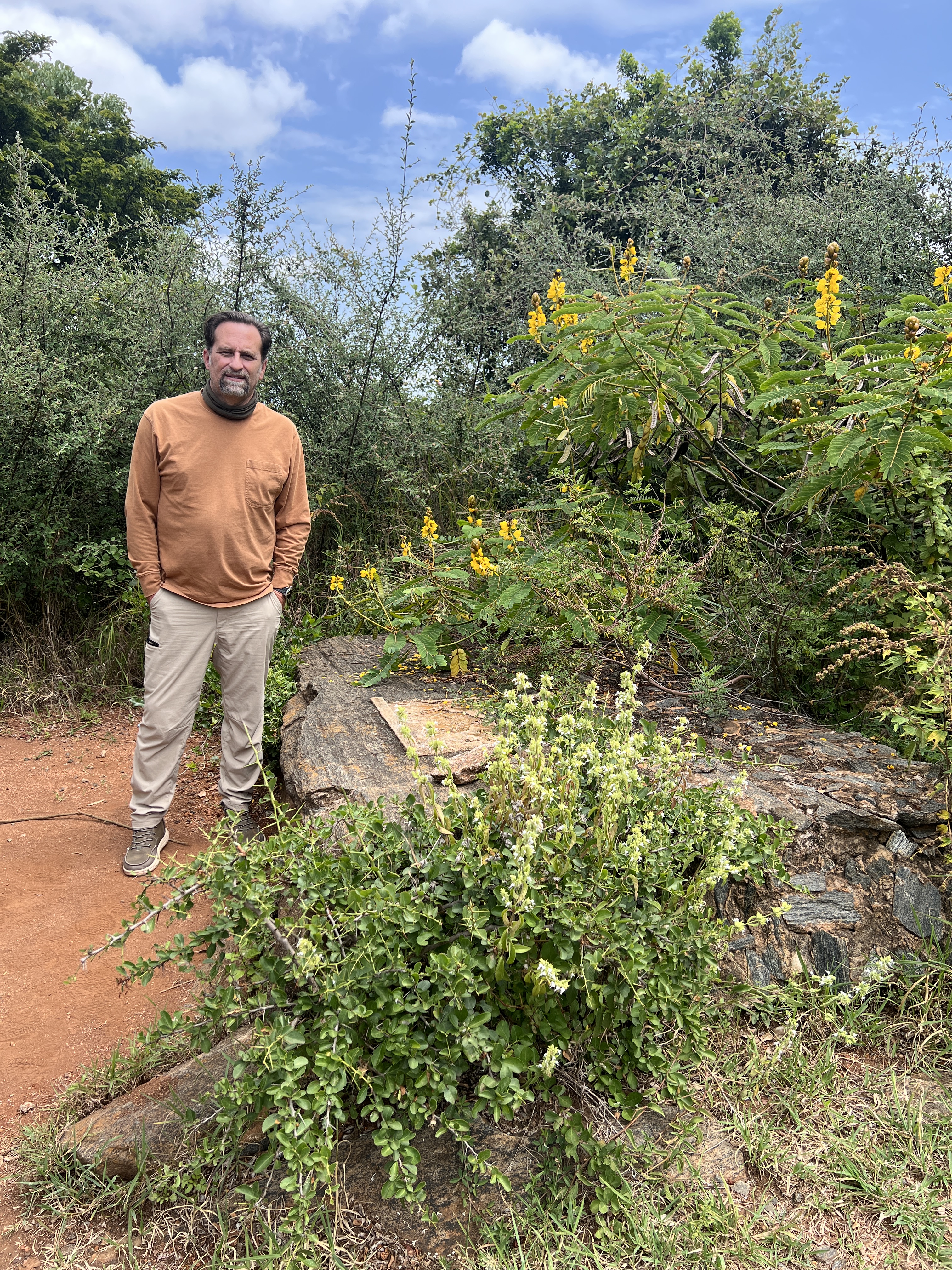
On a more personal historical note, both William Northup McMillan and his wife Lucie were buried near the summit of Ol Donyo Sabuk, overlooking the lands that once formed part of their expansive holdings. Their resting place, set high above the plains, ties their story permanently to the landscape they once helped shape—from frontier estate to protected wilderness, and from private ranchland to national park. I spent a whole afternoon digging through the overgrown bush trying to find their resting place.
It’s true that in the early decades of the Kenya Colony, incidents involving so-called “man-eaters” and “man-killers” were far more frequently recorded. As settlement expanded and colonial infrastructure pushed into previously wild regions, encounters between people and large predators became a defining—and often feared—part of frontier life.
Over time, however, the landscape changed dramatically. As wildlife habitats were fragmented and animals were pushed into increasingly isolated parks and sanctuaries, everyday contact between most Kenyans and large wild animals declined significantly. For many people today, especially in urban and peri-urban areas, direct encounters with large wildlife are rare or non-existent.
Still, the relationship between humans and wildlife has not disappeared—it has simply shifted. In regions around expanding towns such as Juja, human–wildlife conflict remains a real and ongoing issue. As urban areas expand into former habitats and ecological corridors, animals such as baboons, monkeys, and occasionally larger predators can move into human settlements in search of food or territory.
From a research perspective, these interactions are often more complex than simple “predator versus human” narratives. They involve land-use change, resource competition, seasonal movement patterns, and human behavior as much as wildlife behavior. In some cases, what is perceived as “wildlife hunting humans” is better understood as a convergence of shrinking habitat, opportunistic feeding, and accidental or defensive encounters in increasingly shared spaces.
It’s fair to say that in heavily transformed landscapes, wildlife often adapts under pressure rather than choice. As urban expansion surrounds remaining habitat pockets, natural prey bases can decline, and fragmented ecosystems can force animals into more opportunistic survival strategies. In areas around Juja, for example, changing land use and human density can reshape food availability for a range of species, sometimes increasing overlap between wildlife and human activity.
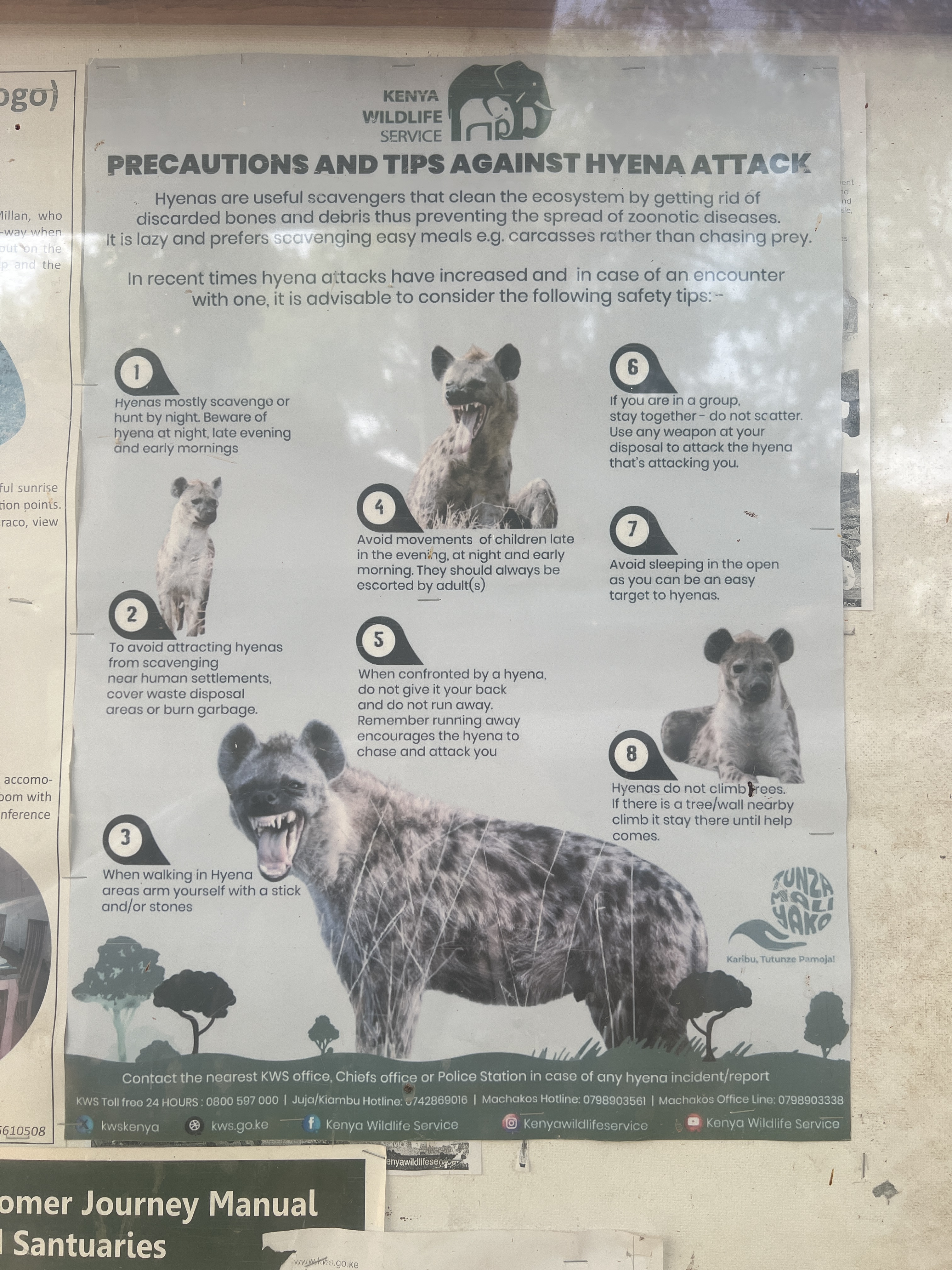
In such environments, scavengers and generalist feeders tend to be the most resilient. Among them is the Spotted hyena—locally referred to as fisi. It is one of the most adaptable large carnivores in Africa, capable of surviving on a remarkably wide range of food sources, from active hunting to scavenging carrion and, in some cases, exploiting human-generated waste.
Their success is rooted in both biology and behavior: strong jaws capable of processing bone, highly flexible diets, and complex social structures that allow them to coordinate movement and feeding over large territories. They can endure periods without food, but they are also highly efficient when resources are available, which is why they persist even in landscapes heavily altered by human activity.
In human-dominated areas, this adaptability can bring them into closer proximity with settlements, especially where waste management, livestock practices, or habitat edges create easy access to food. This is where ecological resilience and human perception often collide—shaping the reputation of an animal that is, in reality, responding to rapidly changing conditions rather than acting outside of them.
Hyenas or “Fisi” in Kiswahili—rightly or wrongly—have long been portrayed in a negative light: a dangerous, cowardly creature, laughing and whooping through the night while searching for its next prey. African folklore paints the hyena in many forms, from witches to ancestral spirits, and in regions where they are common, their nocturnal calls can be deeply unsettling, yet undeniably fascinating.
When staying at a friend’s camp in the Nyae Nyae Conservancy in rural Namibia, we would often leave scraps out in the bush for the hyenas. Then, sitting quietly around the fire, we would listen as they called to one another—summoning their kin to share in the feast. The sounds carried clearly through the night: bones cracking under immense jaws, the constant jostling and fighting over scraps, a raw and unfiltered expression of survival at work in the darkness.
And a night in a bush camp would never be complete without the eerie serenade of hyenas drifting through the darkness, settling into the uneasy silence and sending one to sleep under the thin canvas of a tent—wrapped in that strange, false sense of safety that only the African bush can provide.
Among the Mbugwe people of the Manyara region in Tanzania, traditional belief systems surrounding the Spotted hyena are especially rich and complex. In local cosmology, witches—often understood in the context of witchcraft practitioners or waganga in broader regional terminology—are sometimes believed to keep hyenas as spiritual assets or familiars, referred to metaphorically as “night cattle.” In these accounts, such hyenas are thought to be controlled or influenced by their owners and may even be “marked” in symbolic ways.
Field reports and oral traditions also describe interpretations in which hyenas found with unusual markings or adornments—such as beads entangled in their fur—are seen as confirmation of these beliefs. Within this worldview, the hyena is not merely an animal but part of a moral and spiritual system that links human intention, misfortune, and the unseen world.
Further stories describe witches riding hyenas at night, using them as nocturnal mounts to travel across the landscape and return before dawn. These narratives form part of a wider folklore tradition in which boundaries between human and animal, physical and spiritual, are fluid rather than fixed.
Other beliefs extend into social interpretation as well: for example, some traditions hold that a child born at night while hyenas are active may grow up to be associated with theft or antisocial behavior. In contrast, certain uses of hyena-derived substances—such as dung in medicinal or protective contexts—are also recorded in ethnographic accounts, including the belief that it may contribute to a child’s strength or development.
Importantly, these beliefs also influence behavior toward the animals themselves. In some communities, there is reluctance to kill a hyena due to fear of spiritual retribution from its supposed owner. Where killings do occur, they may be followed by ritualized actions such as dismemberment and burial in separate locations, intended to symbolically disrupt any connection between the animal and a human agent.
Taken together, these traditions illustrate how the Spotted hyena occupies a space that is both ecological and symbolic—existing not only as a predator and scavenger, but also as a deeply embedded figure in cultural explanation, morality, and the interpretation of the natural world.
Life in the bush is often shaped as much by perception as by reality, and the Spotted hyena frequently sits at the centre of that intersection. In many rural landscapes, nocturnal animals in general are associated with uncertainty and fear, and hyenas—because of their calls, scavenging behaviour, and nocturnal activity—have often become focal points for those anxieties.
Across parts of the Horn of Africa, including Ethiopia, there are longstanding traditions in which certain social roles and occupations are linked symbolically with spiritual power. In some accounts, blacksmiths have been viewed ambivalently, sometimes associated with esoteric knowledge or transformative abilities, including beliefs that they could assume the form of hyenas. These narratives are part of a broader folklore framework rather than literal claims, reflecting how communities have historically tried to explain unexplained events, death, or disturbances in the night.
It is also true that hyenas are scavengers, and in areas where burial practices are shallow or where remains are exposed, they may feed on carrion. In some communities, this ecological reality has been woven into cultural interpretation, strengthening associations between hyenas and death, transition, or the boundary between the human and natural world.
Similar motifs appear in various forms across parts of Africa, including regions of Chad, Morocco, Sudan, and Mali, where oral traditions sometimes describe humans who can transform into hyenas or use them as spiritual extensions to move through the night unseen. These stories are part of a wider mythological landscape in which the boundaries between human identity and animal behaviour are fluid, especially in explaining fear, misfortune, or unexplained nocturnal events.
Seen together, these beliefs highlight how the behavior of a highly adaptable carnivore like the Spotted hyena has been interpreted through cultural, spiritual, and symbolic lenses across different regions—shaped less by biology alone and more by the human need to give meaning to the unseen movements of the night.
Truthfully, the lowly Spotted hyena is far from the cowardly figure often painted in folklore. Ecologically, it is a crucial and highly efficient component of the ecosystem—nature’s clean-up crew, moving through the bush and stripping carcasses with remarkable speed and precision, leaving little waste behind.
They occupy a dual role as both scavenger and formidable hunter, capable of taking down prey on their own as well as competing aggressively with other predators. In many cases, they are among the final chapters in the life of a lion or other large carnivore when opportunity, injury, or age shifts the balance of power in the veld.
Despite their reputation, they are powerful and highly coordinated hunters. On more than one occasion, observers have witnessed a clan of Spotted hyena dismantle an entire zebra in under an hour—an intense, efficient process that can reduce a full-bodied animal to little more than a stain on the grassland, bones and all consumed in the aftermath of relentless feeding and competition.
In reality, they are neither simple scavengers nor mere symbols of fear, but adaptable, intelligent animals playing a vital role in maintaining ecological balance across the landscapes they inhabit.
Backing up in the timeline, after the death of William Northup McMillan, his widow Lucie eventually sold off the remaining holdings of the Juja estate. With that transition, the land that had once been a vast private ranch—shaped by colonial settlement, hunting culture, and early frontier agriculture—entered a new phase entirely.
Over time, human encroachment steadily replaced the once-open wild landscapes with expanding settlement and industry. Juja has since evolved into a thriving urban centre, with a growing population now estimated at around 160,000 people. It has also become increasingly integrated into the wider metropolitan expansion of Nairobi, reflecting the city’s outward growth and absorption of surrounding towns.
Today, Juja hosts a range of industrial activity, including plastic and paper manufacturing, alongside residential and commercial development. However, the pace of change has often outstripped structured urban planning. With limited zoning in some areas, development has taken on a fragmented character—large concrete apartment blocks rising in different stages of construction, often lining narrow dirt roads and informal pathways.
At street level, the town is busy and densely active. Markets spill into roadside spaces, small businesses operate side by side, and movement continues throughout the day and into the night. What was once open land tied to a private estate has become a continuously active urban environment—layered, fast-growing, and still in the process of defining its own form.
With the continued growth of the region and the broader expansion of the country’s infrastructure, the demand for stone and concrete has increased significantly. Around Juja and Thika, this has led to the emergence of numerous quarry sites, where heavy machinery and large tractors steadily reshape the landscape.
In these areas, entire sections of earth are excavated into vast pits—some exceeding 80 acres—where stone is extracted, processed, and transported to support construction in surrounding towns and the expanding metropolitan region of Nairobi. The result is a landscape of engineered extraction, where natural terrain is systematically broken down and removed.
Once these quarries are depleted, many are left behind and abandoned. In some cases, they gradually become informal dumping grounds, accumulating waste over time. As nature begins to reclaim these disturbed sites, rainwater collects in the deep excavations, forming large stagnant pools. These new water bodies can, in turn, create conditions for mosquito breeding and other ecological shifts.
Over time, rocky walls, crevices, and uneven terrain begin to host returning forms of life. Vegetation takes hold wherever soil and moisture allow, slowly softening the harsh lines of excavation. Small animals move into the caves and sheltered spaces, adapting to the altered environment.
In this way, the quarries become a kind of unintended cycle—landscapes first shaped by extraction and industry, and later gradually reshaped again by natural processes attempting to reclaim what was removed.
Check back for part 2
The Man Killers of Juja
Copyright © 2026 by D. Jason Miller
All rights reserved. No part of this publication may be reproduced, distributed, or transmitted in any form or by any means, including photocopying, recording, or other electronic or mechanical methods, without the prior written permission of the publisher, except in the case of brief quotations embodied in critical reviews and certain other noncommercial uses permitted by copyright law.

