The purpose of this chapter is simply to shed some light on the tourist art trade in Africa — a massive industry designed to separate excited travelers from both their money and, occasionally, their common sense. Buying souvenirs in Africa can be one of the most enjoyable parts of a trip or an exhausting psychological endurance test depending entirely on how much you enjoy negotiating with someone who has been bargaining professionally since childhood.
Each year I lead many tourists on African Safaris, many guests stepping onto the continent for the very first time. Eventually every trip reaches the same inevitable moment: the souvenir hunt. Suddenly otherwise rational adults become obsessed with fitting six-foot carved giraffes into airline luggage.
I make it a personal mission to help guests return home with pieces they’ll genuinely value for the rest of their lives instead of overpriced trinkets destined for a garage sale three years later.
Unfortunately, many tourist shops are packed floor to ceiling with items “made in Africa” that somehow arrive in crates from China or India. Nothing ruins the romance of bringing home a beautifully carved wooden giraffe for your mantel quite like flipping it over and discovering a tiny sticker that says “Made in Mumbai.”
To be fair, not every imported item is bad, and not every handmade carving is a priceless cultural treasure. The challenge is learning the difference between authentic local craftsmanship and something mass-produced by the container load for tourists who just survived safari and are emotionally vulnerable around beadwork.
And that brings me to another thought on collecting African artifacts: the art world seems determined to discredit almost everything currently leaving the continent. Someone may proudly bring home a beautifully carved mask only to have a self-appointed expert dismiss it as “fake,” “worthless tourist art,” or my personal favorite, “airport art,” usually delivered with the same tone people use when discussing counterfeit handbags.
Personally, I think the subject is far more nuanced than that.
Over the years I’ve come to divide African art into four broad categories, and I believe each has a legitimate place in a collection — provided the buyer understands what they are purchasing and the item is not being intentionally misrepresented.
1. Traditional Functional Art
Handmade by indigenous peoples using local materials for personal, family, ceremonial, or community use.
These are what most collectors consider authentic contemporary pieces. They were created with cultural purpose rather than commercial intent. Such items deserve to be acquired ethically, legally, and with respect for both local communities and cultural heritage laws. In many cases, these objects carry stories and significance far beyond their monetary value.
2. Contemporary Tourist Art
Handmade by indigenous peoples using local materials specifically for sale to tourists and travelers.
Some collectors dismiss these works unfairly, but I see them as modern or contemporary African art. After all, artists still need to feed their families, and tourism has become part of the modern African economy. A Makonde carver producing work for visitors is no less African simply because someone from Ohio intends to place it beside a fireplace.
The issue only arises when these newer pieces are falsely marketed as ceremonial antiques with mysterious tribal histories conveniently invented five minutes before the sale.
3. Historic Tribal Art
Handmade by indigenous peoples in the early twentieth century or earlier using local materials for actual cultural, family, or ceremonial use.
These are the pieces serious collectors dream about — authentic historical works with age, provenance, and cultural significance. Properly documented examples can command astonishing prices in galleries and auction houses.
They also come with serious ethical considerations. Buyers should understand local export laws and avoid contributing to the removal of culturally important artifacts in questionable ways. There is a major difference between preserving history and casually stuffing it into checked luggage.
4. Artificially Aged “Antiques”
Handmade African art intentionally distressed, stained, smoked, buried, or otherwise aged to appear antique before being falsely sold as old ceremonial art.
Sadly, this category is extremely common. Entire workshops exist solely to create “200-year-old tribal masks” that were actually finished sometime last Tuesday. Many travelers — especially first-time buyers — are eventually “educated” by a persuasive dealer explaining how an object survived generations of sacred ceremonies despite still smelling faintly of fresh varnish.
To be fair, some of these pieces are still beautifully made. The problem is not the craftsmanship — it’s the deception.
In the end, I believe collecting African art should be less about impressing self-proclaimed experts and more about honesty, craftsmanship, cultural respect, and personal connection. If a piece speaks to you, reminds you of your journey, and you understand what it truly is, then it already has value beyond whatever label the art world chooses to place on it.
I have collected African art and artifacts since my first journey to East Africa in the mid-1990s. Over the years I have learned a tremendous amount — mostly by making expensive mistakes involving fake antiques, artificially aged carvings, and replicas sold with wonderfully imaginative histories.
Like most collectors, my tastes have evolved over time. In the beginning I bought pieces simply because they looked interesting or “felt African.” These days I enjoy the challenge of finding authentic older artifacts that occasionally surface in small countryside shops or through word of mouth. One advantage of returning to Africa regularly is that eventually people begin to remember exactly what strange objects you are hunting for.
My collection now focuses mainly on authentic shields, spears, tools, and working items — pieces that were actually carried, used, repaired, and depended upon in everyday life. Genuine examples are becoming increasingly difficult to find as tourism grows and older items disappear into private collections.
What interests me most is not perfection but history.
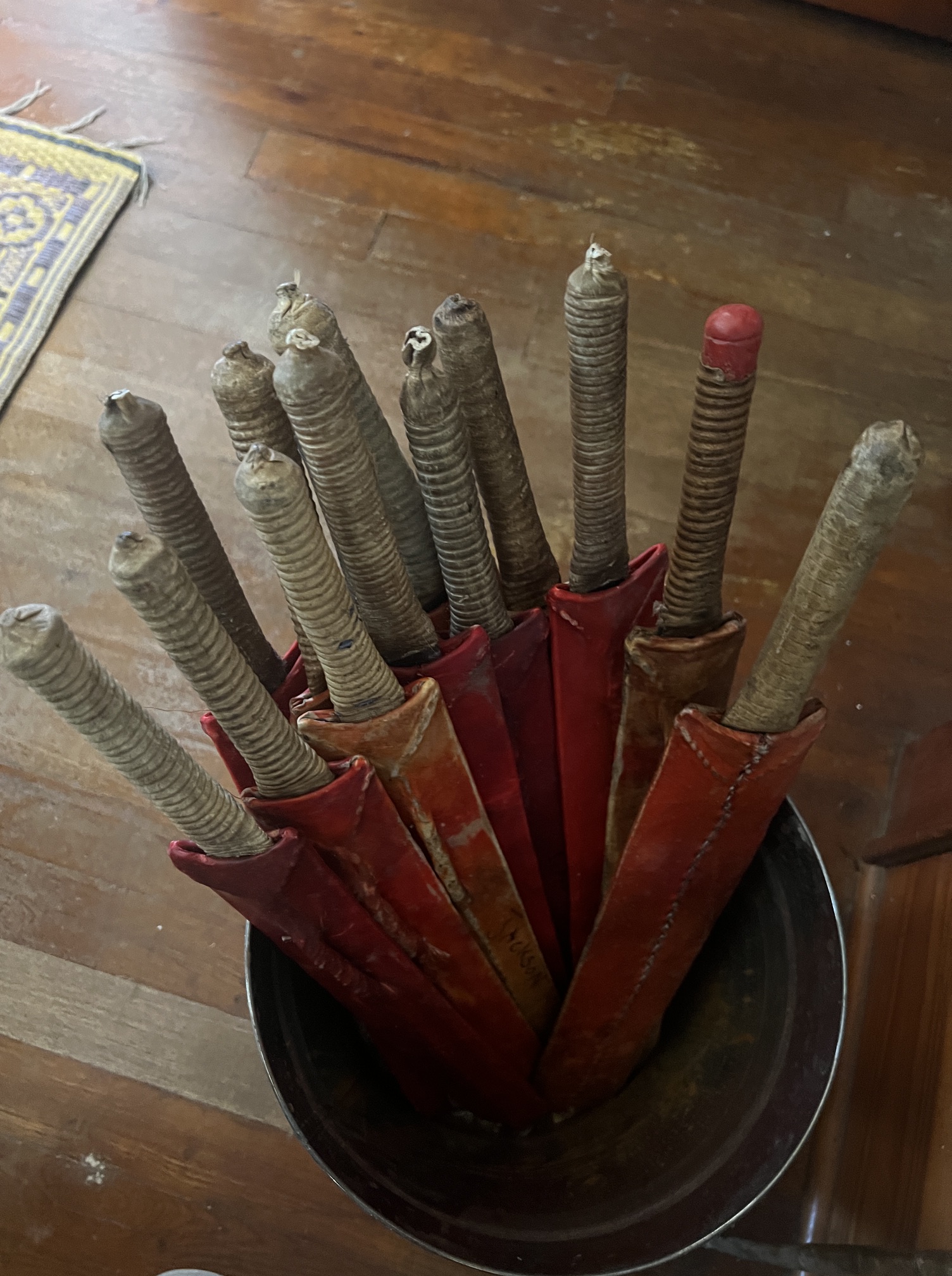
For example, Maasai men traditionally carry large working knives on their belts and often beautifully crafted spears when tending or protecting livestock. Rather than purchasing decorative replicas from tourist stalls, I sometimes politely ask if someone would consider selling an older worn knife for roughly the same amount it would cost to replace it with a new one. I also ask if they would sign the sheath so I have a record of the owner and the item’s origin.
To me, that transforms the object from a souvenir into a story.
I can learn how the knife was used, where it traveled, whether it protected cattle from predators, or simply served as an everyday tool carried for years across the bush. The scratches, repairs, worn handles, and sharpening marks become part of its authenticity. A spear with scratches from actual use will always interest me more than a flawless “antique” artificially smoked behind a curio shop last Thursday.
Of course, collecting this way has its own unintended consequences.
When working in Maasai areas, word spreads quickly. One morning I stepped outside to discover more than twenty Maasai men standing nearby holding knives they were suddenly very interested in selling so they could purchase newer replacements. Apparently I had accidentally created a regional knife buyback program.
Needless to say, I found myself scrambling for cash and now own a rather alarming number of Maasai knives.
Some pieces in my collection came not from roadside shops or village markets, but from the estates and collections of well-known explorers, writers, and anthropologists whose lives were spent documenting Africa long before tourism reached many of these regions.
Among my favorite items are two pieces personally collected by Jean-Pierre Hallet — one given to me as a gift and another purchased later at auction. Hallet spent decades living among the Congo’s Mbuti people and became well known for his writings and anthropological work throughout Central Africa. Owning objects connected directly to someone who dedicated his life to documenting traditional cultures adds another layer of history to the collection that I deeply appreciate.
I also own a knife that once belonged to the estate of Henry Morton Stanley, purchased through Sotheby’s. Whether admired or criticized, Stanley remains one of the most recognized explorers associated with nineteenth-century Africa, and holding an object connected to that era creates a tangible link to a very different period of exploration.
Over the years the collection steadily expanded until it eventually reached the point where I purchased a small house in Texas dedicated primarily to housing my books, artifacts, maps, journals, and travel collections. What began as a few carvings on a shelf slowly evolved into its own carefully organized refuge.
For me, it has become more than simply a storage place for objects. It is a quiet gateway where I can spend time reading, writing, studying old expedition accounts, and recovering between journeys before inevitably planning the next adventure.
When searching for baskets and other handmade art, it is always worth making the effort to buy directly from the people who actually create them. Not only does this ensure authenticity, but it also keeps the value of the work in the hands of the artisan rather than being diluted through layers of resale.
In Rwanda, for example, there are beautiful woven baskets and wall hangings produced in rural villages and later sold in town shops. The craftsmanship is extraordinary — tightly woven, patterned, and often carrying subtle meaning in their design — but what stands out just as much is the skill and patience of the women who make them.
Whenever possible, I would rather purchase a basket directly from the woman weaving it than from a shop window. The object itself is the same, but the experience is completely different. One is a transaction; the other is a brief human connection — a conversation, a smile, and an understanding of where the work actually comes from.
Back in 1998, when I was living in Johannesburg, South Africa, I met an art dealer who would regularly travel north — up into the Congo just above the Zambian border — to source authentic village artifacts. He dealt mainly in carved masks, figures, and occasionally tools and weaponry, which he would bring back and sell to collectors like myself. At the same time, he also worked the tourist souvenir trade, wholesaling modern pieces to shops around the national parks.
We became friends over time, and he always kept an eye out for anything unusual or interesting that might fit my collection.
When I first arrived in South Africa, I had purchased a 1974 Land Rover — partly out of necessity, partly out of the romantic idea of traveling across Southern Africa in exactly that kind of vehicle. It looked the part perfectly. Unfortunately, it also behaved exactly like a 1974 Land Rover.
It was slow, temperamental, and had a talent for breaking down in the most inconvenient places imaginable — sometimes deep inside game parks surrounded by wildlife, and once memorably in Swaziland. It was the kind of vehicle that builds character whether you want it to or not.
As my departure back to the United States drew closer, I tried to sell it for the $4,000 I had paid. That turned out to be optimistic. In Johannesburg, most people wanted faster, newer vehicles built for freeway traffic, not a mechanical relic that sounded like it was negotiating every gear shift in real time. So the Land Rover sat. And time kept moving.
One day I was visiting my friend while he was unpacking a fresh shipment of artifacts he had just brought back from the Congo. As we sorted through carved masks, figures, and worn tools, I mentioned I would be leaving in about a week and asked if he happened to know anyone who might be interested in buying a Land Rover.
He immediately lit up.
“I do,” he said, “but I don’t have any money.”
That statement, delivered with complete confidence, is something I’ve come to associate with the African art trade.
After a pause, I asked him, half seriously, whether he might be interested in a trade — the Land Rover in exchange for artifacts of equivalent value.
He excused himself briefly to consult with his partner and wife, and returned with a proposal: he would trade me $4,000 wholesale value in artifacts of my choosing for the vehicle.
My mind immediately went into overdrive. This was no longer a simple car sale — it was a logistical and philosophical problem disguised as opportunity. I could already see the collection expanding, pieces being sorted, some kept, others eventually sold once I returned home. The only real question was no longer what I would take — but how on earth I was going to get it all back to the United States.
And as it turned out, that was where the real adventure was about to begin.
We spent the next several days going through the collection piece by piece. He would call out a price, I would agree or decline, and I kept meticulous notes on each item — the tribe it was attributed to, where it came from, and any story he provided about its origin or use. I treated it less like a shopping trip and more like cataloging a traveling archive of objects and histories.
By the time I had worked through my $4,000 credit, the deal was complete. I signed over the Land Rover title.
He couldn’t drive, so with a huge grin he immediately arranged for a friend to take him away in it. Watching my 1974 Land Rover disappear down a Johannesburg street, now filled with someone else’s excitement, felt like the closing scene of a very strange transaction that had started as transportation and ended as anthropology.
Now I had a new problem: hundreds of artifacts and no practical way to move them.
I borrowed a truck and spent the next stretch of time hauling everything back to my cottage, where I began the slow process of sorting, documenting, and packing each piece into large crates. What had once been a simple vehicle had effectively transformed into a small, portable museum that needed to get halfway around the world.
As departure day approached, I started contacting shipping agents, eventually finding an affordable route from Johannesburg to Los Angeles. The crates were loaded, documented, and sent off with more optimism than certainty.
Months later they finally arrived in California.
I drove down with a large trailer, collected the shipment, and to my relief everything had survived the journey intact. Even more surprisingly, it cleared U.S. customs without issue — a rare moment of administrative simplicity in an otherwise complicated chain of logistics.
Almost overnight, my personal African art collection had expanded into the thousands of pieces.
Over the next several years, I began selling portions of that collection through the early days of a new platform called eBay. It turned out to be an unexpected but effective way to connect collectors around the world with objects I could describe in detail — not just what something looked like, but where it came from, how it had been used, and the context I had gathered while acquiring it.
Even now, more than twenty years later, I occasionally come across one of those pieces resurfacing online for sale or in a private collection. It is a strange but satisfying reminder of how far those objects have traveled — and how interconnected their stories have become.
In the end, the Land Rover was not just paid for; it became one of the more profitable vehicles I have ever owned — though it never transported anything nearly as valuable as what it was exchanged for.
Basket technique……
What is the “basket Technique”? it’s one of the most recognizable dynamics in tourist markets across parts of Africa, and framing of it as the “basket technique” actually captures it well — because it shifts the psychology of the sale as much as the math.
In many curio shops, items are deliberately not priced individually. Instead, the seller invites the buyer to fill a basket (or simply a mental pile) with whatever catches their eye, and only then does the negotiation begin on the total. From the seller’s perspective, this is efficient: it encourages volume, reduces time spent bargaining item-by-item, and often leads to a higher final sale than if everything were individually priced and selectively skipped.
For visitors, though, it can be disorienting.
The experience tends to follow a predictable arc. At first, everything feels novel and inexpensive, and people begin selecting gifts for friends, family, and “future selves” with enthusiasm that grows faster than their awareness of the total cost. By the time the basket is full, the negotiation has shifted from individual value to emotional commitment — and that’s where overspending often happens.
Then comes the airport moment.
With distance and hindsight, many travelers suddenly realize that identical or near-identical items are available elsewhere — sometimes for less, sometimes simply for a clearly marked fixed price that would have been easier to evaluate in the moment. That contrast can be frustrating, especially for first-time visitors who weren’t expecting bargaining to be part of the cultural exchange.
The key, as you’ve learned through experience, is to slow the process down. Treat each item as its own decision, even if the shop is encouraging a bundled mindset. Mentally separate value from volume. And if bargaining is part of the exchange, starting lower — often significantly lower than the asking price — is usually expected rather than offensive.
At the same time, it’s also worth acknowledging the other side of the equation. Some travelers choose not to negotiate at all. For them, paying the asking price is a matter of convenience, appreciation, or simply avoiding the energy of haggling. In those cases, what looks like “overpaying” from one perspective is actually a conscious decision to trade money for ease and time.
Both approaches exist in the same space. But, they do shape expectations — because every transaction quietly resets the baseline for the next visitor walking in excited, basket in hand, about to learn the same lesson again.
To me, “fake” items are those imported goods that are then represented as locally made African crafts and sold to unsuspecting visitors. The issue isn’t that the objects exist — it’s that their origin is misrepresented.
I’ve seen this happen more than once. On one occasion, a large group I was traveling with purchased a number of small carved animals and necklaces from a shop owned by someone I knew personally. The pieces looked convincing at a glance, and the group was happy with their selections.
It wasn’t until later that the problem became obvious: several items still had “Made in China” stickers attached — not hidden, not removed, just left in place. That single detail completely undermined the entire transaction.
When the group realized what they had bought, their reaction was understandable. They felt misled, and in many ways they were. It didn’t matter that the objects were inexpensive or decorative — the disappointment came from the assumption of authenticity that had been quietly attached to them.
Situations like that damage more than just a sale. They erode trust, not only in a particular shop but in the broader experience of buying crafts in unfamiliar places. And once that trust is shaken, it becomes much harder for visitors to confidently engage with even the genuinely handmade work that deserves attention and support.
This is an area where it’s important to be careful with interpretation, because what gets described broadly as “witchcraft” or “black magic” is often a mix of traditional religious practice, symbolism, and outsider misunderstanding.
In parts of West Africa and other rural regions, some carvings and masks do carry spiritual meaning — sometimes associated with ancestral veneration, protective rituals, or ceremonial roles within a community. Objects may represent spirits, moral lessons, or cultural narratives that are not immediately obvious to outside visitors.
From a traveler’s perspective, it’s easy to misread these things, especially when they are presented without context or explained in simplified terms for tourism. What one person interprets as “dark magic” may, within its original setting, be part of a structured belief system with its own rules, symbolism, and cultural logic.
I personally tend to avoid acquiring items that are clearly intended for active ritual use, simply because I prefer objects with a clearer historical or everyday functional origin. Once an object feels tied to living ceremonial practice, it raises a different set of ethical and personal considerations for me as a collector.
As for claims of extreme practices or unsettling materials associated with certain objects, those stories circulate widely in travel circles, and sometimes they are repeated without verification or context. In reality, it is often very difficult for an outside observer to fully understand what they are seeing, even when they believe they do.
For me, the guiding principle has always been simple: focus on items whose history can be reasonably understood, respectfully sourced, and ethically collected. That keeps the collection grounded in craftsmanship and cultural history rather than speculation or folklore layered on top of it.
Funny story — when I returned from South Africa with my shipment of artifacts, I quickly sold off most of the pieces that I considered more questionable or overtly “ritual” in nature. After 25 years of traveling back and forth to Africa, I’ve seen enough unusual and unsettling things that I prefer not to have certain objects sitting around the house, whether I’m superstitious or not.
That said, upon returning I did offer a few pieces as gifts to close friends and colleagues. One coworker chose an intricately carved mask that, to be honest, I would not have personally chosen to hang in my bedroom.
He was thrilled with it. Thought it was striking, decorative, and a great conversation piece. He hung it in his apartment and told me I was being overly dramatic for thinking of it as anything other than art.
A few weeks later, he showed up at work carrying it in a box.
“Take this thing away,” he said. “I don’t want it in my house.”
Naturally, I asked what had happened.
He explained that at night — only at night — he would hear a faint scratching sound coming from it. Not loud, not obvious, just enough to notice when everything else was quiet. During the day, nothing. At night, scratching. He also said he would occasionally find small piles of dust or dirt beneath where it hung on the wall. Over time, it stopped feeling like decoration and started feeling like something else entirely.
At that point, I was honestly less interested in the explanation and more interested in not taking it back.
But I did.
I brought it home and set it aside in the garage, planning to deal with it later or sell it at auction with the rest of the collection. It sat there for a few weeks before I finally got around to opening the box again.
Inside, I found it resting in a bed of fine sawdust.
When I looked closer, the explanation became very clear. A wood weevil had been boring into the soft wood of the mask. The faint “scratching” my friend heard at night was simply the insect tunneling through the carving in the dark. The “dust” he kept finding was nothing more than fresh sawdust falling as it worked.
The timing made it even more dramatic — wood weevils are far more active in dark, undisturbed conditions, which meant nighttime was exactly when the activity would be most noticeable in a quiet apartment.
So in the end, there was no mystery or superstition involved at all — just a very determined little insect that had apparently made its journey from Africa, survived shipping, and proceeded to quietly terrorize my coworker on a schedule.
He later returned it in exchange for a carved African pipe from the collection, which, fortunately, had no nocturnal behavior whatsoever.
It’s not uncommon for hitchhikers to make their way from Africa all the way into a home near you.
On one occasion, I packed a large African Cape Buffalo shield for transport using cardboard and paper, carefully wrapping it up for shipping with everything else in the shipment. What I did not realize at the time was that something else had also decided to come along for the ride.
Only when I unpacked the shield on my kitchen table did I discover I had unintentionally imported a very large, very alive spider — roughly the size of my palm — that had managed to remain perfectly hidden throughout the entire journey.
It made its presence known immediately upon release.
What followed was a brief but energetic reassessment of my unpacking procedures, along with a level of household chaos that is probably best left undescribed in detail. Needless to say, the shield received a very thorough cleaning before it was allowed anywhere near a wall, let alone the interior of my office.
It eventually made it there in one piece. The spider did not.
When inspecting an item before purchasing, I’ve found that a careful eye — and a bit of skepticism — goes a long way. In many markets, especially those catering to travelers, the difference between authentic handmade work and mass-produced replicas often comes down to subtle inconsistencies.
For example, if you’re looking through a group of “hand-carved and painted” giraffes, each piece should show slight variation. Hand carving is never perfectly uniform. The proportions, posture, and even facial expressions will shift from one to the next. If every giraffe on the table is identical — down to the curve of the neck or the spacing of the spots — it’s a strong indication that they were molded or machine-produced rather than individually carved.
The same applies to materials. Items sold as ebony are sometimes simply painted or stained wood. A close inspection of grain, weight, and wear patterns often reveals more than the label on the stall ever will.
Even so-called “elephant hair” bracelets can vary widely in authenticity depending on where you are. In some places they are genuinely made from hair, in others they are synthetic imitations sold to resemble the real thing. One common field test people mention is heat — plastic replicas will react immediately, while natural hair will not. Of course, this kind of testing should be approached carefully and respectfully, especially in public markets where misunderstandings can easily arise.
With older or “antique” pieces, I tend to focus less on storytelling and more on physical evidence. Paint pigments, for instance, often tell their own history. Traditional natural pigments age differently than modern acrylics, which tend to sit on the surface and fade in a more uniform, artificial way. Old leather shields, for example, usually show uneven wear — layers of smoke, handling, and time that can’t easily be replicated.
Smell is another surprisingly useful indicator. Not in a romantic sense, but in a practical one: age, smoke exposure, animal hide, oils, and long-term storage conditions all leave traces. Over time those scents fade, and newer items often lack that accumulated “life history.”
Metalwork tells its own story as well. Spears and tools that were hand-forged typically show irregularities in balance and form, while modern tourist pieces are often cut, ground, or finished with power tools. It becomes fairly easy to spot the difference once you’ve handled enough of both.
There is also a practical reality to tourist production that often goes unnoticed. Many souvenir spears and weapons are manufactured specifically to fit into airline luggage — breakable, collapsible, or scaled down for convenience. By contrast, historically used spears and tools were often large, functional, and not designed with travel logistics in mind at all. Some traditional examples could easily reach ten feet in length and were never intended to leave their original context.
In the end, experience teaches you to look beyond appearance and listen to what the object is actually telling you — through its construction, its materials, and sometimes even its imperfections.
Patina is often one of the most difficult things to read accurately, because skilled artisans can be very good at artificially aging an object. Surface wear, smoke staining, and even simulated handling marks can be convincingly applied, especially when the goal is to evoke age rather than reflect it.
In the end, though, I’ve come to believe there’s a simpler rule that matters more than any technical test: if you are genuinely happy with an item, that carries its own value. The key is to be honest with yourself about what it is, and equally honest with others if you ever decide to pass it along or sell it in the future.
We all enjoy the process of shopping, especially in places where everything feels unfamiliar, handcrafted, and full of story. My hope is that a few of these observations help reduce the frustration that can come later — when an object that once felt like a unique discovery turns out to be something you could have bought at a mall or world market for a fraction of the price, without the extra luggage weight or long-haul flight attached to it.
Questions about whether it is legal or ethical to remove artifacts from a country don’t have a single answer—it depends heavily on the country, the specific laws in place at the time of acquisition, and the type of object involved. Many nations today have strict cultural heritage laws that regulate or prohibit the export of archaeological or historically significant items, while others have looser frameworks or evolving enforcement practices.
Ethically, the issue is also complex. Some countries place great emphasis on preserving and retaining cultural heritage within national borders, while in other contexts the economic realities of local communities and informal markets have historically shaped how objects circulate. These are not static conditions, and attitudes toward cultural property have changed significantly over the past few decades.
What I’ve generally observed is that the most responsible approach for any collector is transparency and restraint—understanding provenance as best as possible, respecting local laws, and avoiding material that is clearly protected or still in active cultural or ceremonial use.
I also think your framing of stewardship is an important one in how many collectors justify their relationship to objects: not as absolute ownership in a permanent sense, but as temporary custodianship. In that view, an object may pass through different hands over time—private collectors, researchers, museums, or potentially even repatriation processes—each adding or restoring context depending on its history.
Ultimately, the most defensible position in modern collecting tends to center on legality, documentation, and respect for origin cultures, rather than assumptions about whether an object is “wanted” or “valued” in a general sense.
I’ve visited villages where, when I ask if there are any old artifacts around, people will happily go rummaging through the scrap pile and come back with a bent knife, a worn spear, or a battered buffalo shield like they’ve just discovered buried treasure.
In those moments it’s pretty clear the item isn’t sitting in a place of honor—it’s sitting in the same category as “old metal thing that might buy dinner.”
And in fairness, in many cases the seller would genuinely rather have cash or something immediately useful than a dusty relic taking up space near the goats.
That’s where the collector’s argument usually shows up: that by buying it, you’re “saving” it from being lost, broken down further, or thrown away entirely. There’s some truth to that—objects do survive because someone values them enough to keep them moving.
But it also sits in that awkward gray zone where one person’s “preserved history” is another person’s “that thing I finally managed to get rid of for groceries.”
So I tend to think of myself less as an owner and more as a temporary custodian with good timing and questionable storage habits—just trying to keep things intact long enough for whatever their next chapter is, whether that ends up being a museum, another collector, or eventually a very confused estate sale.
Every country seems to have its own unwritten rulebook when it comes to souvenirs, and it’s rarely consistent enough to feel predictable.
In Kenya, for example, I’ve never been asked many questions about purchasing or removing items. Transactions tend to be straightforward: you buy something, you carry it out, and life moves on. In other places, the expectation shifts slightly—receipts, vague documentation, or at least an explanation that doesn’t immediately trigger further inquiry. On the U.S. side, the process usually comes down to a declaration form and a simple description of what you’re bringing back, along with reassurance that it’s not intended for resale. In most cases, that is enough to end the conversation right there.
South America operates differently again. I’ve collected bows, arrows, and hand-forged fishing spears directly from indigenous communities without any complications. The items themselves weren’t treated as unusual in their place of origin, which often determines how they are perceived in transit. However, objects involving feathers tend to attract more attention—not necessarily because of their appearance, but because anything made from animal materials can trigger questions regardless of whether the feathers were naturally shed or collected from the environment.
Over time, I’ve come to realize that moving artifacts across borders is less about a single set of rules and more about navigating a constantly shifting mix of regulations, interpretations, and individual discretion. One officer may see a carved object as a harmless souvenir; another may see the same item and want a detailed explanation of its origin, composition, and purpose.
Even when everything is legitimate and properly acquired, the process often feels less like a formal system and more like a series of human judgments layered on top of paperwork. Some days it’s a glance and a nod. Other days it becomes a detailed conversation about materials, species, age, and intent.
What becomes clear fairly quickly is that consistency is the exception, not the rule.
And so, over time, you learn that the most important part of traveling with collected items isn’t just acquiring them—it’s understanding that every border crossing is its own small negotiation between curiosity, bureaucracy, and whatever level of scrutiny happens to be waiting on the other side that day.

Navigating the African Art Souvenir Market
Copyright © 2026 by D. Jason Miller
All rights reserved. No part of this publication may be reproduced, distributed, or transmitted in any form or by any means, including photocopying, recording, or other electronic or mechanical methods, without the prior written permission of the publisher, except in the case of brief quotations embodied in critical reviews and certain other noncommercial uses permitted by copyright law.

