The purpose of this chapter is simply to shed some light on the tourist art trade in Africa, this is a huge industry that caters to the excited tourist and can either be a fun experience or very frustrating depending on whether you like to negotiate or not. I lead sometimes over 50 people a year to visit Africa, many of them it’s the first-time stepping foot on the continent and inevitably we come to the point of buying souvenirs and I make it my goal to make sure my guests return home with items of value they will cherish the rest of their lives. Sadly, many of these shops are filled with Chinese and Indian made goods which are misrepresented as made in Africa. I would hate to bring home a nicely carved giraffe to place on my mantel to find its mass produced in India.
And that brings up my next thought on collecting artifacts, seems the powers that be in the world of African art make it a point to dis-credit pretty much each item leaving the continent today. Someone may collect a nice mask to be told it’s a “fake” or “worthless tourist art”. I have summarized African art in four categories and feel each category has a place in collections as long as one is not sold an item that is misrepresented.
1. Hand made by indigenous peoples with local materials for personal, family or community use. This I would classify as an authentic piece and must be acquired ethically and carefully.
2. Hand made by indigenous peoples with local materials for sale to the tourist market. This I would classify as a modern/contemporary piece or tourist piece. Not that this is bad, unless marketed as something else.
3. Hand made by indigenous peoples with local materials in the early 20th century or before and used for personal, family or community use. These are the pieces that collectors want. They must be obtained ethically and with respect to local laws removing historic artifacts.
4. Hand made African art, artificially aged and patina’d and misrepresented by the seller as antique and used. Sadly, this is very common, and many a customer have been “taken” by these sellers.
I have been a collector of African art and Artifacts since the mid-1990s on my first journey to East Africa. I have learned a lot over the years mainly by making mistakes with purchases of fake and replica goods across the continent.
My personal collection and tastes have changed over the years, I now make it a challenge to find antique artifacts which sometimes find their way into shops dotted around the countryside, or I as I am fortunate and return to Africa regularly word of mouth travels as to specifically what I am looking for.
Authentic shields, spears and tools are what make up my current collection and they are super hard to find these days. I also prefer to purchase items that have a real history to them. For example, the Masai carry large knives on their belts and sometimes very nicely made spears when protecting their livestock. I make it a point to ask them kindly if they would be interested in selling me their old worn-out knife for the same price as it would cost for them to replace them new. I also ask if they would sign the sheath, so I have a historic record of the owner. I can then learn the history of the item and what it has been used for giving me confidence the item was handmade and used to protect their livestock or a tool used in their everyday life. As a side note, when working in the Maasai area one must be careful as word gets around and one day I had over 20 knives at my doorstep ready for me to purchase so new knives could be obtained. Needless to say, I was scrambling for cash and have a large collection of Maasai knives.
Some of my collections were gifts and purchased from the estates of famous or well-known authors or explorers, I own two items (one was a gift and other purchased at auction) that were personally collected by the Author/ Anthropologist Jean Pierre Hallet, I also have a knife that was part of the estate of Henry M. Stanley purchased at Sotheby’s among other things. My personal collection has grown to the point I purchased a small house in the state of Texas where I house my book and artifact collection. A wonderful gateway for me to spend time reading, writing and resting up for the next adventure.
When searching for baskets and other handmade art try to seek out the people who make these items and purchase directly from them. Rwanda has beautiful woven wall hangings made in rural villages and sold in town at the shops. I would much rather purchase from the woman weaving the basket than from a shop if possible.
Back in 1998 when I lived in Johannesburg South Africa, I met an arts dealer who would drive up into the Congo just north of Zambian border and collect from the village’s authentic artifacts. Mainly carved masks, statutes and occasionally tools and weaponry which I would buy. He also delt in the tourist souvenir trade wholesaling to shops around the national parks etc. We became friends and he would always be on the search for something interesting for me.
Upon my arrival to South Africa, I purchased a 1974 land rover to run around in, even though it was a very cool truck and fit the mold of my romantic notion of traveling around Southern Africa in a land rover it was very slow and caused me much stress breaking down surrounded by wildlife in a park, or stranding me in Swaziland, but that’s another story.
As the time crept closer to head back to the United States, I tried to sell the Land rover for the $4,000.00 US that I paid for it. Unfortunately, the local population of Johannesburg needed faster newer cars for the busy freeways, so the Land Rover sat for sale as my departure date crept closer and closer.
One day I was hanging out with my friend looking through a shipment of artifacts he had just returned with from the Congo, and I explained that I was leaving in a week for the states and asked if he knew someone who wanted a land rover, he lit up and said, “I do, but I don’t have any money to purchase it from you.” That got me thinking… I asked, “would you be interested in trading me artifacts of equal value for the Land Rover?” After consulting with his partner and wife I presume, he agreed to trade me $4k US wholesale price in artifacts of my choice for the land rover. My mind was going nonstop as to what I would do with so many artifacts, I figured I would keep some pieces and sell the rest when I returned home, however I had to figure out how to get them home.
We spent the next few days going through piece by piece, he would call out a price and I would agree or disagree and take meticulous notes of the tribe and situation surrounding the item until I had used up a $4k credit and I handed him the signed title. He couldn’t drive so with a huge smile asked a friend to drive him away in the Land Rover. I had to borrow a truck to haul the many hundred pieces back to the cottage and I began making notes and packing each piece into huge crates.
Time was running out and I had to figure out a way to get these crates to the states so started contacting shipping agents and finally found an affordable way to get them to Los Angeles from Johannesburg. Borrowing my friend’s truck again I moved my prized possessions to the airport and after a few months they arrived in Los Angeles. I drove down with a large trailer and thankfully everything arrived intact and even flew through customs without a hitch.
So instantly my personal African art collection was numbered in the thousands. Over the next few years, I used the brand-new website called ebay and sold many of these artifacts to collectors all over the world. I was able to provide them with detailed information regarding the piece they purchased and even today over 20 years later sometimes I run across one of my pieces from that collection for sale on the internet. I was able to reimburse the cost of the land rover and make a hefty profit over time.
So back to shopping for fun stuff! Many of these souvenir shops use the basket technique which many visitors find annoying and frustrating. One is asked to choose anything you like out of the store and once you have a basket full of items you haggle over the price of everything together. This way of selling items almost guarantees a better profit for the seller than selling and pricing everything individually.
It seems when visiting these shops visitors go a bit crazy and try to buy gifts for every friend and family member to find they have overpaid considerably when they are at the airport to leave and find the same item at the shops for considerably less. Be patient and try to keep each item separate in your head. Always shoot for at least a 50% discount and work from there. If you do not want to haggle, that is fine, many of the hotels and as I stated, the airport has wonderful shops with each item priced individually. I have had other guests simply pay the price and tell me, “It’s worth it to me so I don’t mind of I overpay.” Well, I guess that is ok as well. However, its sets a new standard for the next group of excited tourists.
Fake items to me means items that are imported and represented as African made items and sold to unsuspecting visitors. I have had a large group of visitors purchasing items from a shop that I am close friends with the owner to find he didn’t even take the effort to remove the “made in China” stickers from the little carved animals and necklaces. Needless to say, the visitors made it clear they felt taken advantage of and rightly so.
Some of these items have some deep meanings and history representing evil spirits in the form of masks and fertility idols. Black magic and witchcraft is common in rural areas and sometimes carvings are used to cast spells or used in rituals and sacrifice, not my cup of tea so I avoid such items. I have personally been to remote villages in West Africa and seen wooden carved statues covered in blood from sacrificed animals and even human blood. Definitely something I do not personally want to mess with; however, I am sure collectible in the African art world.
Funny story, when I returned from South Africa with my load of artifacts, I quickly sold off most of these type items to collectors and museums who were looking for such items. I’m not a superstitious person but after 25 years back and forth to Africa I have seen some scary stuff and would rather not have such items hanging around in my house. Upon my return I of course offered some artifacts to close friends as gifts and a fellow co worker chose an intricately carved mask that I wouldn’t personally want to sleep in the same room with. Anyway, he was thrilled to hang it in his apartment and told me I was silly to think of it as anything other than art. Well, a few weeks later he brought it back to work in a box and said take this thing away, I don’t want it in my house. Of course, I was shocked and asked what had happened. He explained in the dead of night that it would make a light scratching sound, he would only hear it when the lights were out, and it was very quiet. During the daytime it was quiet. He also explained that he would find a pile of dirt or dust around it regularly and now it just creeped him out.
Hearing this I didn’t want it back but took it home and put it in the garage to sell later. Being distracted, it was a few weeks before I decided to put it out for auction and when I opened the box found it in a bed of sawdust. After closer inspection I found a wood weevil had bored into the soft wood and the scratching sound he heard was the weevil boring out the wood and the dirt or dust was sawdust falling from the hard work of the weevil onto the floor under where it was hung on the wall. The weevil only works at night or in the dark and that little bug probably journeyed all the way from Africa to the US to scare my friend. My friend replaced the mask with a cool African pipe from the collection.
It’s not uncommon for hitchhikers to find their way from Africa to a home near you. Once I packed a huge African Cape Buffalo shield in cardboard and paper and to my surprise packed a large spider who managed to go unnoticed, that is, until I unpacked the shield on my kitchen table releasing a not so happy spider the size of my palm. Needless to say the shield got a thorough cleaning before making its way to the wall of my office.

When inspecting an item to buy I always look for inconsistencies, for example if you are looking through a bunch of “hand carved and painted” giraffes each giraffe should be a little different, it would be impossible to hand carve a bunch of giraffes and they be exactly like the others on the table. If they are all the same, well, it’s safe to assume they aren’t carved but molded in some fashion. Also, ebony items are sometimes just painted wood, usually a close examination will reveal the truth. Elephant hair bracelets (harmlessly made from the tail hair of the elephant) which goes from highly illegal to sold at roadside markets depending on which country you are visiting can easily be checked for authenticity by applying heat to the bracelet. The replica bracelet will melt as they are made of plastic closely resembling the authentic piece.
In many cases, when looking at antique items I closely study the color pigment, old leather shields weren’t painted with acrylic paint. They were painted with natural pigment, and it will fade a certain way with age. I also smell the item closely, sweat smoke and other odors can tell a story of its history. Spears should be hand forged, not cut from metal, and sharpened with a grinder and it’s easy to spot where a spear was sharpened with a mechanical tool. Most tourist spears are made exactly the size to dismantle and fit into your checked luggage. Some antique spears were 10 feet tall.
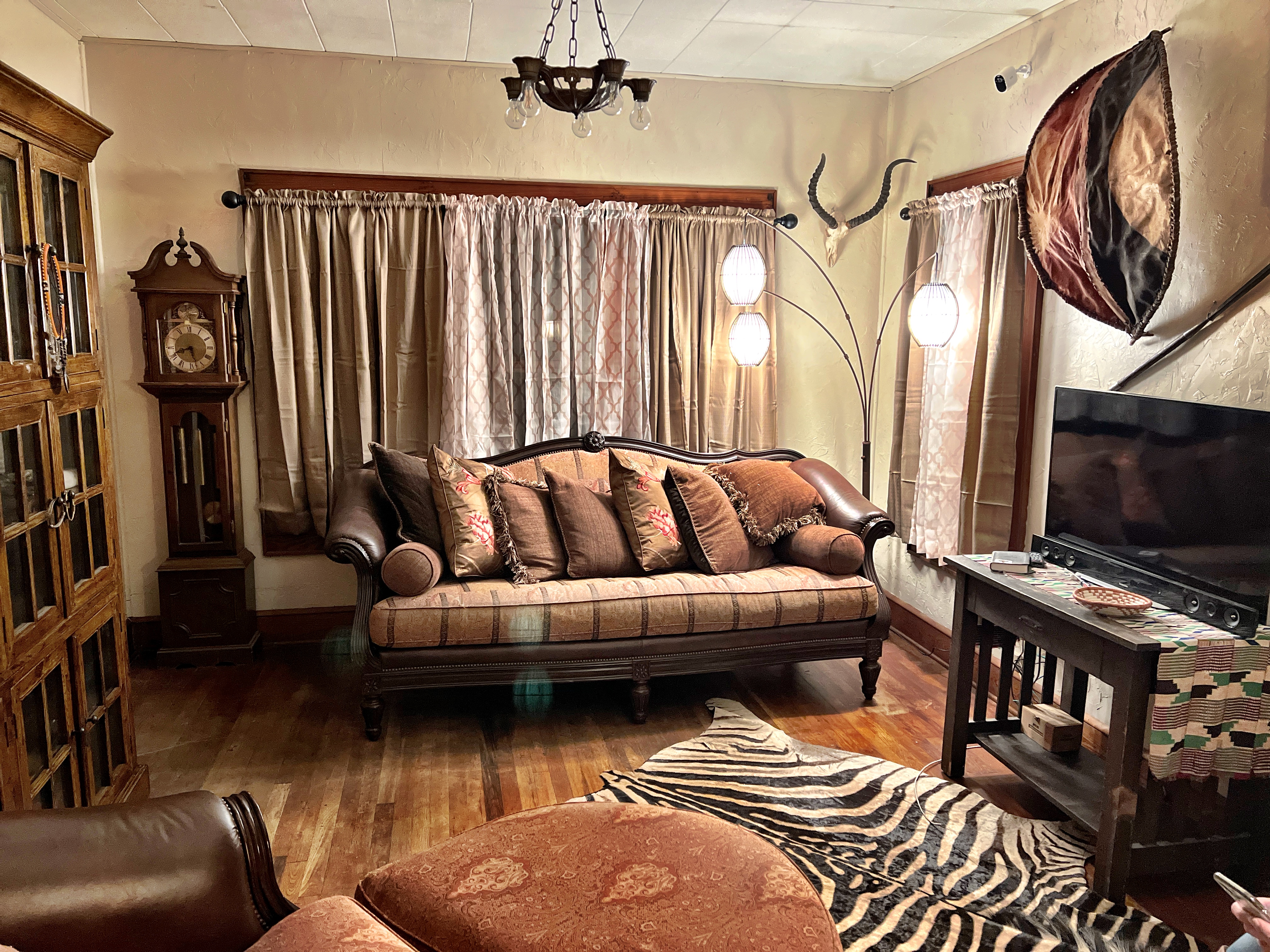
Patina is often hard to decipher as artisans are good at artificially aging an item, I think bottom line is, if you are happy with it, that is all that really matters, just be honest with yourself and others if you decide to sell someday.
Anyway, we all enjoy shopping and hopefully these notes will help you avoid purchasing an item, hauling it thousands of miles home to place on your mantle to find the exact same product for sale at the local mall or world market for less.
Some have asked if it is illegal to remove artifacts from a country, and I guess that would depend on the country. Is it unethical? Perhaps in some cases. But while some countries value their history and its artifacts, some can care less. As they commonly say in Africa, if it pays, it stays. And the way I view my collection is that the items I collect truly aren’t mine, I am just a custodian keeping them safe for their next custodians whether that is another private collection, a museum, or even returned to their original country.
I have visited villages when asked if they have any antiquities and the inhabitants go rummaging around the trash heap to find an old knife, spear or shield and truly would rather have money or something more useful than the old buffalo shield that is of no use or importance to them currently. It can be argued that due to my interest and purchase I am preserving history, saving the item from eventually being destroyed.
Kenya has never questioned me buying and removing items, some countries require a receipt and some information on the item, even though I have never been personally asked. I have been asked on the US side what I am bringing in and usually a description and the fact I am not bringing it to sell is enough to thwart any additional inspection.
South America is a bit different; I have collected a slew of bow and arrows from indigenous people as well as hand forged fishing spears without issue. However, I have been questioned regarding feather headdresses but mainly because items are made of animal parts, even though many feathers are to be found scattered here and there in the jungle.
Last bit of advice, if you are traveling with the intentions of collecting items to bring home as checked baggage, purchase a large pelican case as they can hold a lot of items safely and for spears, bows, arrows and other long items purchase an expandable fishing pole hard case that’s about 12 inches in diameter and can be extended to about ten feet. I have never had a problem or even asked what is inside when checking this case. Also, its light and can be collapsed down to about four feet and checked when not in use. I keep one at my workplace in Africa and about once a year bring items home.
If you have any questions, feel free to reach out and I will do my best to answer them.
 Jason Miller (Kyalo)