From my travel journal June 1996
“Kilimanjaro.” Africa’s highest peak and the tallest free-standing mountain on Earth. Climbing it is no rare triumph—thousands make the ascent each year—and I make no claim to heroism. Still, standing on that mountain felt like one of the great accomplishments of my life, made more meaningful by the hardships that turned the climb into a true adventure.
Kilimanjaro has stirred imaginations for centuries. The earliest known reference appeared in a Chinese manuscript around 500 A.D., though what it described remains a mystery. In 1848, German missionaries Johann Rebmann and Ludwig Krapf reported seeing a snow-capped giant rising above the African plains. The claim was mocked across Europe; geographers refused to believe snow could exist just three degrees south of the Equator.
By 1884, explorer Henry Hamilton Johnston had circled the mountain’s vast perimeter, though he never reached the summit. At the time, many believed the altitude and thin air made survival impossible. Then, in October 1889, German explorer Hans Meyer finally stood on the summit, proving the mountain could be conquered after all.
More than a century later, I would follow that same path upward—toward the clouds, the cold, and the thin air of Kilimanjaro.
3:00am International airport Cairo
Half-awake under the harsh airport lights, I waited for my very late flight. Cairo never sleeps. Travelers from every corner of the world shuffled past—families asleep on luggage, businessmen pacing, pilgrims wrapped in blankets. Despite the delay, I was eager to get on my way to Nairobi. I was flying Egypt Air, famous for its lateness. Finally, at 4:30 a.m., we lifted off into the dark African sky, heading south toward Kenya. I could only hope my ride in Nairobi had not abandoned me after a six-hour delay. At sunrise I moved to an empty window seat in the back of the plane. Below us was nothing but clouds glowing gold in the morning light. Then Mount Kenya appeared above them, its summit blazing in the sun like an island floating in the sky. Soon we descended into thick gray clouds. The world disappeared outside the window until, suddenly, we broke through beneath them and the green countryside of Kenya spread below. Minutes later we landed smoothly in Nairobi.
Arrival in Africa
It took nearly an hour to survive immigration, collect my backpack, and earn another passport stamp. Outside, Tede—our driver—waited patiently beside the van, looking far less tired than I felt. We loaded up, stopped in Nairobi for fuel and a few last-minute climbing supplies, then headed south toward Arusha, Tanzania.
Leaving the city, we crossed the old Mombasa Railway, built in the late 1800s to link the coast with the African interior. From there we followed the A104 toward the Tanzanian border on a road smoother than many back home.
At first, I was slightly disappointed. There were farms everywhere, roadside shops, and enough power poles to ruin my imaginary National Geographic moment. I had expected endless wilderness, roaming lions, and dramatic music playing somewhere in the distance. Tede just laughed and told me to be patient.
A few hours later, Africa finally began to cooperate.
The farms faded away. Tall mimosa trees appeared across the plains. Somewhere along the drive the power lines vanished without me noticing. Then came the wildlife—first impala, then zebra, and finally giraffes wandering casually near the road as if this sort of thing happened every day.
Occasionally I spotted a Masai boma in the distance, standing alone against the open land. Meanwhile, I kept staring at the horizon waiting for Kilimanjaro to appear in all its glory. Instead, low clouds covered everything. Africa, apparently, enjoys suspense.
By late afternoon we rolled into the dusty border town of Namanga and prepared for another round of immigration paperwork.
Entering Tanzania.
After stamping out of Kenya, we drove a few blocks through gates guarded by serious-looking men carrying machine guns and pulled over again to enter Tanzania. Crossing African borders, I was quickly learning, was rarely a simple affair.
Tanzania required a visa, a yellow fever certificate, and apparently a deep interest in our luggage. After some confusion, delays, and a bit of firm discussion from Tede, we were finally waved through without losing either our gear or our patience.
The Tanzanian side felt immediately different. Gone were the crowds of vendors swarming the roadside. Everything looked rougher, quieter, and far more primitive. At last, I began to feel like I had found the Africa I had imagined for years.
Villages appeared far off across the plains, and occasionally I spotted Masai standing motionless in the brush along the road, watching us pass. Wildlife became more common here. Ostriches wandered the grasslands everywhere, zebra herds raced across the distance, and giraffes floated above the treetops like moving cranes.
I kept hoping for elephants, scanning every patch of bush with unreasonable optimism. Africa, however, was still making me earn a few things.
The President stole my room!
Our destination for the day was the Mt. Meru Hotel in Arusha. As we drove south, the road curved around the massive dark slopes of Mount Meru towering above the plains.
It was June 24th, though at the time we had no idea that Tanzania was hosting an event important enough to completely ruin our hotel reservations.
By the time we reached Arusha, we were exhausted, dusty, and starving. But the moment we pulled into the hotel parking lot, it was obvious something unusual was happening. Soldiers carrying automatic rifles stood everywhere. Military vehicles blocked the entrance, and nervous-looking officials hurried in every direction.
This was clearly not normal hotel hospitality.
Inside, we approached the front desk and explained that we had reservations booked two months earlier. The clerk quickly informed us that there were no rooms available and that we needed to leave immediately.
We asked who exactly had taken our rooms.
“The President of Tanzania,” he replied.
As it turned out, we had unknowingly arrived in the middle of a major East African peace conference. The presidents of Tanzania, Kenya, Uganda, Rwanda, and Burundi were all meeting at our hotel that very afternoon.
Oddly enough, because we were dressed fairly well from our international flight—and because Tede knew the hotel owner—they agreed to let us stay long enough for lunch before politely throwing us out of international diplomacy.
We were seated beside a huge window overlooking the ceremony outside. A military band played national anthems while rows of soldiers stood stiffly at attention, rifles pointed skyward. The entire courtyard buzzed with tension and excitement. Somehow, nobody paid any attention to the two exhausted travelers eating lunch in the middle of it all.
We were warned very firmly not to take our cameras out of the car.
Then the excitement suddenly escalated. Sirens sounded in the distance and a convoy of black Mercedes swept through the gates at high speed, kicking dust across the parking lot. One by one the presidents stepped from their cars and walked to the podiums as the band played and soldiers snapped to attention.
For nearly an hour we sat there eating lunch and casually watching presidents greet one another only yards away from our table. It remains the only time in my life I have accidentally wandered into an international peace conference while looking for a hotel room.
Eventually the ceremony ended and the leaders disappeared into a private meeting room to discuss politics, treaties, and who knows what else. Meanwhile, we returned to the far more pressing problem of figuring out where we were going to sleep that night.
On to Moshi.
By this point we had gone nearly thirty hours without sleep, and thanks to the presidential peace conference there was not a hotel room left in Arusha. So, tired beyond reason, we decided to continue on to Moshi that same night.
In hindsight, this may not have been our brightest decision.
Once darkness fell, the drive turned into a full-scale adventure. The road was narrow, rough, and filled with potholes large enough to qualify as small craters. It reminded me of driving from Quito into Ecuador’s upper Amazon Basin—except this road somehow had even more holes than a Texas highway.
As we climbed higher in elevation, the landscape began to change. The air cooled and thick vegetation crowded the roadside. Palm trees, banana groves, and endless coffee plants gave the hillsides a tropical rain forest feel.
Meanwhile, Tede drove like a rally racer avoiding land mines.
We swerved constantly to dodge potholes deep enough to remove an axle, only to find old Land Rovers with no headlights coming directly at us while doing the exact same thing. Every few seconds one of us would spot another crater in the road and yell something highly intelligent like, “Hole!”
Somehow we kept moving forward through the darkness, bouncing and weaving our way toward Moshi beneath the hidden slopes of Kilimanjaro.
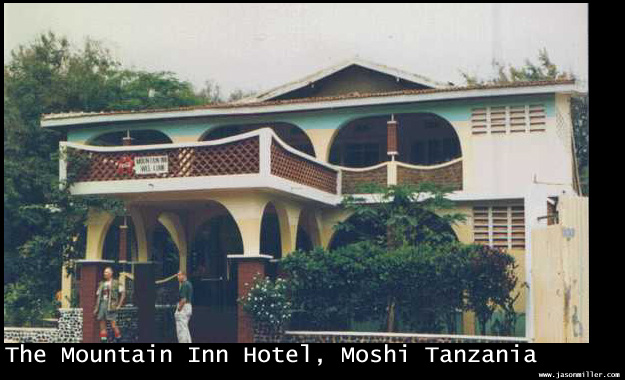
The Mountain Inn Hotel.
We finally rolled into Moshi late that night, exhausted beyond words. The Mountain Inn, owned by my friend Mr. Shaw—who also ran the tour company taking us up Kilimanjaro—felt less like a hotel and more like a rescue mission.
After the madness of border crossings, peace conferences, and crater-filled roads, the place seemed almost unreal.
The hotel sat tucked among lush tropical gardens filled with palms, flowering bushes, and towering banana trees. Soft yellow lights glowed along the wooden walkways, and the wide porch wrapped around the building beneath the shadow of the mountain. The cool air coming down from Kilimanjaro carried the smell of wet earth, flowers, and wood smoke.
After nearly thirty hours without sleep, a hot shower felt life-changing.
Clean clothes made me feel almost human again.
Later I carried a plate of food upstairs to the second-floor balcony and sat quietly listening to the African night. Insects hummed endlessly in the darkness while distant dogs barked somewhere down in town. Occasionally I could hear faint music drifting through the cool evening air. Above the gardens the sky was perfectly black and filled with stars.
Eventually Mr. Shaw joined us to go over the climb. He explained the route, the dangers of altitude sickness, and the importance of pacing ourselves on the mountain. He spoke calmly, like a man who had watched many overconfident climbers suffer badly above the clouds.
Finally he ended the briefing with the most important sentence of the evening:
“Meet your guide at eight sharp. Breakfast is at seven if anyone is interested.”
After surviving African roads all day, I was very interested.
Even though exhaustion was catching up with me, I stayed awake long after everyone else had gone to bed. Wrapped in the cool winter air of Tanzania, I sat on the balcony writing in my journal, determined not to forget a single detail. Tomorrow we would finally begin the climb up Kilimanjaro.
Day 1 of the Climb.
3:30 a.m. — I woke to the sound of heavy rain pounding on the roof. Perfect, I thought. Just my luck to begin climbing Kilimanjaro in a storm. I rolled over and tried desperately to steal a few more hours of sleep.
By 6:00 a.m. the rain had stopped and weak sunlight filtered through the window. Low clouds still hung over Moshi, threatening more rain at any moment, but the morning air felt fresh and alive. Outside, the sounds of tropical birds echoed through the gardens like a jungle orchestra warming up for the day.
I packed my backpack carefully with all the essentials for survival on a mountain: warm clothes, rain gear, and Rice Krispie Treats.
Breakfast was served downstairs where I met up with my friend and several other climbers joining our group. Everyone looked excited, nervous, or dangerously overconfident.
After breakfast I tried calling home, but the hotel clerk informed me the phones had been out for weeks. Apparently this was not considered unusual.
Soon we loaded our gear into an old Land Rover and headed toward the park entrance. I sat beside the driver and spent the drive questioning him about Kilimanjaro. He explained that he was Masai and had traded his traditional red robe for civilian clothes and a steering wheel.
As the road climbed toward the mountain, he shared an old Masai legend about Kilimanjaro—known long ago as “Ngaie Ngai,” the House of God.
According to the story, Menelik, the legendary son of King Solomon and the Queen of Sheba, once crossed this land after conquering much of East Africa. Reaching the high saddle between Mawenzi and Kibo, he became violently ill from the altitude. Believing death was near, he chose to die as a king. He gathered his army, loaded slaves with treasure and jewels from his conquests, and marched upward into the clouds toward the summit.
The mountain swallowed them whole.
Only a few soldiers ever returned. They claimed Menelik and the treasure disappeared forever into Kibo’s crater beneath the ice and clouds. The legend says one day a descendant of Menelik will return, rediscover the treasure, and reclaim the lands of his ancestors with the wisdom of Solomon himself.
Whether true or not, it was an excellent story to hear while driving toward a giant volcanic mountain hidden in clouds.
At the park gate we signed the official climber register. There is another book waiting at the summit for those lucky—or stubborn—enough to make it to the top.
Here we also met the porters.
Hundreds of local men gathered around the entrance hoping for work carrying gear up the mountain. For a few dollars a day they hauled food, tents, water, and ridiculous amounts of unnecessary equipment for climbers who quickly discover that even carrying their own jacket at 19,000 feet feels unfair.
Our group had four guides for roughly fourteen climbers. My head guide, Nicholas, was calm, patient, and permanently smiling.
The porters amazed me immediately. Many wore worn-out jackets and thin shoes completely unsuited for cold mountain weather. My own porter carried my heavy backpack balanced effortlessly on top of his head while wearing slick-soled dress shoes better suited for church than a mountain trail.
When I suggested he wear the pack properly on his back, he smiled and said it was more comfortable this way.
Apparently Africans possess neck muscles unknown to the rest of humanity.
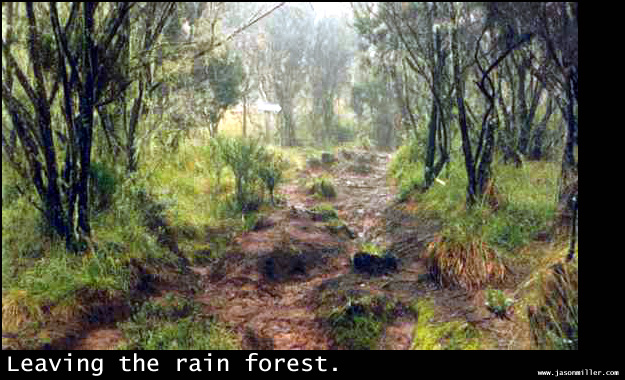
Soon our cook handed out lunches in plastic bags, Nicholas gave us a thumbs up, and we began climbing through the rain forest.
The trail wound upward beneath enormous green trees draped in moss and vines. Rivers rushed down every hillside from the constant rain. The air smelled of wet earth and leaves. Everything dripped.
Some members of our group immediately treated the climb like an Olympic event and disappeared up the trail. Nicholas wisely stayed behind with those of us more interested in enjoying the mountain than dying on the first day.
The porters moved past us at unbelievable speed, balancing impossible loads on their heads while somehow remaining cheerful.
After several hours we stopped for lunch. Mine consisted of a sandwich, a boiled egg, and one small banana that was somehow the sweetest banana I had ever tasted.
Farther up the trail the rain forest became even thicker. Monkeys leaped through the treetops overhead while brightly colored birds darted through the mist. Clouds rolled through the forest until visibility shrank to barely a hundred feet.
I asked Nicholas about elephants and leopards. Old hunters once claimed Kilimanjaro’s forests held giant tuskers and huge cats. Nicholas explained that most elephants had moved away, though a few still roamed the northern slopes. Leopards, he said, were extremely rare and secretive.
Then he casually added that once darkness fell we should not leave our huts at camp—not even to use the long-drop toilet.
This information did not improve my comfort level.
Several times I stepped quietly off the trail just to listen to the forest. I found moss-covered streams, tiny squirrel-like animals drinking at the water’s edge, and a silence broken only by rain and distant bird calls.
By afternoon the weather turned miserable. Thick fog rolled in, rain soaked the trail, and mud swallowed our boots. My feet were freezing, my shoes soaked through, and somehow my spirits remained unbelievably high.
Finally I reached Mandara Hut at roughly 9,000 feet.
The camp sat hidden deep within the rain forest, surrounded by thick fog so dense I could barely see fifty feet ahead. I discovered I was among the first of our group to arrive. My porter and several others had already rushed ahead earlier to prepare camp before we stumbled in pretending to be exhausted heroes.
I peeled off my wet socks, crawled into my sleeping bag, and immediately fell asleep.
Two hours later a knock on the hut door woke me. Dinner was ready.
So back into wet boots I went.
Dinner consisted of popcorn, soup, tea, and conversations with climbers from other groups. That evening I met an older German man named Horst who had climbed Kilimanjaro several times before. He had once lived in Africa and spent hours telling stories about the old days while we drank hot tea in the cold damp dining hut.
He admitted he was unsure whether his age would allow him to reach the summit this time, but he smiled and said the challenge itself was reason enough to try.
Outside, rain drifted softly through the forest while Kilimanjaro disappeared into the darkness above us.
The beginning of the end.
By 9:40 that night I was back in the hut, freezing in the dark beside a few of my companions while writing in my journal by flashlight. Sleeping was difficult at 9,000 feet. Every time I drifted off, the thin air would jerk me awake gasping for oxygen like a fish thrown onto shore.
Unfortunately, lack of oxygen was about to become the least of my problems.
Up until now I had felt great. I had survived Cairo, airport food, questionable roadside meals, and African border crossings without any stomach trouble whatsoever. Then, sometime around midnight, Kilimanjaro finally struck back.
I woke with a stomach cramp so violent it felt like someone had stabbed me with a spear.
At first I tried to ignore it. Surely this would pass. Surely I could survive until morning without leaving my warm sleeping bag and venturing outside into the freezing rain forest darkness.
Time moves very slowly when you are sick.
The hut was pitch black except for the occasional beam of a flashlight. I was freezing cold and sweating at the same time while strange night sounds echoed through the forest outside. My stomach continued staging a full rebellion.
Finally, after what felt like three years of suffering, I surrendered.
I struggled into my wet clothes, fought hopelessly with the laces on my soaked shoes, then finally abandoned the shoes altogether and stumbled outside wearing only icy wet socks.
Immediately I remembered Nicholas warning us not to wander around camp after dark.
Naturally, my imagination instantly produced every man-eating lion, leopard, and jungle horror story I had ever heard.
Bent over in pain, I shuffled through the freezing mud searching desperately for the long-drop toilet while imagining the Ghosts of Tsavo patiently waiting in the fog for weak tourists with food poisoning.
At last I found the hut.
The “bathroom” was essentially a deep hole in the ground with a wooden shack built over it. There was no seat, nowhere comfortable to stand, and the only thing available to hold onto was the door—which swung inward every time I touched it.
At that moment I seriously reconsidered the entire concept of adventure travel.
I remained there for nearly two miserable hours, freezing and sick, wondering how on earth I was supposed to continue climbing this mountain. The thought of turning back after only reaching 9,000 feet felt crushing, but climbing higher seemed equally impossible.
Eventually I staggered back toward camp. On the way I noticed a dark figure standing silently outside the huts. Half delirious, I called out, “Good morning.”
Thankfully it turned out to be one of my companions who couldn’t sleep and had come outside to enjoy the clear night sky.
The fog had lifted completely. Above us stretched the brightest stars I had ever seen in my life. Without the damp clouds, the air felt warmer and strangely peaceful. We sat quietly on the wet ground for a while staring up at the endless African sky.
For a few minutes I forgot how miserable I felt.
Then my stomach politely reminded me.
The rest of the night became an endless cycle of failed sleep attempts and emergency runs through the mud to the long drop. By dawn I was exhausted, dehydrated, freezing cold, and still balancing over that horrible hole in the floor as daylight slowly uncovered the dark continent around us.
The fog rolled back in with the morning cold. I dressed as warmly as possible, packed my backpack slowly, and tried to decide what to do.
I didn’t want to tell anyone how sick I was.
And I absolutely did not want to become the guy who quit Kilimanjaro on the second day.
Day 2 , 12,500 Feet
I decided to skip breakfast the next morning, though I wandered over to inspect the cooking arrangements out of curiosity. I immediately regretted this decision.
The cooks stood over steaming pots in the freezing morning air with runny noses from the cold, casually wiping them with their hands while buttering bread and stirring porridge. Under normal conditions I probably would not have cared much. In my current condition, however, it was enough to destroy what little appetite remained.
After the others finished their heroic nutritious breakfast, the porters loaded the gear, Nicholas gave the usual thumbs up, and we began Day Two.
Our destination was Horombo Hut at 12,500 feet.
I honestly did not know if I would make it.
Within minutes my stomach cramped so badly I could barely walk. I stopped constantly to disappear into bushes while Kerry and Nicholas patiently stayed behind encouraging me forward. Before long the rest of the group and nearly all the porters vanished ahead into the fog, leaving only the three of us alone on the trail.
Nicholas repeated the same phrase over and over:
“Poli poli.”
Slowly slowly.
It became the unofficial anthem of Kilimanjaro.
At times I could only manage twenty steps before doubling over in pain. We climbed at the speed of continental drift while Nicholas calmly assured me that pace did not matter as long as we kept moving.
The forest around us was beautiful in a strange prehistoric way. Giant trees dripped with thick green moss found only on Kilimanjaro’s unique slopes. The muddy trail slowly began drying as we climbed higher, and eventually the dense fog broke apart into patches of sunlight.
For the first time all day I felt warmth on my face.
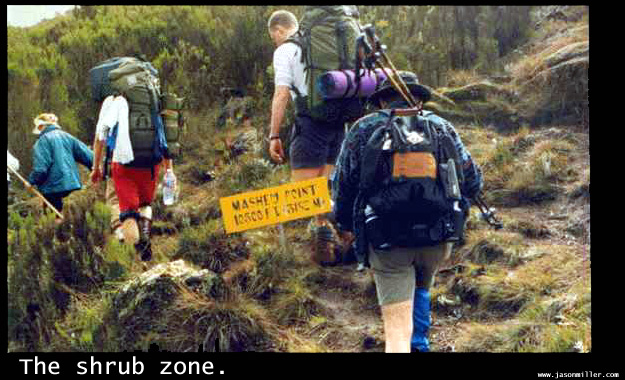
The rain forest suddenly gave way to open moorland filled with strange cactus-like plants towering twenty feet high. Other shrubs spread across the hillsides like giant African sagebrush. The landscape no longer felt tropical—it felt alien.
Along the trail we constantly passed Africans carrying impossible loads balanced on their heads. As they passed, I would greet them with my limited Swahili:
“Jambo.”
“Jambo.”
“Habari?”
“Mzuri.”
Then, without slowing down, they would launch into rapid conversations with Nicholas in flowing Swahili while continuing up or down the mountain. I asked Nick what they were talking about.
He explained there was an entire communication network flowing along the mountain—weather reports, deaths, village news, and messages for family members traveling between camps.
Kilimanjaro had its own grapevine.
By midafternoon I had fallen hopelessly behind.
According to my journal entry from that day:
“2:50 p.m. — Day Two. I am now the last one climbing.”
Kerry stayed beside me the entire time, clearly worried. My porter, meanwhile, had disappeared far ahead carrying my water, food, dry clothes, and every item I desperately needed at that moment.
Eventually we found a small stream where I refilled my water bottle. Kerry mixed some powdered electrolyte drink into it, and for a brief glorious moment I felt almost human again.
We finally reached the lunch stop only to discover we had missed the rest of the group by several hours.
Nearby sat one of the mountain toilets overlooking an unbelievably beautiful valley around 11,000 feet. Under different circumstances it would have been a breathtaking location.
Instead, it became the lowest point of my climb.
The stomach pain grew unbearable. Then I looked down and saw blood.
At that moment I became convinced I had dysentery and was probably dying somewhere on the side of Kilimanjaro.
The temperature hovered near freezing and I was too cold to properly clean up, so with absolutely no dignity remaining, I pulled out my Swiss Army knife and began cutting away clothing layers like a desperate field surgeon.
Adventure travel had officially peaked.
Afterward I sat on the cold ground with Kerry and Nicholas trying to eat lunch while sharp cramps twisted through my stomach. I quietly admitted to myself that I probably would not make it to the summit.
Nicholas studied me carefully, then explained our situation. We were too far from the previous camp to safely turn back before dark. Horombo was closer.
So we kept climbing.
Soon thick clouds swallowed the mountain again. Visibility dropped to barely ten feet. Rain began pouring down, followed shortly by hail.
If Kilimanjaro had any additional miserable weather options available, it was clearly testing them all on me.
We huddled together on the trail while freezing rain poured from the brim of my hat straight down my neck. My clothes were soaked through. My waterproof gear, of course, remained somewhere far ahead with my porter.
Even Nicholas began to look concerned.
At one point around 3:30 p.m. he pointed into the fog and calmly announced that if the weather were clear, we would be able to see camp.
This was not especially comforting since we could barely see our own boots.
After twelve brutal miles we finally staggered up the last steep hill into Horombo Hut at 12,500 feet. A thermometer outside the communal hut read five degrees.
Inside, the rest of the group had already finished hot tea and dinner. I honestly did not care. I only wanted dry clothes and a sleeping bag.
The fog was so thick I could barely see the sleeping huts from the dining hut, but somehow I located my backpack sitting in the mud looking as exhausted as I felt.
Against all logic, I had made it through Day Two.
Horrible night 2.
I was relieved to discover that one woman in our group happened to be a nurse—and apparently carried an entire pharmacy inside her backpack.
After hearing my symptoms, she handed me a collection of pills which I swallowed immediately with a three-dollar Coke that tasted like the greatest beverage ever created.
At 12,500 feet, warm Coca-Cola was medicine.
I crawled into my sleeping bag hoping for a miracle. Later Nicholas stopped by with sliced fruit and insisted I eat something. Then, smiling calmly, he informed me that tomorrow would be “a hard climb.”
Excellent.
Sometime during the night I woke with a pounding headache splitting my skull. Certain it had to be near dawn, I decided to wait until morning before crawling into the freezing darkness for aspirin.
Finally I asked someone in the hut what time it was.
“10:50!” came the answer from the darkness.
It felt like I had already lived through three separate nights.
I forced myself out of my warm sleeping bag cocoon, found some aspirin, and eventually drifted back to sleep.
A few minutes later Kerry suddenly shouted from across the hut:
“JASON!”
“What?”
“You’re not breathing!”
“I am now,” I answered.
At altitude, everyone sounded like they were dying anyway. All night the hut echoed with gasping, coughing, snoring, and people randomly waking themselves up trying to breathe thin mountain air.
Sleep on Kilimanjaro was less rest and more a shared medical condition.
Lying awake in the darkness, my mind wandered home. Somewhere back in America people were eating lunch, going to work, and living perfectly normal lives with absolutely no idea that I was ten thousand miles away, sick on the side of an African volcano, struggling to breathe inside a frozen hut above the clouds.
Eventually exhaustion won.
Sometime before dawn, I finally fell asleep.
Day 3 15,500 feet
I opened my eyes expecting another day of misery and instead found bright sunlight pouring through the hut window.
I stayed perfectly still for a moment, waiting for the stomach cramps to return. Nothing.
Then came an even greater miracle:
I was hungry.
After two days of feeling half dead, I climbed out of my sleeping bag with the excitement of a man resurrected. I pulled on fresh clothes and stepped outside into sharp freezing air and brilliant sunshine. Overnight the storm had vanished completely.
The view stopped me cold.
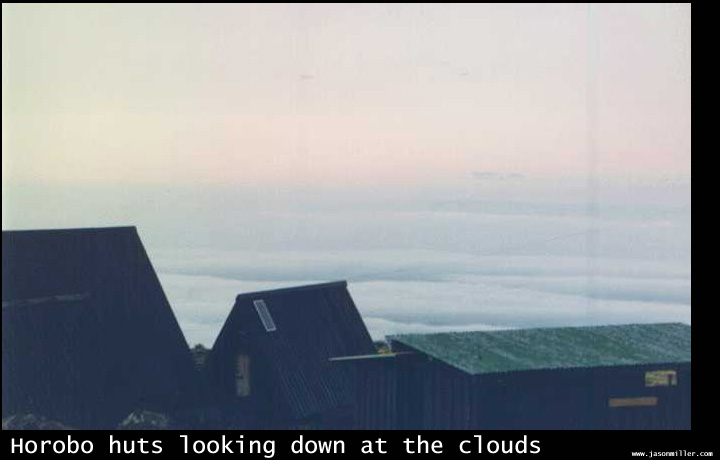
Far below us the clouds stretched across Africa like a giant white ocean, their tops glowing in the morning sun. Above them rose Mawenzi’s jagged black spires and, farther ahead, the icy summit of Kibo shining against a deep blue sky.
After days trapped in fog and rain forest, it felt as if we had climbed into another world.
Sunlight has a way of restoring faith in life, and suddenly I felt ready to climb the whole mountain in one day.
At breakfast I completely ignored the memory of the cooks’ questionable hygiene from the morning before and ate everything in sight. After nearly two days without real food, even mountain porridge tasted magnificent.
For the first time we could clearly see the summit of Kilimanjaro towering above us. I remember thinking it looked incredibly close.
I was very wrong.
At 7:00 a.m. we started toward Kibo Hut at 15,500 feet. Compared to the brutal suffering of Day Two, this felt almost peaceful. The trail climbed gradually across the long saddle between Mawenzi and Kibo while the landscape transformed once again.
All vegetation disappeared.
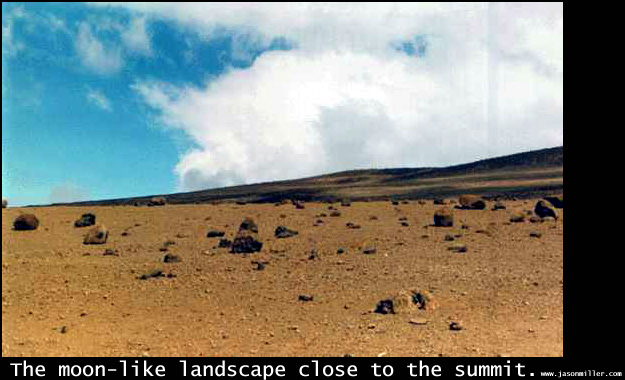
The moss, trees, and giant shrubs vanished behind us, replaced by endless volcanic rock, dust, and emptiness stretching to the horizon. It no longer looked like Africa. It looked like the surface of the moon.
Mawenzi towered beside us in dark jagged cliffs with a permanent patch of snow clinging near its summit. Ahead stretched a thin dusty trail disappearing endlessly toward Kibo.
Oddly enough, I felt fantastic.
For the first time on the climb I stayed near the front of the group—not because I was racing, but because I finally had energy again. Meanwhile the altitude was beginning to punish everyone else. Headaches, dizziness, and exhaustion spread quietly through the group.
Apparently Kilimanjaro simply rotated its victims.
We stopped for lunch beside a massive volcanic boulder somewhere out in the wasteland. Same sandwich. Same boiled egg. Same tiny banana. Somehow still wonderful.
Along the trail I kept practicing my terrible Swahili with passing porters.
“Jambo.”
“Poli poli.”
Soon our entire group was saying “Poli poli” about everything from climbing to eating popcorn.
At one point I noticed a strange metal stretcher with one bicycle wheel underneath it. It looked like a cross between a wheelbarrow and medieval torture equipment.
“That’s the ambulance,” Nicholas explained casually.
It was used to carry injured—or dead—climbers down the mountain.
He mentioned that people die on Kilimanjaro every year from heart attacks, aneurysms, and altitude sickness. A thirteen-year-old boy had recently died on the climb.
The mountain suddenly felt less friendly.
At 2:00 p.m. I finally reached Kibo Hut.
The camp sat in a cold barren sea of volcanic rock beneath the summit cone. Unlike the lower camps hidden in forest, Kibo looked harsh and lifeless. The huts were built from stone and concrete, and everyone slept together inside one large freezing building lined with wooden bunks.
Since I arrived first, I proudly claimed the upper bunk beside a small window.
Important mountaineering priorities.
Soon the others stumbled in and we sat drinking hot tea and eating popcorn while clouds rolled back across the mountain and temperatures plunged. Nicholas gathered us together and calmly explained that we would begin climbing for the summit at midnight in order to reach the top by sunrise.
The room immediately grew quieter.
Reality had finally arrived.
Kerry had barely spoken all day. Though he refused to admit it, I could see the altitude hammering him. Others looked equally rough—faces pale, eyes exhausted, everyone breathing harder than normal just sitting still.
Outside, voices suddenly echoed through camp. A European climber was being rushed down the mountain on the stretcher suffering from severe heart problems. Even moving fast, Nicholas said it would still take more than twenty-four hours to reach the bottom.
I never learned whether he survived.
As darkness settled over Kibo, more people in our group quietly decided not to attempt the summit. Some had severe headaches. Others were nauseated or dizzy. At 15,500 feet, simply reaching this camp was already higher than most mountains in America.
For many, this was enough.
That night my journal read:
“7:20 p.m. — Kibo Hut, 15,500 feet.”
The cold had become brutal. Everyone lay buried deep inside sleeping bags wearing every piece of clothing they owned. I stuffed dirty laundry inside my coat for extra insulation and kept my camera inside the sleeping bag so the film would not freeze.
Outside my small window the African sky blazed with stars brighter than anything I had ever seen.
Moonlight reflected across the endless volcanic rock while icy wind howled against the hut walls. Looking out into that frozen darkness, I thought about the first explorers who climbed this mountain with primitive gear, little food, and almost no understanding of altitude.
I wondered if I could have survived what they endured.
Then I looked at my watch. Four hours until we left for the summit.
Night to the Summit.
11:15 p.m.
After almost no sleep, we forced ourselves out of our sleeping bags to drink hot tea and prepare for the summit climb. Out of our original group of fourteen, only five of us were still attempting the top.
Everyone else, wrapped deep inside their sleeping bags, wished us luck and safety as we stepped out into the freezing African night.
The cold hit immediately.
I was surprised by how dizzy I felt just from standing up after lying down for a few hours. Nicholas organized us into a single-file line with two assistant guides joining the climb in case someone needed to turn back.
Then we started upward into the darkness.
Almost immediately there was commotion behind me. Kerry had become severely dizzy just walking around camp and could barely stand. After struggling for several minutes, he made the difficult decision to turn back.
I felt terrible for him. He wanted the summit badly.
He disappeared back toward the hut while the rest of us continued climbing into the night.
The slope above Kibo was unbelievably steep. Rather than climbing straight up, we zigzagged endlessly across the mountain in short switchbacks. At times I could stand upright and touch the slope in front of me with my hand.
Every step felt heavy.
The guides carried flashlights, but the moon cast an eerie silver glow across the mountain that lit the volcanic gravel around us. The sandy ground constantly slid backward beneath our boots, and before long my shoes were full of rock and grit.
The temperature hovered somewhere around fifteen below zero, though strangely it did not feel quite that cold. Maybe suffering has a way of dulling the senses.
I wore nearly everything I owned: Levi’s stuffed with layers underneath, multiple sweatshirts, heavy coat, wool socks, hood tightened shut, and even a T-shirt wrapped around my head to block the wind. My nose ran constantly, but I refused to remove my frozen hands from my pockets long enough to wipe it.
This was not exactly elite mountaineering equipment.
Every twenty minutes we stopped for a short break. Each time I turned around to look down the mountain, dizziness hit instantly. Far below, the tiny lights of Moshi glowed against the darkness thousands of feet beneath us.
The view was unreal.
Somewhere down there lions hunted, tribes slept beside cooking fires, and life carried on completely unaware that a handful of exhausted climbers were inching their way toward the roof of Africa above them.
The higher we climbed, the harder breathing became.
Even standing still I could not catch my breath. My arms and legs tingled from lack of oxygen. My heart pounded so hard I could hear it inside my hood.
I kept thinking about the European man rushed down the mountain earlier with heart problems. I wondered if he had ignored warning signs too long.
I had invested three brutal days into this climb and stood only hours from the summit, but suddenly the mountain felt dangerous in a very real way.
Quietly, I prayed for enough wisdom to know when to stop—or enough strength to continue.
At 16,500 feet we stopped to rest and I discovered my water bottle had frozen solid inside my coat. Sitting on the frozen ground, I finally noticed snow surrounding us in every direction.
We passed the cave where Hans Meyer once slept before reaching the summit in 1889. I imagined him and his men huddled inside trying to keep a fire alive in the freezing thin air with primitive gear and no real understanding of altitude.
They must have suffered terribly.
At 17,000 feet another climber in our group became violently sick and began vomiting beside the trail. After several miserable minutes he decided to turn back. We watched silently as he and one guide zigzagged downward into the darkness until their flashlight disappeared.
Now only three of us remained.
Nicholas slowed the pace even more.
“Poli poli.”
Slowly slowly.
Every step became a battle for oxygen. My muscles burned. My lungs never seemed to fill completely no matter how hard I breathed.
Five hours had passed and we still had farther to climb.
I kept reminding myself that I had paid a lot of money to suffer this badly.
Finally, just before dawn, the eastern sky began glowing orange and yellow above the horizon. Instead of warming up, the temperature dropped even lower. The trail steepened until we were no longer hiking but climbing over volcanic rock.
As sunrise spread across Africa, I stopped and looked out over the edge of the mountain.
It was one of the most beautiful sights I had ever seen.
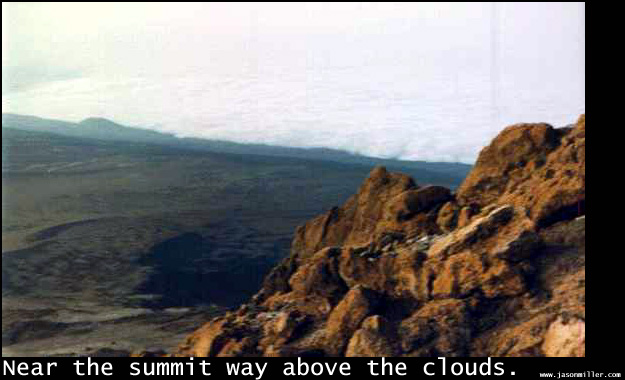
Unfortunately we were behind schedule. We were supposed to reach the summit by sunrise before the clouds rolled in later that morning. Nicholas looked at me carefully and asked if I wanted to turn back.
I honestly considered it.
Then he shouted ahead:
“Tende! Poli poli!”
Slowly, steadily, we continued upward.
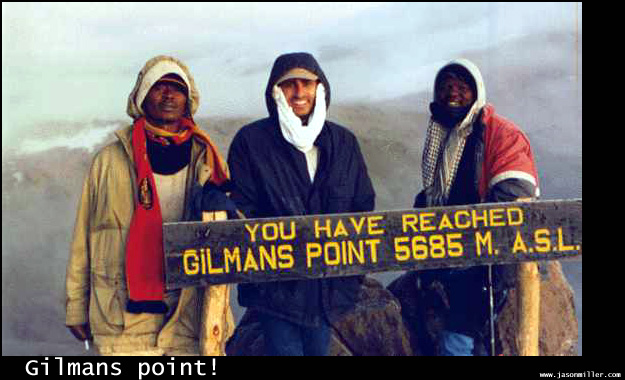
After another brutal hour of climbing over loose rock and ice, we finally reached Gilman’s Point at roughly 19,000 feet.
I had made it.
Beyond the crater rim the glaciers stretched across the summit in massive walls of blue-white ice glowing in the morning sun. Clouds floated thousands of feet below us across the plains of Africa.
No photograph could ever truly capture that view.
Standing there above the clouds, staring out across the roof of Africa, I realized some moments become permanent. Long after possessions wear out and memories fade, certain images remain burned into your mind forever.
This was one of them.
After about five minutes of photographs, frozen smiles, and exhausted silence, I decided I had absolutely no desire to climb the additional three hundred feet to Uhuru Peak without proper ice gear.
I was more than satisfied.
As the sun climbed higher, the snow became blindingly bright against the dark volcanic rock. I stuffed a few volcanic stones into my pocket for souvenirs and began slipping and sliding straight down the mountain instead of carefully zigzagging.
Only then did I discover something important:
Climbing down hurts far worse than climbing up.
After four days on the mountain my leg muscles shook uncontrollably every time I stopped to rest. I would sit on the rocks gasping for breath while my legs twitched beneath me like they belonged to someone else.
But none of it mattered anymore.
I had stood on the roof of Africa.
Feeling of accomplishment
My entire outlook changed after the summit.
The pressure was gone.
I had come to Africa to climb Kilimanjaro, and somehow, against stomach sickness, freezing temperatures, and common sense, I had actually done it. Now I could finally relax and enjoy simply being there.
After two hours of sliding, stumbling, and half skiing downhill through volcanic gravel, I made it back to Kibo Hut. The camp was a mixture of celebration and suffering. Some of our group were extremely sick from the altitude while others had bounced back completely and were already joking around and packing gear to head down the mountain.
I crawled into my sleeping bag and rested until the other summit climbers finally staggered in looking equally exhausted and victorious.
After lunch we packed quickly and began the long descent back to Horombo Hut at 12,500 feet. Going downhill felt glorious. With every thousand feet we lost, headaches faded, breathing became easier, and everyone’s mood improved dramatically.
Amazing how cheerful people become once oxygen returns to the brain.
The walk back across the saddle felt entirely different now. Instead of struggling to survive, I could finally slow down and appreciate the mountain. I spent much of the afternoon taking photographs, writing in my journal, and listening to the stories of fellow climbers from around the world.
Along the trail I ran into my German friend Haas slowly making his way uphill with his wife. He had wisely spent an extra day acclimating at Horombo Hut before attempting the summit.
When I told him I had made it to Gilman’s Point, he broke into a huge smile and shook my hand proudly. I wished him luck and told him I hoped we would meet again someday, though deep down I knew we probably never would.
That is the strange thing about travel. Some people drift into your life for only a few hours yet remain in your memory forever.
By evening we finally reached Horombo again. It felt almost funny breathing the “thick” air at 12,500 feet after spending time near 19,000. Two days earlier this altitude had left us gasping like stranded fish.
Now it felt luxurious.
I celebrated survival with another overpriced Coca-Cola. Every camp higher on the mountain added another dollar to the price, proving that even on the roof of Africa inflation still existed.
That night our group gathered together in high spirits, swapping stories and laughing in a way only exhausted travelers can. For the first time since the climb began, everyone looked relaxed.
Watching the porters and guides around camp, I realized how extraordinary these men really were. There were fourteen climbers in our group, supported by eighteen porters, three guides, and two cooks.
The porters carried fifty-pound loads up and down the mountain for about one dollar a day.
The cooks earned around two-fifty and somehow managed to create hot meals in freezing conditions with almost no equipment whatsoever. The guides made between three and five dollars a day while carrying the responsibility of keeping overly ambitious tourists alive.
One guide always stayed at the front with the speed climbers, another remained in the middle with the porters and supplies, and Nicholas stayed in the back watching over the slow, sick, and struggling climbers like me.
No matter how difficult things became, the Africans always seemed cheerful. They would be drenched in sweat beneath fifty pounds of gear, climbing at impossible altitude, and still smiling, singing, and greeting everyone who passed with a bright:
“Jambo!”
Their spirit impressed me as much as the mountain itself.
A common day on Kilimanjaro.
Life on Kilimanjaro quickly settled into a strange little routine.
Every morning began at 6:00 a.m. sharp with the sound of people coughing, zippers opening, and climbers gasping for oxygen while trying to crawl out of warm sleeping bags into freezing air. Breakfast was served promptly at 7:00 and usually consisted of toast, a small slice of ham, porridge mixed with egg, and hot tea sweetened with hand-ground sugar from sugar cane.
At altitude, even dry toast tasted magnificent.
After breakfast we packed our gear and handed everything over to the porters. By 8:00 a.m. the climbers and head guide would leave camp first while the cooks and porters stayed behind cleaning dishes and breaking down camp.
An hour later they would effortlessly pass us on the trail carrying fifty-pound loads on their heads while smoking cigarettes and chatting casually in Swahili.
Meanwhile we struggled just to breathe.
It was honestly humiliating.
No matter how exhausted we felt, the porters always reached the next camp hours before us. By the time we staggered into camp cold, sore, and miserable, our bags had already been delivered to the huts and snacks were waiting.
After changing into dry clothes, most of us immediately collapsed into our bunks for an hour-long nap that felt better than any luxury hotel sleep back home.
Around 4:00 p.m. the head cook would walk through camp yelling:
“Tea time!”
Those might have been the most beautiful words spoken on the mountain.
We would drag ourselves to the dining hut for hot tea, popcorn, cookies, and whatever other snacks the cooks had somehow managed to create at impossible altitude with almost no equipment.
Tea time became the social hour of Kilimanjaro.
Climbers from all over the world gathered around rough wooden tables swapping stories about mountains, jungles, deserts, and places most people only read about in magazines. I noticed very few Americans on the mountain. Most climbers were German, Australian, or European adventurers chasing experiences instead of comfort.
As darkness settled over camp, everyone returned to their huts to organize gear for the next day’s climb. Then around 6:00 p.m., usually after darkness had already fallen, came the knock on the door:
“Dinner is served.”
Flashlights in hand, we would stumble back through the freezing night air toward the dining hut.
Dinner usually consisted of bread, watery soup, massive servings of rice or potatoes, and—if fortune smiled upon you—a piece of chicken or beef. Everything was washed down with hot tea or an outrageously expensive Coca-Cola whose price increased by roughly one dollar every camp higher you climbed.
Inflation apparently existed even on volcanic mountains.
After dinner the conversations continued late into the evening while outside the African porters sat around campfires laughing, singing, and talking in rapid Swahili. I often wondered what they thought about the strange white tourists paying huge amounts of money to voluntarily suffer climbing a freezing mountain.
Probably something close to insanity.
Lying inside my sleeping bag at night, freezing despite wearing nearly every piece of clothing I owned, I could still hear the porters talking and laughing for hours outside. Sometimes their conversations continued almost until dawn.
Yet somehow every morning they woke cheerful, rested, smiling, and ready to carry another fifty pounds uphill.
Their endurance impressed me.
Race for thicker air.
Day Five — June 29
For the first time on the mountain, I actually slept well.
In fact, I slept so deeply that when I opened my eyes I had no idea where I was for a few seconds. Then reality returned: cold hut, thin air, sore body, Kilimanjaro.
I swung my legs off the bunk and nearly collapsed. Muscles I didn’t even know existed screamed in protest from the summit climb. Apparently every step downhill had collected payment.
After our usual breakfast, we packed for the final march off the mountain. I was ready for a real bed, a hot shower, and food that didn’t involve powdered soup and mystery meat.
The morning started beautifully. For the first few hours we remained above the clouds, hiking beneath bright sunshine with sweeping views across the African plains. The warmth on our backs felt wonderful after days of freezing wind and volcanic dust.
Then we dropped back into the rain forest.
The clouds swallowed us whole.
Within minutes the hard trail turned into thick black mud so sticky it tried to pull the boots right off my feet. Rain hammered through the jungle canopy until all of us were soaked again.
Kilimanjaro apparently wanted one final laugh before letting us leave.
Our goal had been to reach the bottom by around two in the afternoon, but the trail became a muddy disaster. Some places the mud reached nearly to our knees. Water rushed down the paths like small rivers, and more than once the current knocked me sideways while I tried to keep my footing.
At that point hiking became less “mountaineering” and more “controlled falling.”
Still, the rain had one advantage: it masked our noise in the jungle. I spotted monkeys swinging through the trees and all kinds of wildlife that normally disappeared long before humans approached. Unfortunately the downpour made photography impossible unless I wanted my camera to become an aquarium.
The trail grew steeper and slicker the lower we descended. I slipped constantly, sometimes landing flat on my back in the mud while everyone nearby laughed hysterically before taking their own turn crashing downhill.
Misery loves company.
After four miserable, muddy hours I finally reached Mandara Hut and ducked inside the dining hut to escape the rain. It felt strange standing there remembering how only days earlier this same camp had hosted one of the worst nights of my life.
Amazing how quickly suffering becomes nostalgia.
I ate lunch and waited for the rest of the group, growing increasingly worried as time dragged on. The steepest section of trail still remained above them. Eventually a few climbers stumbled into camp and informed me the others were nearly an hour behind, trapped in knee-deep mud farther up the mountain.
Deciding I had enough mud for one lifetime, I left a note at the hut and continued downhill.
The clouds became so thick we could barely see thirty feet ahead. Most climbers avoided descending in weather this bad because of mudslides and dangerous trail conditions, but we had a schedule to keep for my friend’s upcoming marathon in Kenya.
So down we went.
Sliding, stumbling, laughing, and occasionally crashing straight into the mud.
At one point I watched a companion completely lose footing, both legs shoot into the air, and disappear backward into a puddle like a cartoon character. We laughed so hard none of us could breathe—which at altitude was already difficult enough.
By late afternoon I finally saw the park gate through the fog.
We stumbled into camp around 4:30 p.m. absolutely exhausted, soaked to the bone, and covered head to toe in African mud.
I signed my name into the summit registry confirming I had reached Gilman’s Point, and they handed me an official certificate for the climb.
It felt strangely anticlimactic after all the suffering.
While waiting for the rest of the group, I washed my filthy clothes and boots in an icy river beside camp. Then I sat on a concrete bench staring into the jungle wondering how long everyone else would take.
Waiting for people in the wilderness feels endless when you have no idea where they are.
Eventually the rest of the group arrived looking like survivors of a natural disaster. Together we sorted through our gear while the porters, cooks, and guides stood patiently in a long line nearby.
One by one we walked down the line tipping the men who had carried us, fed us, encouraged us, and probably saved several of us from making terrible decisions on the mountain.
Back at the Mountain Inn in Moshi, I took my first shower in five days. The hot water felt almost unreal. That night I ate a giant plate of pasta and probably appreciated it more than any meal in my life.
We rested in Moshi for several days before returning to Kenya for our flight home.
Looking back now, I would not trade a single miserable, freezing, exhausting moment of that climb.
Kilimanjaro humbled me, sickened me, froze me, exhausted me—and gave me one of the greatest adventures of my life.
Reflections
2025- Looking back now, it’s strange reading the words of that younger version of myself wandering through Africa in 1996 with wide eyes and very little understanding of the continent beyond adventure books and old safari stories.
That first trip changed my life.
Since then I’ve returned to Africa more than fifty times, worked and lived across over twenty-one countries, and experienced hardships, beauty, friendships, danger, humor, and hospitality on a scale that only Africa seems capable of providing. The continent has a way of getting into your blood. Once it does, part of you is always pulled back.
A lot has changed since that first climb.
Africa has changed. Kilimanjaro has changed. Even the way people travel has changed. Some of the quiet isolation we experienced on the mountain in 1996 has long since given way to larger crowds, better gear, satellite phones, guided systems, and modern tourism.
And honestly, I’ve changed most of all.
Sometimes rereading this journal makes me laugh a little—and cringe a little too. I can see the naïveté of a younger man romanticizing parts of Africa he barely understood at the time. Back then I viewed everything through the eyes of pure adventure, often without the deeper perspective that only years of returning, working, and building relationships across the continent would eventually teach me.
But maybe that innocence is also what makes the story special.
It was written before experience polished the edges off wonder.
Before Africa became familiar.
Before I understood how much I still had to learn.
What remains true after all these years is the feeling I had standing high on Kilimanjaro watching the sunrise spread across the clouds below me: the realization that the world is far bigger, harsher, more beautiful, and more humbling than we imagine from home.
That lesson has never left me.
A Humble Journey: My First African Adventure Climbing Kilimanjaro
Copyright © 2026 by D. Jason Miller
All rights reserved. No part of this publication may be reproduced, distributed, or transmitted in any form or by any means, including photocopying, recording, or other electronic or mechanical methods, without the prior written permission of the publisher, except in the case of brief quotations embodied in critical reviews and certain other noncommercial uses permitted by copyright law.

