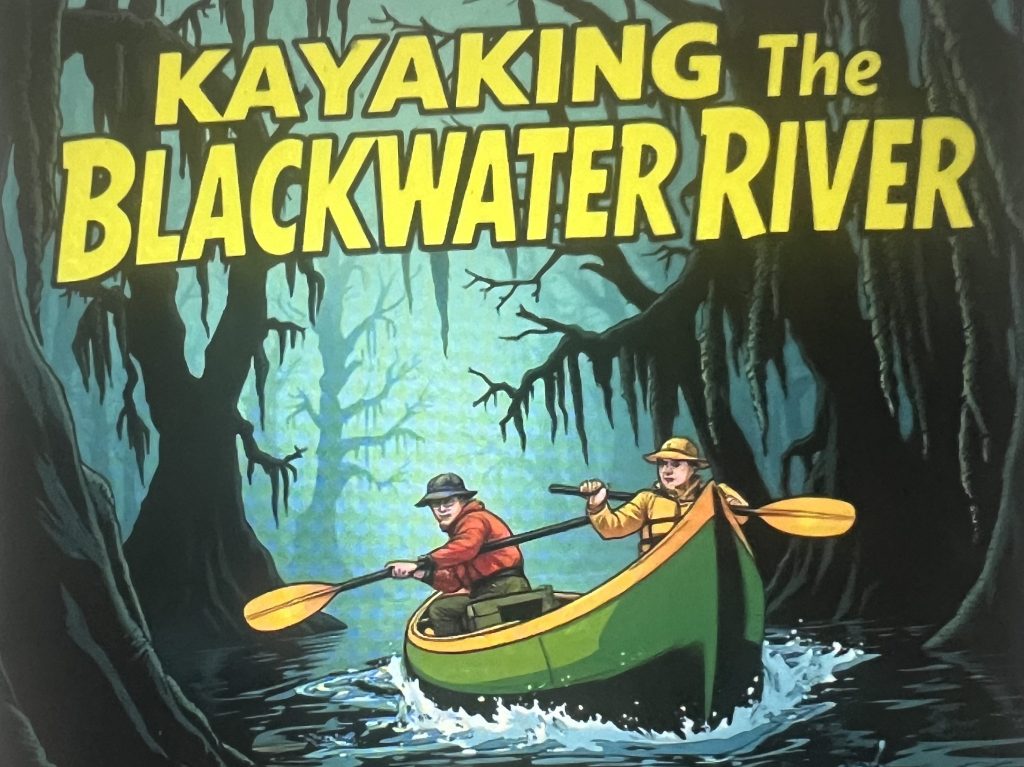
By Jason Miller
The Blackwater River begins in the Bradley area of southern Alabama and winds its way through the Florida panhandle before eventually emptying into Blackwater Bay and the Gulf of Mexico. My cousin Michael and I had a simple enough plan: paddle beyond Blackwater River State Park the first day, camp somewhere along the river, then continue south to Blackwater Bay where our wives would meet us at a predetermined pickup point we had marked with a GPS reading. Like many outdoor adventures, the plan sounded much smarter sitting at a kitchen table.
We launched just inside the Florida state line at Kennedy Bridge Road, where the river was finally large enough for actual paddling instead of endless portaging. I had spent weeks searching the internet for information about the lower Blackwater River and found almost nothing useful. The only map we could find was an old VFR aeronautical chart intended for pilots, which turned out to be less than ideal for two men trying not to get lost in a flooded swamp. Michael paddled his Old Town Loon loaded with most of the camping gear while I paddled my cedar-strip sea kayak carrying the important equipment: camera gear, communications equipment, navigation devices, and eventually the burden of every bad decision we made downstream.
Our “advanced navigation system” consisted of a GPS 2000 and a GSC satellite email device stored carefully inside the waterproof hatch of my kayak. This gave us tremendous confidence for approximately the first twelve hours.
The Blackwater was stunning. The water was crystal clear and ice cold, with a dark coffee tint caused by tannins from the surrounding vegetation. The local Indians called it “Oka-Lusa,” meaning “Water Black.” White sandbars lined the banks beneath towering pine and cedar trees alive with birdsong. The whole river felt wild and untouched, like Florida before airboats and souvenir shops.
I took our first GPS reading and discovered we were twenty-eight miles, as the crow flies, from our rendezvous point. Unfortunately, rivers do not travel as crows fly. Rivers travel like intoxicated snakes. The first stretch twisted endlessly east and west, and we paddled hard for hours while somehow remaining emotionally stationary. Around midday we stopped on a beautiful sandbar and cooked noodles for lunch while convincing ourselves we were making excellent time. We were not.
That afternoon we floated through mild rapids and dodged countless submerged stumps and deadfall hidden beneath the dark water. I had read this section of the Blackwater was considered “technical,” which sounded exciting online but translated in reality to “constant opportunities to destroy your kayak.” At one point we passed the rusted remains of an old logging barge abandoned along the riverbank, slowly dissolving back into the swamp. It looked less like scenery and more like a warning.
Meanwhile, my homemade kayak seat was rapidly becoming a humanitarian crisis. Before the trip I had proudly built a custom wooden-framed seat with tightly stretched canvas, imagining something between handcrafted elegance and orthopedic luxury. Unfortunately, after an hour of river moisture the canvas sagged like wet laundry while the wooden frame concentrated all my body weight directly into one small pressure point located beneath what Southerners politely call your “hind end.” By midafternoon I was paddling with the posture of a wounded shrimp.
Michael kindly traded kayaks with me periodically so I could recover in the spacious comfort of the Loon. The tradeoff was fair because the Loon paddled like a bathtub filled with camping equipment and regret, while my sea kayak sliced beautifully through the water.
As evening approached, we slowly realized we had made a serious error in timing. We had originally pictured ourselves cooking dinner leisurely at camp around sunset. Instead, sunset arrived while we were still very much trapped inside the river’s endless coils. Birdsong faded, crickets and frogs took over, and occasionally we heard an alligator splash somewhere in the darkness, which added a nice motivational element to the paddling.
We passed under Peadon Bridge shortly after Bull Pen Branch entered the Blackwater. By this point we had begun to understand the river’s basic philosophy: never proceed directly anywhere if unnecessary. At 7:30 p.m. we stopped along the bank, cooked canned food, ate dried apples, and debated whether to camp or continue. Fatigue and bad judgment teamed up decisively, and we chose night paddling.
To simplify things, we loaded all the gear into my kayak and tied it alongside the Loon, with mine slightly forward to reduce the overall turning radius. On paper it was actually a pretty clever setup. In practice, it transformed us into a poorly illuminated river train. Armed with flashlights and one headlamp, Michael paddled in front while I steered from the rear. Navigating both kayaks through submerged stumps, fallen trees, and shifting current in total darkness turned out to be one of the more stressful activities I’ve voluntarily participated in.
At one bend, the current suddenly grabbed both kayaks sideways and slammed us broadside into a fallen tree. Sharp branches jutted out over the water in every direction, looking exactly like the sort of place cottonmouths would consider premium real estate. The current pinned us hard against the limbs while we fought to free the boats without flipping everything into the river. Eventually we broke loose and dragged the kayaks around the obstruction, though by then every splash in the darkness sounded reptilian.
The full moon finally rose high enough to throw silver light across the river, giving us just enough visibility to identify obstacles moments before hitting them. Around 11:30 p.m. we pulled onto a sandbar and made camp. Michael pitched his small tent while I hauled the kayaks ashore and rinsed off in the moonlit water, which had grown noticeably warmer the farther south we traveled toward the Gulf.
At 5:30 the next morning we woke sore, stiff, and still dangerously optimistic. We needed to reach our pickup point by 1:00 p.m., though we had arranged for our wives to check email at 11:00 in case we were running late. This seemed like excellent planning at the time.
The kayak seat had deteriorated from uncomfortable to criminal, so after another hour I finally stopped, pulled out my Swiss Army knife saw, and cut the entire thing apart. Sitting directly on the hull was somehow a dramatic improvement. At roughly the same moment, my GPS began fogging internally from moisture. Excellent. I took a fix before it died and discovered we were finally only twelve miles from our destination as the crow flies, which in Blackwater terms probably translated to somewhere near Arkansas.
Then came the emotional collapse.
We paddled beneath a bridge and realized it was Deaton Bridge Road—the exact same bridge we thought we had passed the previous night in darkness. After three hours of night paddling, we had essentially advanced the distance of a distracted housecat.
A sign on the bridge informed us the canoe trail ended there. That should have concerned us more than it did.
Past the bridge, the river widened and the white sandbanks disappeared into sprawling marshland. Tributaries branched off in every direction. My GPS finally died completely from water damage, leaving us with only a deck compass and rising uncertainty. To make matters worse, the river abruptly dead-ended into a massive logjam where years of flood debris had completely blocked the channel. The current shoved us directly into the tangle, forcing us to climb onto floating moss-covered logs and drag the heavily loaded kayaks across by hand.
I slipped repeatedly while hauling my kayak and finally plunged waist-deep between the logs. During the process I soaked my disposable grocery-store camera, which honestly felt perfectly appropriate for the expedition at that point.
Once over the jam, the river grew strangely narrow. “What would you do,” I joked to Michael, “if the river just disappeared completely into the swamp?” Michael laughed nervously, which in hindsight was probably the correct emotional response.
For the next several hours, the Blackwater transformed from river into puzzle. Channels narrowed to only a few feet across, dense vegetation blocked sunlight overhead, and tributaries split endlessly through the swamp. Sometimes we had to stop and study the current just to determine which direction the actual river flowed.
Then we saw jellyfish drifting in the current.
This excited us tremendously because jellyfish meant brackish water, which meant we were nearing the bay where freshwater met the Gulf. Morale improved instantly. Then the river narrowed again.
We dragged the kayaks through another shallow stretch before emerging into a wider pool where an old wooden staircase descended from the trees along the bank. Michael rounded a bend ahead of me and disappeared from view. When I caught up, he was standing motionless in shin-deep water staring ahead with the thousand-yard stare of a man witnessing geographical betrayal.
The Blackwater River had ended.
Not in a bay. Not in the Gulf. In a swamp.
The channel simply vanished into shallow water and impenetrable marsh grass. Trees surrounded us in every direction except the one we had come from. The river had apparently decided at some point to stop being a river altogether. I immediately remembered joking earlier about the river disappearing and strongly considered apologizing directly to nature.
We explored on foot, hoping the channel reopened somewhere ahead, but after wading a hundred yards into the swamp we saw nothing but more swamp. We were fortunate just to find our way back to the kayaks.
At that point we assessed the situation. We had food for several days, plenty of drinking water, and military aircraft flew overhead often enough that survival itself wasn’t the concern. Our wives waiting at the pickup point, however, absolutely was.
We considered trying to portage the kayaks through the swamp but quickly abandoned the idea. That left one option: turn around and paddle back upstream.
The return trip was absolutely brutal. Against the current we alternated between paddling at full effort and dragging the kayaks through waist-deep water while trying not to lose footing in the mud. Sometimes it felt easier to swim beside the kayak than paddle it. We tied ropes to the boats and hauled them upstream like exhausted mules.
Eventually we returned to the staircase and climbed to the logging road above it, carrying food and water in case we could walk out faster than paddling. Every time we reached a fork in the dirt road, Michael drew arrows in the sand so we could find our way back. After an hour of walking, we realized civilization was still nowhere in sight. We discussed the complicated logistics of hitchhiking to a phone, explaining our location, and somehow directing our wives miles down random logging roads to retrieve us and the kayaks.
Suddenly paddling upstream seemed slightly less terrible.
So naturally, we chose that instead.
We split up periodically while I attempted to email updates through the satellite device, which took nearly an hour to acquire enough signal to send even the shortest message. Michael pushed ahead while I fought upstream alone through bends and side channels, trying to remember which forks we had originally followed. At one point he radioed from farther ahead saying he had reached the logjam. Later he called saying he saw a sandy bank. I used these updates like primitive wilderness milestones to measure how badly I was losing the race.
Eventually we encountered fishermen along the bank and asked how far the state park was.
“Only a few miles,” they said cheerfully.
In river language, this translates roughly to: “You’ll get there eventually if spite keeps you alive.”
Late that evening Michael finally radioed that he could see the state park bridge. A few minutes later he reported that he had caught a ride with a ranger to a pay phone to contact the wives.
Not long after, I rounded another bend and finally saw civilization: campers, tents, swimmers, and people enjoying the river in ways that did not involve existential collapse. I pulled onto shore beside Michael’s kayak and climbed out feeling less like an adventurer and more like something recently released back into the wild after medical observation.
Using the GCS 1000, I emailed our wives for rescue. An hour later the wives arrived, and we loaded the kayaks before driving straight to Cracker Barrel, where we consumed enough food to alarm the waitress.
Looking back, the trip reinforced several valuable lessons: always research your route thoroughly, never trust aviation maps for river navigation, do not build your own kayak seat, and if a local ranger later tells you a flood rerouted the river years ago and collapsed the original channel into a swamp, that is information worth obtaining before paddling forty miles into it.
Apparently, the sandy bank we found near the swamp had once been the old riverbed. If we had followed it another few miles, we might actually have reached open water.
So close.
Still, there are plenty of other rivers left to conquer—or more realistically, plenty more rivers waiting patiently to embarrass us.
Kayaking the Blackwater River
Copyright © 2009 by [Author Name]
All rights reserved. No part of this publication may be reproduced, distributed, or transmitted in any form or by any means, including photocopying, recording, or other electronic or mechanical methods, without the prior written permission of the publisher, except in the case of brief quotations embodied in critical reviews and certain other noncommercial uses permitted by copyright law.

