From my journal Quito Ecuador June 1994- Jason Miller
Cotopaxi rises to 19,346 feet and is considered the tallest active volcano in the world. Local legend says it erupts roughly every one hundred years, with its last eruption recorded in 1890. Somewhere near the 18,000-foot level lies one of the most striking ice glaciers in the Andes, and that was the objective for our climb.
On this trip we were joined by a Nazarene Work and Witness group of visiting college students at the Ecuadorian mission. Another missionary, Todd, also came along. James and Todd were both seasoned climbers who had been on Cotopaxi and other peaks in the region many times before. In total, there were seven of us. We set out in an old Chevy Suburban, its age already showing but still dependable enough for the mountain roads.
Candy, Jame’s wife, had thoughtfully packed James and me a generous lunch of sandwiches, which we stored in the back for later. After about two and a half hours of driving, we reached the base of Cotopaxi. Because the lower slopes are relatively gentle, we were able to continue driving up the mountain road to around 15,000 feet.
The moment I stepped out of the vehicle, I felt it immediately—thin air, shortness of breath, and a brief wave of dizziness. It was my first real experience at high altitude, and I had no frame of reference for what was ahead. I began organizing my camera gear and camcorder, intending to document everything. James, observing what I was carrying, wisely suggested I reconsider and take only my small camera. Later, I would be extremely grateful for that advice.
From below, the route to the refuge building looked deceptively simple, like a mild uphill walk. The reality was very different. The ground was composed of thick black volcanic ash mixed with sharp lava rock. Each step slid backward almost as much as it moved forward, and the loose stones quickly filled our boots, making every movement uncomfortable.
Almost immediately, one of the group decided to remain at the truck and wait for our return. The altitude was already taking its toll. As we continued upward, clouds rolled in rapidly, swallowing the landscape. Visibility dropped, temperatures fell, and the mountain began to feel increasingly hostile.
I found myself stopping every 10 to 15 feet just to catch my breath. Every few minutes I would turn back toward the valley, take a photo, and watch as the view below disappeared into shifting clouds. James, by contrast, seemed unaffected by the altitude. He waited patiently each time I needed to stop, encouraging me forward and reminding me that the glacier ahead would be worth the effort.
At the time, I was completely drained—cold, exhausted, and struggling to breathe in the thin, wet air. What had looked like a short hike from below was turning into one of the most demanding physical efforts I had ever experienced.
Nearly three hours after leaving the truck, we reached the refuge building. I remember looking at my watch in disbelief. From the parking area, I had assumed it might take fifteen minutes to reach what was clearly visible on the slope above us. The mountain had completely reshaped my sense of distance and effort.
I often carried a journal on trips like this, and I paused there briefly to write:
“It is VERY cold and I am definitely not used to the climate and elevation so the going is hard! I am not exaggerating in the least when I say that this is the most physically demanding thing I have ever done in my life! I can see the refuge probably a hundred yards straight up from here where I am sitting but it will probably take me at least an hour to get there. This is frustrating due to every two steps I slide back one and every five I stop to catch my breath. I would consider turning back but I would never forgive myself for not giving it my all to experience this beauty.”
Looking back now, I understand how unprepared I was for altitude and alpine conditions. I had never been above 7,500 feet before, and I was dressed for a jungle trek rather than a frozen volcanic peak. The experience left me with a lasting respect for high mountains and a much deeper understanding of how quickly conditions can change with elevation.
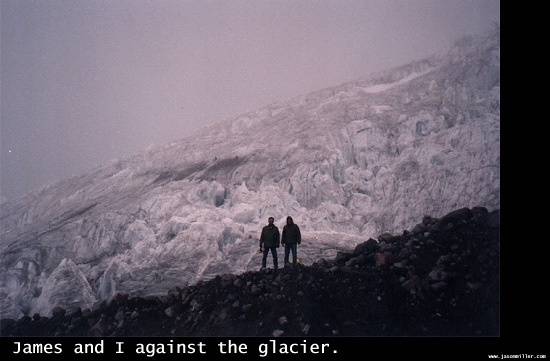
From the refuge, the landscape shifted again. The climb turned into a traverse across the upper mountain rather than a straight ascent, and we continued toward the glacier with only a few hundred feet of additional elevation gain.
What I saw next was almost beyond description. A massive wall of ice rose into the sky, stretching hundreds of feet upward. The glacier was alive with sound—deep cracks and sudden booms as sections shifted and fractured. Ice formations hung everywhere, including icicles reaching nearly fifty feet in length, along with cavern-like openings carved into the ice.
Walking through it felt like entering another world. The air was silent except for the glacier itself. The ground was slick, constantly shifting, and even when standing still there was a strange sensation of motion beneath your feet.
We took photographs beside the ice wall and carefully explored sections of the glacier, climbing a short way onto its surface. The experience was both beautiful and unsettling—magnificent in scale, but constantly reminding you of its instability.
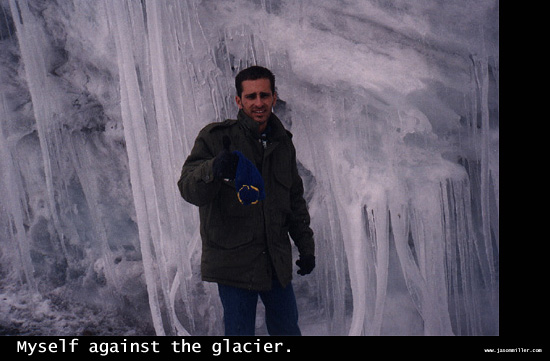
After a couple of hours, the weather began to turn again. Clouds thickened, sleet started to fall, and my altitude headache worsened. We decided it was time to descend. On the way down, I picked up a few pieces of lava rock as souvenirs, slipping carefully across the same unstable ash that had challenged us on the way up.
The descent was easier in terms of breathing, though the footing remained tricky. Still, the physical relief of moving downhill made a noticeable difference. What had felt nearly impossible on the ascent was now manageable, though still
By the time we returned to the Suburban, the day took an unexpected turn. Our packed lunch had been eaten by members of the college group who assumed it was for everyone. I was exhausted, hungry, and dealing with a strong headache—with no aspirin available. Frustration was unavoidable, but James and I chose not to let it escalate. There was still a long drive ahead.
We began the descent toward Quito.
About twenty minutes into the drive, James, who had long experience with the vehicle, heard a faint knocking sound from underneath. After stopping along a narrow mountain road, a quick inspection revealed the problem: the driveline had broken. The Suburban was not going any further.
We were stranded on a winding road carved into the mountainside. Tension rose quickly among the group as fatigue and hunger set in. James and Todd immediately began planning a solution. The idea was straightforward: Todd would catch a bus back to Quito, arrange a truck and trailer, and return for us. In Ecuador, buses ran frequently enough that this was considered feasible.
As darkness approached, James and I remained with the vehicle. Because the road was a blind curve, we became concerned about visibility and safety. James began collecting firewood to create a signal fire behind the Suburban. When we discovered we had no functioning matches, he improvised a method using fuel from the vehicle itself and managed—after several attempts—to get a fire started.
Once lit, the fire became our only steady reference point in the growing darkness. We spent hours there, feeding it with wood gathered from the roadside while passing trucks and buses shook the vehicle as they rushed by. Several drivers stopped to offer assistance, and James politely declined, confident in the plan already in motion.
Time passed slowly. First five hours, then nine. There was still no sign of Todd or the group’s return. At some point, exhaustion overtook concern, and we alternated between resting and talking quietly beside the fire.
Eventually, sometime after 2:00 a.m., headlights appeared on the road. A horn sounded, and a vehicle pulled in—it was Todd. He had returned alone, carrying food and drink.
His journey had been far more difficult than expected. After bringing the group safely back to Quito, he had arranged a trailer, loaded it himself after unloading construction materials, and driven back through the night. Only then did he locate us on the mountain road.
Without delay, we secured the Suburban to the trailer and prepared for the final leg home. The drive back to Quito took several more hours, complicated by road closures that forced us through narrow city streets. We finally arrived around 5:30 a.m., exhausted, hungry, and completely drained—but safe.
It was a long, unpredictable day in the Ecuadorian Andes—one marked by thin air, breaking ice, mechanical failure, long waits in the dark, and unexpected acts of endurance.
Cotopaxi: A day in the clouds
Copyright © 1994 by Jason Miller
All rights reserved. No part of this publication may be reproduced, distributed, or transmitted in any form or by any means, including photocopying, recording, or other electronic or mechanical methods, without the prior written permission of the publisher, except in the case of brief quotations embodied in critical reviews and certain other noncommercial uses permitted by copyright law.

