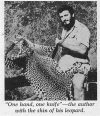
Hanging on the wall of my office is an authentic turn of the last century African spear from the Nandi tribe that was a gift from a very special friend of mine that dedicated his life to saving the Efe’ Pigmy tribes of the eastern Congo. He also amassed one of the largest collections of authentic African artifacts on the planet which are housed at the UCLA African art exhibit at the museum of cultural history. But alas I am getting ahead of myself.
In the early 1990’s I worked for Tandy Corporation in their data center in downtown Fort worth Texas, I had yet to step foot on the African continent so spent literally every spare moment reading countless books on the subject of Africa. On my lunch break I had an hour of freedom and would venture a few blocks South and across the alley to Barber Book Store on Throckmorton Street. This historic bookstore opened in 1925 and housed 50,000 old and out of print books. It was heaven for me to pursue the old dusty shelves looking for vintage books on the subject of Africa. At the time I was on a tight budget and books were sort of a luxury so I usually based my purchases on the less expensive books while moving the more expensive books I wanted to a corner section of the shelf hoping they would not disappear until payday. My hour lunchbreak would fly by as I read all I could in the limited time I had and occasionally a new book would accompany me back to work.
One particular book kept attracting my eye. I was trying to learn basic KiSwahilli at the time and the book titled “Congo Kitabu” kept catching my attention. “Kitabu” is “book” in KiSwahilli. I noticed the book was signed by the author, Jean Pierre Hallet, so it was one of the more expensive purchases so every time I visited the store, I would thumb through it a bit and put it back opting for a less expensive option. Little did I know that as I perused the pages of that old book someday in the future, I would play small roll in the story of Jean Pierre Hallet and he a large roll in mine. Sadly however, the book disappeared from the shelf one day and my connection to Mr. Hallet would have to wait.
On the shores of Lake Kivu in modern day Rwanda in the 1920’s the famous Belgium Painter Andre Hallet and his wife lived an artist’s existence along the with the local people of that region. Andre was very well known for his beautiful oil paintings of African people and landscapes and in 1934 he forged a strong relationship with the Tutsi king Mwambi Matura III (of Ruanda-Burundi) and painted a series of detailed portraits of the king’s family and court. Today his paintings are housed in more than 60 museums around the world including the louvre in Paris France.
Andre’s wife was soon expecting a child and due to complications, she was sent home to Belgium to give birth. Good thing she did as Jean Pierre came into the world stubborn and difficult from day one. Born on August 4th 1927 at 14 pounds it took his poor mother 6 months to recover.
As a young boy back in Africa Jean Pierre was raised alongside his African brothers and sisters where he mastered Kingwana the local language and relished growing and playing with the local children and was excepted as one of them. At this time Ruanda-Urundi was under Belgium control, the lands were sparsely populated compared to today and wildlife and adventure was around every corner.
As Jean Pierre started growing into a young boy it was obvious there was trouble on the horizon, slightly rebellious and boisterous he was not interested in school or rules as he would rather meet with the other children and explore the endless flora and fauna that was at his back door and many times he would stay out days at a time exploring coming home to worried and frustrated parents. He even refused to learn French and would only communicate in Kingwana.
Realizing there was no controlling this young boy it was decided he would be sent back to Belgium for his education and some structure. So after the long journey via train to the east African town of Mombassa a six year old Jean Pierre left the only land he had ever known, a land of dusty streets, wild animals, the beautiful lake Kivu and his close African friends and embarked on the long journey to the land of restrictions, rules and concrete and his loving Aunts home in Belgium.
Longing to be back home in his beloved Africa Jean Pierre slowly adapted to life in Belgium, still a rebellious lad at heart and growing into a young man that was ‘larger than life” He did well in school and soon darkness was on the horizon.
WW2 was in full swing when Belgium surrendered to the Nazis and a young man such as Jean Pierre was not going to sit around and do nothing and at a sprite 16 years old an already over 6 feet tall, he joined the Belgium Resistance Movement and promptly transferred into the Infantry Brigade in the Belgium Army until the end of the war.
Decorated for his service the now six foot four inch, two hundred and twenty four pound Jean Pierre focused back on his beloved Africa. Going to school to study agriculture he quickly signed up for the Ministry of Colonies working as an Agronomist and was placed into the Southern Congo region. On March 8th 1948 twenty one year old Jean Pierre Hallet arrived in Angola to travel overland to his first assignment in Kitanga from the west.
Arriving at the District Commissioner’s office Jean Pierre’s first assignment was to travel on foot village to village assessing the local farming activities and making sure it was being practiced under the guidelines set forth by the Belgium Government. Needless to say, this work wore thin on Jean Pierre as he was sympathetic to the local people and their customs also, being very anti bureaucracy he soon began rocking the boat within his department.
Once his first assignment was complete and his report written he was ready to head into the bush again on his second assignment which would take him 45 days walk north into some wild country and he was overly excited. So excited that in his haste to leave the compounds of office work left without the proper amount of Quinine, the anti-malaria drug of the day.
It was custom of the time for Agronomist in this department to bring porters, cooks, interpreters, and even in some instances a “Tipoye” a hammock type chair so one can be carried by porters from village to village. This appalled Jean Pierre and not only did he refuse Tipoye but would only take a cook and Swahilli speaking interpreter so he was forced to learn the local language. He walked everywhere and he would request to stay in the villages he was visiting, he ate their food, learned the local customs, and earned the trust of the people he was serving. He loved to do magic tricks and was well known in the region amongst the children and people.
This did not sit well with the local Government at the time and conflict was always on the horizon and it came to a head on his second assignment when he was partnered with another colleague who shall remain nameless. One morning this colleague was having problems with his large entourage of help so he lined them up and with a large whip began whipping his staff. “Fimbo nane” translates to eight blows of the whip and that was the legal limit as to how many lashes a man could administer. That morning Jean Pierre was in the neighboring tent and upon hearing the commotion came out to witness this atrocity. He instantly ran and intervened to the shock of his partner who claimed that his actions would undermine the Government Authority and respect from the locals. It nearly came to blows and the man backed down, but this wasn’t the last time Jean Pierre questioned authority. On a side note, it was Jean Pierre who through lots of letter writing and questioning tactics succeeded in getting Flogging banned in 1955 in the Belgium Congo.
From that moment onward Jean Pierre travelled alone, which he preferred anyway. He was much more comfortable with his African brothers and sisters than the stuffy white shirts and pith helmets of the Belgium Government. Continuing to travel north on foot his small Safari became well known amongst the local tribal people, he was fair, helpful with their farming activity, did not burden them with fines and taxation and he began to speak their language and grasp their traditions.
One night he was awakened by a loud commotion in the center of the village and found his cook to be in a fight with a man whose wife the cook expressed an unhealthy interest in, they were both drunk on local beer and the man was swinging a knife and made contact more than once with the cook. Jumping into the middle of the fight Jean Pierre took the full blade in the thigh of his leg and instantly everyone gasped and jumped back, silence covered the area, hurting a government official is punishable by death and the whole village would be punished.
Jean Pierre packed up his cook and asked quickly for some hot water, everyone jumped to action and back in the tent he attended to the wounds of his cook and then turned the attention upon his thigh. Filling the wound with hot water and medicine he used his sewing kit and with kaki thread sewed up his wound. He never wrote a report on this incident thus protecting the villagers from any repercussion, however tropical air and moisture caused the wound to heal very slow and having to walk daily caused his immune system to weaken and the wound would not stabilize.
Thirty days into his assignment Jean Pierre began to feel weak and feverish. Unfortunately, forgetting the quinine he was not protected against malaria and soon he was stuck in his tent fighting for his life. Nights of endless sweating and delirium and days of suffering the heat in his tent, only his two companions to help him, but sadly there wasn’t much they could do but try to get him to eat and drink. While attempting to use the bathroom Jean Pierre noticed blood, and realized he had Black Water Fever, pretty much a death sentence in those days. He was far from any hospital and too weak to walk and too delirious to think of a plan to escape. Calling his interpreter to his side he scratched out a note on a piece of paper and begged him to run as fast as he could to obtain help.
The next morning there was commotion outside the tent, the runner found help in the previous village they had visited, and a group of men arrived with a hammock and carefully placing Jean Pierre within the hammock and strapping him tight began the long journey on foot continuing north as intersect the only road in the area. Jean Pierre was unconscious, and the journey was treacherous, the men switched as each group became exhausted and they crossed rivers, valleys and forests expecting any minute to find Jean Pierre dead in which they would quickly abandon their load as to not be blamed for his death.
Finally, in the middle of a moonless night they stumbled upon a dirt road running east and west, not knowing which way to go they stopped and put down their load and waited. As time crept on, they noticed some lights on the horizon reflecting against the dark forest and a large truck soon was upon them. Begging the driver to help them he agreed to take Jean Pierre to Elizabethville which was on the drivers current route.
Six days later Jean Pierre woke up to see the faces of his parents and a Doctor stating he should not be alive. He had lost 40 pounds and could barely walk but was alive. The Doctor insisted he take a six month leave from work and fully recover as a relapse would mean curtain death so Jean Pierre utilized the time to study Fish farming as based on his short work experience he noticed the desperate need for protein amongst the villages he was working with.
More coming soon
 Jason Miller (Kyalo)